
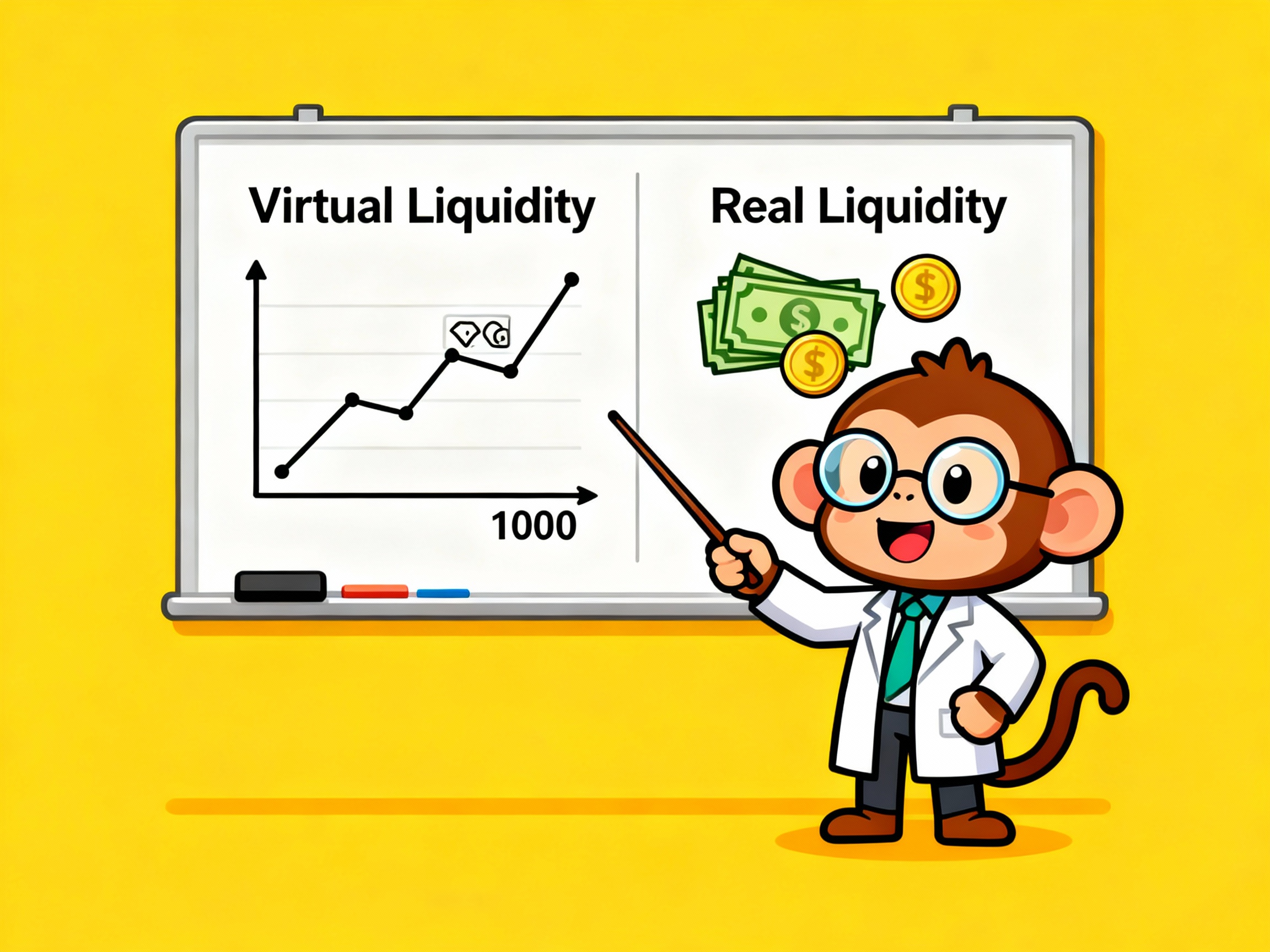
Liquidity is the most misunderstood concept in memecoin markets. Traders assume “liquidity pool” means reliable exit capability, but this assumption often proves catastrophic. The distinction between virtual liquidity (theoretical, on bonding curves) and real liquidity (practical, on DEXs) determines whether traders can actually exit positions or become permanently trapped. This guide examines the technical differences, how each type functions, why they matter in practice, and how understanding this distinction reveals critical vulnerabilities in memecoin infrastructure—particularly how Ape.Store’s approach differs from traditional launchpad models.
Understanding Liquidity Basics
What Is Liquidity?
Liquidity is the ability to buy or sell an asset at a fair market price without significantly moving the market. Two dimensions:
1. Depth – How much can you trade without price impact?
textHigh depth: Trade $10M without 1% price movement
Low depth: Trade $10k causes 10% price movement
2. Speed – How quickly can you execute?
textHigh speed: Execute in milliseconds
Low speed: Execute in seconds or minutes (or never)
Types of Liquidity
Type 1: Spot Market Liquidity
- Direct buying/selling between participants
- Example: DEX (Uniswap, Raydium)
- Characteristics: Real-time pricing, immediate execution
Type 2: Bonding Curve Liquidity
- Automated market maker (AMM) following mathematical formula
- Example: Pump.fun bonding curve, Ape.Store bonding curve
- Characteristics: Algorithmic pricing, guaranteed execution (while curve active)
Type 3: Book Depth (Order Book)
- Aggregated buy/sell orders at different price points
- Example: Centralized exchanges
- Characteristics: Transparent pricing, variable execution
For memecoins, primarily Types 1 & 2.
Virtual Liquidity: Bonding Curves Explained
How Bonding Curves Work
Bonding curve is a mathematical formula determining token price based on supply.
Simple example:
textPrice formula: P = S^2 (Price = Supply squared)

Supply: 0 tokens, Price: $0.00
Supply: 1M tokens, Price: $1.00 (1^2)
Supply: 2M tokens, Price: $4.00 (2^2)
Supply: 3M tokens, Price: $9.00 (3^2)
Supply: 10M tokens, Price: $100.00 (10^2)
How buying/selling works:
textAlice buys: 1M tokens at current price ($1.00)
- Supply moves: 0 → 1M
- Price moves: $0 → $1.00
- Alice pays: $1.00

Bob buys: 1M tokens at new price
- Supply moves: 1M → 2M
- Price moves: $1.00 → $4.00
- Bob pays: $3.00 (higher because supply increased)

Charlie sells: 1M tokens (reverse curve)
- Supply moves: 2M → 1M
- Price moves: $4.00 → $1.00
- Charlie receives: $1.00 (lower than Bob paid)
The mechanism:
- Every buy increases supply (price rises)
- Every sale decreases supply (price falls)
- Capital accumulates in contract (held in escrow)
Why Bonding Curves Are “Virtual” Liquidity
“Virtual” because:
- Not real traders – No actual buyers/sellers (formula executes automatically)
- No counterparty – You trade against mathematical formula, not people
- Deterministic pricing – Price always follows formula (no negotiation)
- Illusory depth – Seems liquid (can always buy/sell) but mechanics are artificial
Example: Illusion of Depth
textOn bonding curve:
- You can buy 100M tokens (formula will execute it)
- Price impact linear (formula calculates new price)
- Seems infinitely liquid (formula handles any quantity)

In reality:
- No actual sellers (you're trading against contract)
- Curve designed to eventually hit graduation threshold
- "Liquidity" disappears once curve ends
- Migration to DEX required (or tokens become illiquid)
Bonding Curve Lifetime
Timeline:
textPhase 1: Accumulation (Days 0-1)
- Capital accumulates in contract
- Supply increases
- Price follows formula (upward)

Phase 2: Graduation (Hours to Days 1-3)
- Market cap hits threshold (~$69k for Ape.Store)
- Bonding curve ends (no new sales from curve)
- Capital migrates to real DEX (Uniswap v2 for Ape.Store)
- Real liquidity begins

Result: Virtual liquidity (curve) → Real liquidity (DEX)
The Critical Transition
When bonding curve ends:
textBefore graduation:
- Can always sell back to curve
- Guaranteed exit (at calculated price)
- Liquidity feels permanent

After graduation:
- Curve no longer accepts sales
- Must sell on DEX (Uniswap v2)
- Liquidity depends on DEX pool depth
- Exit capability depends on real buyer availability
Trader consequence: Bonding curve lulls traders into false security about liquidity.
Real Liquidity: DEX Pools Explained
How DEX Pools Function
DEX pool is a smart contract holding two assets in balance:
textUniswap v2 pool (example):
├─ Token: 100M SHIB
├─ USDC: $100,000
└─ Formula: (SHIB × USDC) = k (constant product)

If you buy $10k of SHIB:
- USDC added: $110,000
- SHIB removed: ? (formula recalculates)
- Formula: 100M × 100k = 110k × SHIB_remaining
- SHIB remaining: 90.9M (approximately)
- You get: 100M - 90.9M = 9.1M SHIB (less than proportional)
- Price impact: Significant (removed 9% of pool)
Key mechanism:
textLarger trade = Greater slippage
Small trade → 0.1% price impact
Medium trade → 1% price impact
Large trade → 10%+ price impact
DEX Liquidity Characteristics
1. Pool-based, not formula-based
textVirtual (Curve): Price determined by formula
Real (DEX): Price determined by pool balance
2. Real capital requirement
textBonding curve: No capital until graduation
DEX pool: Capital required upfront
**For $100k DEX pool:
- $100k USDC actually held
- 100M tokens actually held
- Both are real, withdrawable assets
text
**3. Liquidity provider (LP) participation**
LP deposits: $100k value (50-50 token/stable)
LP receives: LP tokens (represent share of pool)
LP earns: 0.25-0.30% trading fee (from each trade)
Trader consequence: LPs incentivized to provide liquidity
(earn fees from trader slippage)
text
**4. Exit capability depends on pool depth**
Pool: 100M tokens / $100k USDC
Small exit (sell $1k worth):
- Slippage: <1%
- Easy exit
Large exit (sell $50k worth):
- Slippage: 5-15%
- Difficult exit
Extreme exit (sell $80k worth):
- Slippage: 30-50%+
- Practically impossible (price collapse)
text
### Permanent LP Burn: What It Means

**On Ape.Store (and Pump.fun):**
After bonding curve ends:
- DEX pool created: 100M tokens / $100k USDC
- LP tokens minted: (represent pool ownership)
- LP tokens burned: Sent to null address (destroyed)
Result: No one can ever withdraw liquidity
Pool locked permanently
$100k USDC forever backing tokens
text
**Implication:**
Advantage: No rug pull possible (mathematically impossible)
Pool permanent (no expiration)
Disadvantage: Can’t rebalance liquidity (stuck as-is)
Outdated pool composition (if token utility emerges)
text
## Comparing Virtual vs Real Liquidity

### Characteristics Comparison

| Characteristic | Virtual (Curve) | Real (DEX) |
|--|--|--|
| **Trader counterparty** | Formula | LP pools |
| **Price determinant** | Mathematical formula | Supply/demand via AMM |
| **Execution guarantee** | Guaranteed (until graduation) | Depends on pool depth |
| **Slippage** | Linear (predictable) | Non-linear (unpredictable) |
| **Duration** | Hours/days (temporary) | Indefinite (permanent) |
| **Capital requirement** | Accumulated during phase | Required upfront |
| **LP incentive** | None (formula-driven) | Trading fees (0.25-0.30%) |
| **Liquidity depth** | Fixed (contract balance) | Variable (LP participation) |

### Timeline: Liquidity Evolution

**Hour 0-24: Bonding Curve Phase**
Liquidity type: Virtual
Trader experience: Guaranteed execution, predictable slippage
Price discovery: Formula-driven
Example trade: “Sell 1M tokens at $0.005 = get $5,000 guaranteed”
Risk: None (curve guarantees execution)
text
**Hour 24 onward: DEX Phase**
Liquidity type: Real
Trader experience: DEX-dependent, variable slippage
Price discovery: Supply/demand via AMM
Example trade: “Sell 1M tokens at DEX, get $3,000-5,000 (depends on pool)”
Risk: Substantial (depends on pool depth, other traders)
text
**The Transition Crisis:**
During curve phase: Traders feel safe (“I can exit anytime!”)
At graduation: Everything changes (different liquidity rules)
Post-graduation: First sellers experience harsh slippage reality
Result: Trader dissatisfaction (“I couldn’t exit at curve price!”)
text
## Real-World Example: Virtual → Real Liquidity Failure

### Case Study: "TokenX" Launch

**Bonding Curve Phase (Day 1):**
Creator announces: “TokenX launches today”
Community excited: “We can always exit on bonding curve!”
10:00 AM:
- Token launches
- Alice buys: $5,000 for 1M tokens
- Price: $0.005 per token
11:00 AM:
- Community FOMO peaks
- Bob buys: $50,000 for 8M tokens
- Price: $0.015 per token (price moved up)
12:00 PM:
- Bob realizes: “This might crash”
- Bob sells: 8M tokens on curve
- Bob receives: $50,000 back (curve guarantees)
- Community reassured: “See? We can exit!”
Token reaches $69k market cap → Graduation triggered
text
**Graduation Moment:**
Smart contract executes migration:
- Bonding curve ends (no more curve trading)
- LP pool created on Uniswap v2: 100M tokens / $69k USDC
- LP tokens burned (permanent lock)
- Token now trades on Uniswap v2 (not curve)
text
**Post-Graduation Reality (Hour 25):**
Charlie owns: 1M tokens (bought for $5,000 on curve)
Charlie thinks: “I can exit for $5,000 anytime (curve was liquid!)”
Charlie attempts: Sell 1M tokens on Uniswap v2
Uniswap pool: 100M tokens / $69k USDC
Charlie’s trade: Remove 1M tokens (1% of pool)
Expected price: ~$0.005 (curve price)
Actual price: $0.003 (50% worse!)
Charlie receives: $3,000 (instead of $5,000)
Charlie’s realization: “Virtual liquidity ≠ real liquidity”
Charlie’s outcome: -40% loss from curve exit price
text
**Why the price difference?**
Curve: Formula-driven (always executes at formula price)
DEX: Supply/demand driven (price reflects actual buyer interest)
Between curve and DEX:
- Community FOMO peaked (hype exhausted)
- Insiders exited (on curve during peak)
- Remaining holders: Late buyers, cultists, bagholders
- New buyer demand: Zero (FOMO over)
- Real price discovery: Much lower than curve implied
Curve price ($0.005) = Artificial (unsustainable)
DEX price ($0.003) = Real (reflects actual demand)
text
## How Ape.Store's Design Affects Liquidity Transition

### Bonding Curve Design Differences

**Pump.fun curve:**
Target market cap: Variable (~$50-100k)
Graduation: When volume peaks (not fixed threshold)
Graduation uncertainty: Community doesn’t know when migration happens
text
**Ape.Store curve:**
Target market cap: Fixed at ~$69k
Graduation: Deterministic (everyone knows threshold)
Graduation certainty: Community prepared for transition
Curve lock: 24-hour delay (allows verification before migration)
text
**Implication:** Ape.Store's fixed threshold enables better preparation; traders know when transition happens; reduces surprise/panic at migration.

### Uniswap v2 Pool Quality

**Pump.fun (Raydium pool):**
Pool: Variable depth (depends on initial capital)
Liquidity provider incentives: Standard Raydium 0.25% fees
Pool monitoring: Solana-specific tools only
Slippage: Moderate (Raydium is active, but not institutional-grade)
text
**Ape.Store (Uniswap v2 pool):**
Pool: Standard 0.30% fee (Uniswap v2 standard)
Liquidity provider incentives: Professional LPs participate (Uniswap recognized)
Pool monitoring: Extensive (Uniswap monitored by many tools)
Slippage: Better (Uniswap v2 more mature, more LPs)
text
**Implication:** Ape.Store's Uniswap integration provides better real liquidity post-graduation; more institutional LP participation; better execution prices.

## The Liquidity Trap: How Virtual Liquidity Deceives Traders

### The False Confidence Problem

**What traders assume:**
“I can exit anytime!”
“Bonding curve liquidity is real liquidity!”
“I’m safe because I can always sell back to curve!”
text
**Reality:**
“I can exit on bonding curve (temporary)”
“Virtual liquidity is not real liquidity”
“I need DEX liquidity to sustainably exit”
“DEX liquidity depends on real buyer demand”
text
### The Graduation Shock

**Typical trader psychology:**
Day 1 (Curve phase):
- “This is safe, I can exit anytime”
- Confidence high (illusory liquidity)
Day 2 (Graduation):
- “Curve ends, DEX begins, same thing right?”
- False assumption
Day 2-3 (DEX reality):
- “Why can’t I get curve price on DEX?”
- “Pool depth low, slippage high”
- “I’m trapped at worse prices”
- Panic selling begins
- Negative feedback loop (more panic = worse prices)
text
### The Professional Exploitation

**What professional traders do:**
- Accumulate on curve (while liquidity safe)
- Monitor curve-to-DEX transition carefully
- Exit immediately post-graduation (before DEX slippage knowledge spreads)
- Re-enter at depressed DEX prices (when retail panics)
- Profit from curve-DEX price differential
text
**Result:** Professionals exploit retail's liquidity naivety.

## Real Liquidity Metrics: How to Evaluate

### Metric 1: Pool Depth

**What to measure:**
How much can you trade before 5% price impact?
High depth: $1M before 5% impact = excellent liquidity
Medium depth: $100k before 5% impact = adequate liquidity
Low depth: $10k before 5% impact = poor liquidity
Very low: <$1k before 5% impact = essentially illiquid
text
**How to calculate:**
Use Dexscreener or similar tool:
- Search token on Uniswap v2 (Ape.Store) or Raydium (Pump.fun)
- Look at trading chart
- Attempt hypothetical trade sizes
- Observe slippage at each size
- Identify breakpoint (5% slippage threshold)
text
### Metric 2: Liquidity Sustainability

**What to measure:**
Is pool depth stable or declining?
Stable depth: Same LPs continuing participation (good sign)
Declining depth: LPs withdrawing capital (bad sign)
Growing depth: New LPs adding capital (excellent sign)
text
**How to track:**
Monitor over weeks:
- Week 1 pool depth: $100k
- Week 2 pool depth: $90k (declining 10%)
- Week 3 pool depth: $75k (declining further)
- Week 4 pool depth: $50k (collapsing)
Interpretation: Liquidity evaporating (professional LPs withdrawing)
Project sustainability questionable
text
### Metric 3: Trading Volume

**What to measure:**
Is volume real (organic) or fake (wash trading)?
Real volume: Diverse traders, bidirectional (buy/sell balance)
Fake volume: Few large trades, unidirectional (one-way)
text
**How to identify:**
Look at transaction history:
- Real: Many small trades ($100-$10k each)
- Fake: Few massive trades ($1M each)
Real: Different wallet addresses trading
Fake: Same wallets trading repeatedly
Real: Volume consistent across timeframes
Fake: Volume spikes (bot activity patterns)
text
### Metric 4: Holder Distribution

**What to measure:**
Is liquidity owned by many LPs or concentrated?
Distributed: Many LPs, <10% any single LP (good)
Concentrated: Few LPs, >30% single LP (risky)
Whale-dominated: One LP >50% (extremely risky, rug-pull potential)
text
**How to check:**
Use Etherscan/Basescan:
- Find Uniswap v2 pair address
- Look at token balance holders
- Top 10 holders should represent <40% of liquidity
- If top 1-3 hold >50%, liquidity concentration risk high
text
## FAQ: Virtual vs Real Liquidity Questions

**Q: Why do bonding curves use virtual liquidity instead of real?**

A: Design choice. Virtual liquidity advantages: (1) Gradual capital accumulation (creators don't need upfront capital), (2) Guaranteed trading (formula executes any size), (3) Price discovery (formula-driven), (4) Simplicity. Disadvantages: (1) Temporary (only until graduation), (2) Illusory (traders deceived about sustainability), (3) Transition shock (graduates to real liquidity suddenly).

**Q: After graduation, can tokens return to bonding curve?**

A: No. Bonding curves are one-way. Migration from curve → DEX permanent. Token stays on DEX indefinitely (or until delisted). No return to curve phase.

**Q: Is real liquidity on Ape.Store (Uniswap v2) better than virtual liquidity on bonding curve?**

A: Different, not necessarily "better." Real liquidity more sustainable (doesn't end). Virtual liquidity more guaranteed during phase (formula executes). After graduation, only real liquidity exists; traders must accept DEX trading realities.

**Q: Can multiple liquidity pools exist for same token?**

A: Yes. Token could have: (1) Uniswap v2 pool on Base (after Ape.Store graduation), (2) Raydium pool on Solana (if also listed), (3) Uniswap v3 pool on Ethereum (if expanded). Multiple pools reduce single-pool dependence; increase liquidity optionality.

**Q: What's minimum pool depth needed for viable trading?**

A: Depends on trading size. For $1k trades: $50k pool depth adequate. For $10k trades: $500k pool depth adequate. For $100k trades: $5M pool depth adequate. General rule: Pool should be 50-100x your trade size for acceptable slippage (<5%).

**Q: If LP tokens burned, can liquidity ever be withdrawn?**

A: No. Burned LP tokens mathematically destroyed; no private key exists to recover them. Liquidity locked forever (or until pool contract modified, which isn't possible on immutable smart contracts). This is feature (security), not bug (limitation).

**Q: Can DEX pools run out of tokens?**

A: In theory yes, in practice no. Extreme sell pressure would deplete pool of tokens, leaving only stables. But: Price would rise exponentially (formula effect), making continued selling prohibitively expensive. Protocol stops extreme sell pressure through mathematics, not mechanics.

**Q: Why does DEX slippage exist at all?**

A: Mathematical necessity. AMM formula (x*y=k) ensures price moves with every trade. Slippage is compensation to liquidity providers for allowing pool to become imbalanced. Without slippage, bots could arbitrage pools into emptiness (DEX would break). Slippage protects pool longevity.

**Q: Is 5% slippage normal or should I expect less?**

A: Depends on pool depth and trade size. (1) Deep pools (<1%), (2) Medium pools (1-3%), (3) Shallow pools (3-10%), (4) Very shallow pools (10%+). If experiencing >5%, either pool is shallow or you're trading outsized amount. Consider smaller position.

**Q: What happens if I try to buy more tokens than pool can sell?**

A: Transaction fails (reverted). You can't exceed pool balance. Maximum purchase limited by pool's token reserve divided by slippage tolerance (usually set to 50%+ max impact).

## Conclusion: Virtual Liquidity Is a Trap

### The Critical Insight

**Virtual liquidity (bonding curves) is NOT real liquidity.**

It feels real (can always trade), works reliably (during curve phase), but disappears abruptly (at graduation).

**Real liquidity (DEX pools) is the long-term reality.**

After graduation, traders depend entirely on DEX pool depth, LP participation, and real buyer demand.

### The Investor Implication

**When evaluating memecoin:**

1. **Bonding curve phase:** Ignore liquidity (temporary, meaningless for long-term)
2. **Post-graduation liquidity:** Evaluate carefully (determines exit capability)
3. **Pool depth:** Must be deep enough for your position size
4. **LP participation:** Check if professional LPs present (sign of legitimacy)
5. **Volume sustainability:** Monitor if volume real or wash trading

### Why Ape.Store's Approach Matters

**By using Uniswap v2 (post-graduation):**

✅ **Professional infrastructure** – LPs participate (not just formula)
✅ **Institutional monitoring** – Uniswap monitored by many tools/arbitrageurs
✅ **Sustainable depth** – LPs incentivized to maintain (earn fees)
✅ **Verified quality** – LP burn prevents rug pulls (capital permanent)

**Result:** More reliable real liquidity post-graduation; better trader outcomes.

### The Practice

**Smart traders:**

1. Enjoy bonding curve safety during curve phase (guaranteed execution)
2. Plan exit before graduation (move to real liquidity while possible)
3. Evaluate post-graduation pool depth (before committing capital)
4. Understand DEX slippage dynamics (price impacts are real)
5. Exit liquidity traps before they collapse (recognize when sustainability impossible)

**Naive traders:**

1. Confuse virtual with real liquidity (catastrophic mistake)
2. Get trapped in poor DEX pools post-graduation
3. Discover liquidity cliff (can't exit at desired price)
4. Forced to sell at market prices (accept heavy losses)
5. Learn expensive lesson: Virtual liquidity is illusion