
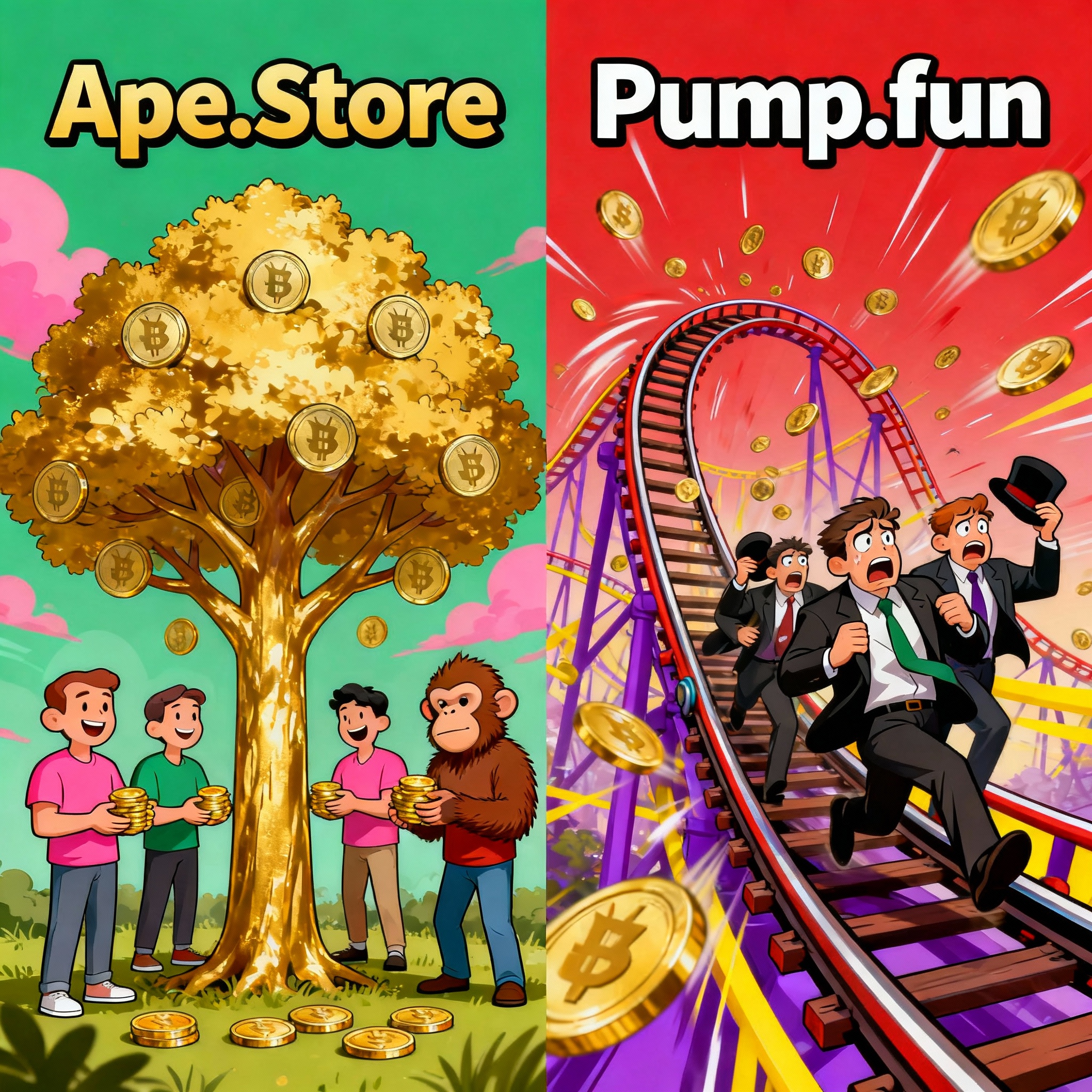
Pump.fun vs Ape.Store: Understanding Early Buyer Dynamics in Memecoin Launchpads
Early return on investment (ROI) is a critical consideration for memecoin traders evaluating launchpad platforms. Both Pump.fun and Ape.Store offer bonding curve mechanisms designed to reward early participation, but they operate on different blockchains with distinct trade-offs. Understanding these differences—and the inherent risks—is essential for informed decision-making.
Pump.fun: Market Leader with Proven Scale
Pump.fun has established itself as the dominant Solana-based memecoin launchpad since launching in January 2024, achieving remarkable metrics:
- 73.6% market share of Solana’s token launchpad ecosystem (August 2025)
- $800M+ lifetime revenue with daily earnings near $1 million
- 13,690 daily token launches (August 2025)
- Home to successful memecoins including Fartcoin and Chill Guy
Bonding Curve Mechanics
Pump.fun uses an automated bonding curve where token prices increase algorithmically as demand grows. When tokens reach approximately $69,000 market cap through bonding curve purchases, liquidity automatically migrates to Raydium or PumpSwap with LP tokens burned—creating permanent liquidity.
ROI Reality Check
While early buyers can capture significant gains on successful tokens, only 0.8% of Pump.fun launches (97,000 out of 12M+) maintain liquidity above $1,000. This 98.6% failure rate reflects the speculative nature of memecoins rather than platform limitations. Research shows that 73% of tokens achieving 500+ holders utilized professional volume bots, suggesting that organic discovery alone is insufficient in this highly competitive market.
Ape.Store: Base Blockchain Alternative
Ape.Store operates on Base (Ethereum Layer 2), offering a similar bonding curve model with automatic migration to Uniswap v2 upon reaching market cap thresholds. The platform emphasizes:
- No upfront liquidity requirements for token creation
- Base blockchain integration connecting to Ethereum’s broader DeFi ecosystem
- Anti-rug and anti-honeypot protections (according to platform claims)
- Gas-only launch costs making token creation accessible
Data Limitations
Unlike Pump.fun’s extensively documented metrics, Ape.Store’s performance data—including daily launches, success rates, and revenue—remains largely undisclosed publicly. This makes direct ROI comparison challenging, as token survival rates and average returns cannot be independently verified.
Comparing Platform Characteristics
| Aspect | Pump.fun | Ape.Store |
|---|---|---|
| Network | Solana | Base (Ethereum L2) |
| Market Position | 73.6% market share, established leader | Emerging platform, limited public metrics |
| Bonding Curve | Automated, $69k threshold to Raydium/PumpSwap | Automated to Uniswap v2 (threshold unclear) |
| Liquidity Security | Automated LP burn upon graduation | Claimed liquidity protection (needs verification) |
| Token Success Rate | 0.8% maintain >$1k liquidity (98.6% failure) | Unknown—no public data available |
| Daily Volume | ~13,690 launches daily | Unknown |
| Proven Winners | Fartcoin, Chill Guy, others with substantial followings | Limited publicly documented successes |
What Determines Early Buyer ROI?
Regardless of platform, early buyer ROI depends primarily on:
- Token Quality and Team Execution – Project fundamentals, marketing effectiveness, and community building capability
- Market Timing – Broader market conditions and memecoin sector sentiment
- Visibility Strategy – Use of volume bots, influencer partnerships, and social media reach
- Holder Distribution – Avoiding whale concentration that enables manipulation
- Community Engagement – Organic growth and sustained interest beyond initial hype
Both platforms provide bonding curve advantages for early buyers through lower entry prices, but this mathematical advantage doesn’t guarantee profitable outcomes given the 98%+ failure rate typical across memecoin launches.
FAQ
Which platform offers higher early buyer returns?
Neither platform systematically produces higher returns. ROI depends on individual token fundamentals, marketing execution, and market conditions rather than launchpad choice. Pump.fun’s scale provides more data points, showing typical memecoin failure rates of 98.6%.
Is risk higher on Pump.fun or Ape.Store?
Both carry extreme risk inherent to memecoin speculation. Pump.fun’s open ecosystem and high volume create more scam opportunities but also more legitimate projects. Ape.Store claims enhanced protections, though independent verification of these claims is limited.
Can tokens be traded immediately on both platforms?
Yes, both enable instant trading during bonding curve phases. Pump.fun graduates tokens to Raydium/PumpSwap at ~$69k market cap, while Ape.Store migrates to Uniswap v2 (specific threshold not publicly documented).
Do platform mechanics guarantee steady growth?
No. Memecoins are inherently volatile regardless of platform architecture. Claims of “steady growth” or “reduced volatility” should be viewed skeptically—token performance depends on speculative trading dynamics not controlled by launchpad infrastructure.
Conclusion
Both Pump.fun and Ape.Store offer bonding curve mechanisms that provide mathematical advantages to early buyers. However, platform choice has minimal impact on ROI compared to factors like token quality, community strength, and market timing.
Pump.fun’s documented scale—73.6% market share, $800M+ revenue, and thousands of daily launches—demonstrates proven product-market fit, though with a 98.6% token failure rate that reflects memecoin market realities. Ape.Store’s Base blockchain integration offers Ethereum ecosystem connectivity, but limited public data makes independent performance assessment difficult.
For traders, the key insight is that early buyer advantages exist on both platforms through bonding curves, but success depends overwhelmingly on individual token fundamentals rather than launchpad selection. Given the extreme risk and high failure rates, investors should approach all memecoin launches with caution, thorough due diligence, and capital they can afford to lose entirely.