
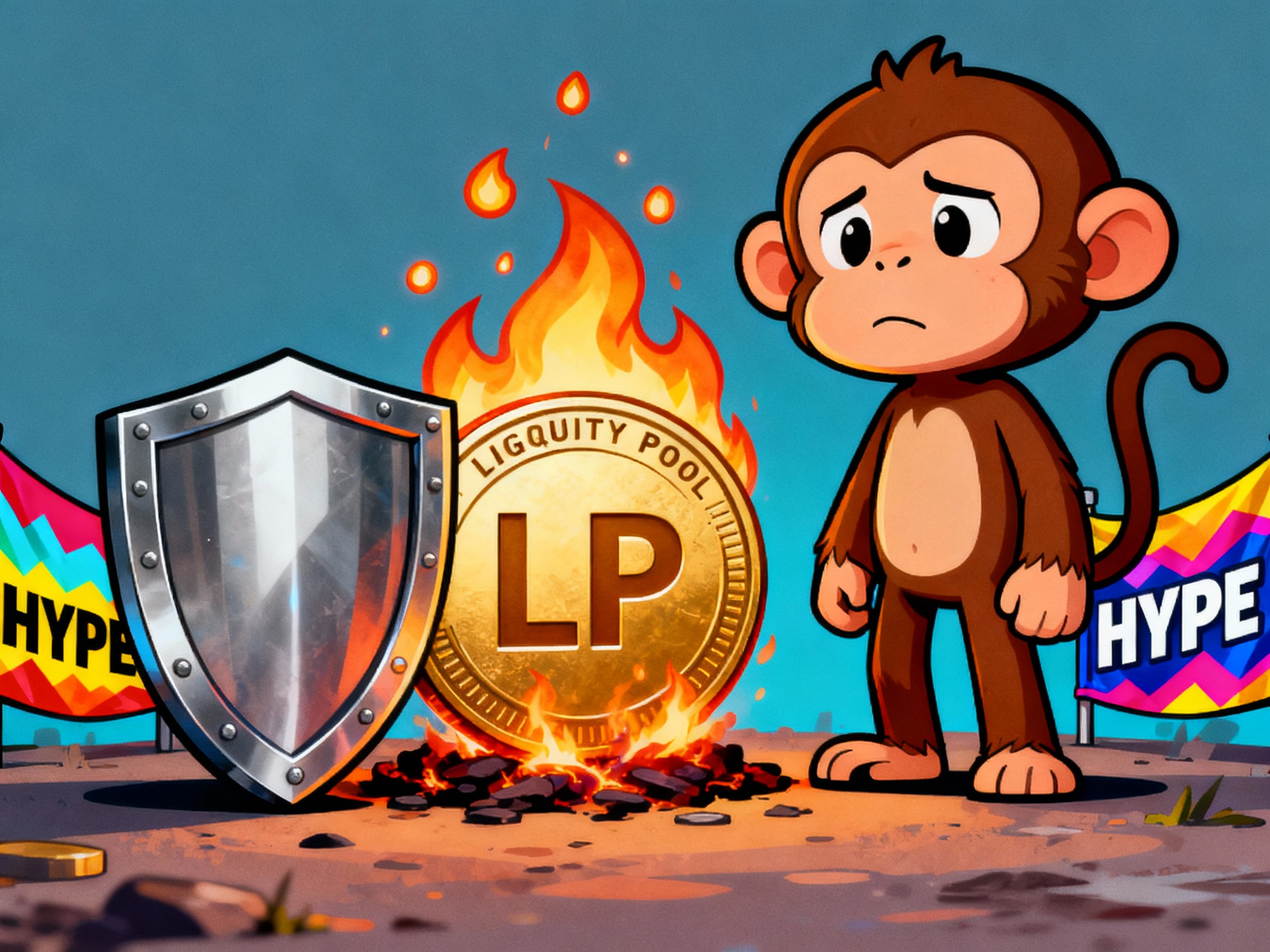
“LP tokens burned” has become the memecoin industry’s stamp of approval—a guarantee against rug pulls that projects advertise prominently. But does burning liquidity provider tokens actually prevent exploitation, or is it sophisticated marketing that obscures more dangerous vulnerabilities? This guide examines LP burn mechanics in technical detail, analyzes what security guarantees they actually provide versus what they claim, explores how burns can be circumvented or faked, and critically evaluates whether Ape.Store’s implementation represents genuine protection or theater. Understanding LP burns separates informed participants from those relying on false security signals.
Understanding LP Tokens and Why They Matter
What Are LP (Liquidity Provider) Tokens?
When you create a liquidity pool on a DEX (like Uniswap v2 or Raydium), the protocol mints LP tokens representing ownership of that pool.
Example:
textAlice creates Uniswap v2 pool:
├─ Deposits: 100M TokenX
├─ Deposits: $100,000 USDC
└─ Receives: 10,000 LP tokens (UniswapV2Pair tokens)

LP tokens represent:
- 100% ownership of pool
- Right to withdraw 100M TokenX + $100k USDC
- Proof of liquidity provision
LP token mechanics:
textIf Alice owns 10,000 LP tokens (100% of supply):
- Can withdraw: Entire pool (100M tokens + $100k)

If Bob later adds liquidity, receiving 5,000 LP tokens:
- Total LP supply: 15,000 tokens
- Alice's share: 10,000/15,000 = 66.7%
- Bob's share: 5,000/15,000 = 33.3%
- Each can withdraw proportional share
Why LP Tokens Are Security-Critical
LP tokens = liquidity control.
textWhoever holds LP tokens can:
✅ Withdraw liquidity from pool
✅ Remove all capital (rug pull)
✅ Destroy project liquidity (token becomes worthless)
✅ Extract accumulated trading fees

Outcome: LP token holder has complete power over pool
Rug pull scenario:
textDay 1: Creator launches token
       Creates pool: 100M tokens / $100k USDC
       Receives: 10,000 LP tokens
       Creator holds LP tokens (not burned)

Day 7: Community buys tokens
       Pool now: 80M tokens / $150k USDC (trading increased value)

Day 8: Creator withdraws liquidity using LP tokens
       Removes: 80M tokens + $150k USDC
       Pool now: Empty
       Token price: Crashes to $0 (no liquidity)
       Community: Holds worthless tokens

Result: Creator extracted $150k + 80M tokens
        Community lost everything
Prevention: Remove creator’s ability to use LP tokens = prevent rug pull.
LP Burn Mechanism: How It Works
The Burning Process
“Burning” LP tokens means sending them to an address where they can never be retrieved.
Technical implementation:
text// Smart contract code (simplified)
address constant DEAD_ADDRESS = 0x000000000000000000000000000000000000dEaD;

function burnLPTokens() public {
    uint256 lpBalance = lpToken.balanceOf(address(this));
    lpToken.transfer(DEAD_ADDRESS, lpBalance);
    // LP tokens now in dead address (unrecoverable)
}
Burn addresses commonly used:
text1. 0x0000...0000 (null address, truly unrecoverable)
2. 0x0000...dEaD ("dead" address, readable vanity address)
3. 0x0000...1111 (burn address variant)

All mathematically equivalent: No private key exists
Verification:
textUser checks Etherscan/Basescan:
├─ Finds LP token contract address
├─ Views token holders
├─ Sees: Dead address holds 10,000 LP tokens (100%)
└─ Conclusion: Liquidity permanently locked
What LP Burn Actually Guarantees
Guaranteed protections:
✅ No withdrawal of liquidity pool – Mathematically impossible
✅ Permanent pool existence – Can’t remove capital
✅ No creator rug pull via LP tokens – Creator can’t access
What LP burn does NOT guarantee:
❌ Token price stability – Price can still crash (demand disappears)
❌ Project success – LP burn doesn’t make project viable
❌ No other exploits – Contract bugs, insider dumps, etc. still possible
❌ Liquidity sufficiency – Burned liquidity might be too shallow to matter
Critical insight: LP burn prevents ONE attack vector (liquidity withdrawal), not ALL attack vectors.
When LP Burn Is Genuine Security
Scenario 1: Standard Implementation (Ape.Store)
Process:
textToken launches on bonding curve:
├─ Capital accumulates ($100k USDC)
├─ Graduation threshold reached ($69k market cap)
├─ Smart contract automatically:
│  ├─ Creates Uniswap v2 pool
│  ├─ Deposits accumulated capital + tokens
│  ├─ Receives LP tokens
│  └─ Burns LP tokens (sends to dead address)
└─ Result: Liquidity permanently locked

Verification available:
✅ Transaction visible on Basescan
✅ LP tokens in dead address (confirmable)
✅ Smart contract code auditable (open-source)
Security level: ⭐⭐⭐⭐⭐ (Excellent – mathematically guaranteed)
Why it works:
- Atomic transaction (burn happens same transaction as pool creation)
- Open-source verification (community can audit code)
- Public blockchain record (burn permanent and visible)
Scenario 2: Manual Creator Burn (Less Common)
Process:
textCreator manually creates pool:
├─ Deposits tokens + capital
├─ Receives LP tokens
├─ Manually sends LP tokens to dead address
└─ Result: Liquidity locked (if creator honest)

Verification available:
✅ Transaction visible on blockchain
✅ LP tokens in dead address
⚠️ Timing gap (between LP creation and burn)
⚠️ Trust required (creator could not burn)
Security level: ⭐⭐⭐ (Good – but requires trust during gap)
Risk:
- Creator controls LP tokens temporarily (could rug before burning)
- Manual process error-prone (might burn wrong tokens)
- Community must monitor (ensure burn actually happens)
When LP Burn Is Marketing Theater
Fake Burn 1: Partial LP Burn
Deceptive claim: “LP tokens burned!”
Reality:
textCreator creates pool, receives 10,000 LP tokens
Creator burns: 5,000 LP tokens (50%)
Creator keeps: 5,000 LP tokens (50%)

Marketing: "LP BURNED ✅"
Reality: Creator still controls 50% of liquidity (can rug pull)
How to detect:
textCheck LP token holders on Etherscan:
├─ Dead address: 5,000 LP tokens (50%)
├─ Creator address: 5,000 LP tokens (50%) ⚠️
└─ Conclusion: Partial burn (rug pull still possible)
Security level: ⭐ (Poor – creator retains control)
Fake Burn 2: Wrong Token Burned
Deceptive claim: “LP tokens burned!”
Reality:
textCreator creates pool, receives LP tokens (TokenA/USDC pair)
Creator creates second pool, receives LP tokens (TokenB/USDC pair)
Creator burns: TokenB LP tokens (unrelated pool)
Creator keeps: TokenA LP tokens (the actual pool)

Marketing: Shows burn transaction as "proof"
Reality: Burned unrelated tokens (slight of hand)
How to detect:
textVerify burn transaction carefully:
├─ Confirm: LP token address matches actual pool
├─ Cross-reference: Pool address with burned token address
├─ Verify: Burned tokens are correct LP tokens (not different)
└─ Use: Etherscan/Basescan token info to confirm
Security level: ⭐ (Terrible – deliberate deception)
Fake Burn 3: Minting More LP Tokens
Deceptive claim: “Original LP tokens burned!”
Reality:
textCreator creates pool, receives 10,000 LP tokens
Creator burns: 10,000 LP tokens (looks legitimate)
Creator adds liquidity again: Receives 10,000 NEW LP tokens
Creator now has: Liquid LP tokens (can rug pull)

Marketing: "Original LP burned" (technically true, but misleading)
Reality: New LP tokens give same control
How to detect:
textMonitor pool after burn:
├─ Check if additional liquidity added (new LP tokens minted)
├─ Verify: Total LP supply unchanged (should remain constant)
├─ Watch: For creator wallet receiving new LP tokens
└─ If LP supply increases: Potential manipulation
Security level: ⭐⭐ (Poor – circumvents burn protection)
Fake Burn 4: Time Lock Presented as Burn
Deceptive claim: “LP tokens locked/burned!”
Reality:
textCreator locks LP tokens in time-lock contract (not burn)
Lock duration: 1 year
After 1 year: Creator can retrieve LP tokens
           Creator can rug pull

Marketing: "LOCKED" (implies permanent, actually temporary)
Reality: Time bomb (rug pull delayed, not prevented)
How to detect:
textCheck LP token destination:
├─ Burned (0x000...dead): Permanent ✅
├─ Time-lock contract (0xabc...123): Temporary ⚠️
├─ Multisig wallet: Governance-controlled (variable risk)
└─ Creator wallet: No protection ❌

Always verify destination is burn address, not lock contract
Security level: ⭐⭐ (Temporary protection only)
Legitimate Alternatives to LP Burn
Alternative 1: Community Multisig
How it works:
textLP tokens sent to multisig wallet
Multisig controlled by: 5-10 community members
Withdrawal requires: 3-of-5 signatures (majority)

Result: Creator can't unilaterally rug
        Community votes on liquidity decisions
Advantages:
- ✅ Flexible (liquidity can be rebalanced if needed)
- ✅ Democratic (community controls)
- ✅ Responsive (can adapt to circumstances)
Disadvantages:
- ❌ Governance attack risk (malicious actors could collude)
- ❌ Complexity (coordination overhead)
- ❌ Not permanent (multisig could vote to unlock)
Security level: ⭐⭐⭐⭐ (Good – community-controlled)
Best for: Projects with strong governance, mature communities
Alternative 2: DAO Treasury
How it works:
textLP tokens sent to DAO smart contract
DAO governance token holders vote on usage
Proposals: Rebalance liquidity, add to different pools, etc.

Result: Community governs liquidity through voting
Advantages:
- ✅ Transparent governance (all votes on-chain)
- ✅ Flexible rebalancing (adapt to market conditions)
- ✅ Community ownership (token holders control)
Disadvantages:
- ❌ Governance complexity (requires active participation)
- ❌ Attack surface (governance exploits possible)
- ❌ Voter apathy (low participation = few control)
Security level: ⭐⭐⭐⭐ (Good – decentralized control)
Best for: Projects with active governance, long-term vision
Alternative 3: Vesting Schedule
How it works:
textLP tokens locked with linear vesting:
- Year 1: 0% unlocked
- Year 2: 25% unlocked
- Year 3: 50% unlocked
- Year 4: 75% unlocked
- Year 5: 100% unlocked

Result: Gradual unlock over time (predictable)
Advantages:
- ✅ Predictable timeline (community knows schedule)
- ✅ Creator incentivized (long-term alignment)
- ✅ Balanced (protection + flexibility)
Disadvantages:
- ❌ Eventually unlocks (not permanent)
- ❌ Long-term uncertainty (what happens at unlock?)
Security level: ⭐⭐⭐ (Moderate – time-limited protection)
Best for: Projects with multi-year roadmaps, creator accountability
Ape.Store’s LP Burn Implementation
Technical Process
Ape.Store’s automated LP burn:
textStep 1: Bonding curve accumulation
- Capital accumulates in smart contract
- $100k USDC collected from buyers

Step 2: Graduation trigger
- Market cap reaches $69k threshold
- Smart contract detects graduation

Step 3: Pool creation
- Contract creates Uniswap v2 pool automatically
- Deposits: 100M tokens + $100k USDC
- Receives: LP tokens

Step 4: Atomic LP burn
- Same transaction: Burns LP tokens
- Destination: 0x000...dead address
- Result: Liquidity permanently locked

Step 5: Verification
- All steps visible on Basescan
- Community can verify burn immediately
- No gap between pool creation and burn
Security characteristics:
✅ Atomic execution – Pool creation + burn in one transaction (no time gap)
✅ Automatic – No manual creator action required (no trust needed)
✅ Verifiable – Open-source contract + public blockchain
✅ Permanent – LP tokens in dead address (mathematically unrecoverable)
Security level: ⭐⭐⭐⭐⭐ (Excellent – industry best practice)
Comparing Implementations
| Platform | Burn Method | Timing | Verification | Security |
|---|---|---|---|---|
| Ape.Store | Automatic, atomic | Same transaction | Basescan (public) | ⭐⭐⭐⭐⭐ |
| Pump.fun | Automatic, atomic | Same transaction | Solscan (public) | ⭐⭐⭐⭐⭐ |
| Manual platforms | Creator-initiated | Gap possible | Varies | ⭐⭐⭐ |
| Time-locked | Lock contract | Delayed unlock | Contract-dependent | ⭐⭐⭐ |
| Multisig | Community-held | Governance | DAO transparency | ⭐⭐⭐⭐ |
What Ape.Store’s Burn Protects Against
Protected attack vectors:
✅ Classic rug pull – Creator can’t withdraw liquidity
✅ Exit scam – Creator can’t remove capital after launch
✅ Liquidity drain – Pool permanent (can’t be emptied)
✅ Confidence attacks – Community knows burn happened (verifiable)
Unprotected attack vectors (LP burn doesn’t prevent):
❌ Founder token dump – If creator holds token allocation, can still dump
❌ Smart contract exploits – Bugs in token contract still exploitable
❌ Market manipulation – Wash trading, pump-and-dump schemes
❌ Social engineering – Phishing, impersonation, fake channels
❌ Natural price decline – Market demand disappears (project fails organically)
How to Verify LP Burn Yourself
Step-by-Step Verification (Ape.Store Token)
Step 1: Find the token contract
textGo to Ape.Store platform
Find token page
Copy token contract address (e.g., 0xabc...123)
Step 2: Locate Uniswap v2 pair
textGo to Basescan.org
Search token contract address
Click "Holders" tab
Find: Uniswap V2 pair contract (usually top holder)
Copy pair address (e.g., 0xdef...456)
Step 3: Check LP token distribution
textGo to Basescan, search pair address
Click "Token" tab (shows LP token info)
Click "Holders" sub-tab
Look for burn address:
- 0x000...dead or
- 0x000...0000

Check percentage: Should be 100%
Step 4: Verify transaction history
textStill on Basescan, pair contract page
Click "Transactions" tab
Find pool creation transaction
Verify: LP tokens minted AND burned in same transaction
Look for: "Transfer" event to dead address
Confirm: All LP tokens transferred (not partial)
Step 5: Cross-reference with official channels
textCheck Ape.Store official Farcaster/Discord
Verify: Pool address matches official announcement
Confirm: No warnings about fake pools
If all checks pass: ✅ LP burn legitimate
If any check fails: ⚠️ Investigate further or avoid token
Red Flags During Verification
🚩 Red Flag 1: Partial burn
textDead address holds: 50% of LP tokens
Creator holds: 50% of LP tokens
Verdict: Not fully protected
🚩 Red Flag 2: Wrong address
textLP tokens sent to: Random address (not dead address)
Verdict: Not burned, controlled by someone
🚩 Red Flag 3: Multiple pools
textMultiple Uniswap pairs exist (fragmented liquidity)
Only one pair has burned LP tokens
Verdict: Liquidity could be in unburned pool
🚩 Red Flag 4: Recent LP minting
textOriginal LP tokens: Burned ✓
New LP tokens: Minted after burn (10,000 new tokens)
Verdict: Creator can still rug via new tokens
🚩 Red Flag 5: Time-lock contract
textLP tokens destination: Smart contract (not dead address)
Contract type: Time-lock with unlock date
Verdict: Temporary lock, not permanent burn
The Psychology: Why LP Burn Became Marketing Standard
The Trust Problem
Historical context:
text2020-2021: Rug pulls epidemic
- Estimated 90%+ of tokens rug pulled
- "Devs ran away" became meme
- Community trust destroyed
- "DYOR" became mandatory

Innovation: LP burn as trust signal
- Projects advertising: "LP BURNED ✅"
- Community response: "Okay, safer"
- Market dynamic: Burned LP = competitive advantage
Result: LP burn became industry expectation.
The Marketing Evolution
Phase 1 (2021): Genuine innovation
textLP burn = real security differentiator
Community: Actively verifies burns
Projects: Compete on security transparency
Phase 2 (2022-2023): Marketing checkmark
textLP burn = expected minimum (not advantage)
Community: Assumes burn legitimate (stops verifying)
Projects: "LP BURNED" becomes slogan
Phase 3 (2024-2025): Security theater
textLP burn = marketing hype (often fake)
Community: Rarely verifies (trusts claims)
Projects: Fake burns proliferate (partial, time-locked, wrong tokens)
Scammers: Exploit trust ("LP burned" = automatic trust)
Current state: LP burn necessary but insufficient. Claims mean nothing without verification.
FAQ: LP Burn Questions
Q: If LP is burned, how can liquidity ever be added later?
A: New liquidity can always be added to pool (anyone can add). Adding liquidity mints NEW LP tokens (proportional to contribution). Original burned LP tokens stay burned. New LPs receive their own LP tokens (representing their share).
Q: Can burned LP tokens ever be recovered?
A: No. Dead addresses (0x000…dead, 0x000…0000) have no private keys. Mathematically impossible to sign transactions from these addresses. Tokens sent there are permanently unrecoverable. This is cryptographic guarantee, not policy.
Q: What if the burn address is actually controlled by someone?
A: Standard burn addresses (0x000…dead, 0x000…0000) cannot be controlled. Private key would need to be 0x000…000, which isn’t valid. If non-standard address used, verify it’s truly dead (no transaction history sending FROM address).
Q: Is LP burn alone sufficient for investment safety?
A: No. LP burn prevents liquidity withdrawal only. Doesn’t prevent: (1) Founder token dumps, (2) Contract bugs, (3) Market manipulation, (4) Organic project failure. LP burn = one security layer among many needed.
Q: How can I tell if time-lock will unlock?
A: Check smart contract code. Look for: (1) Unlock timestamp (when lock expires), (2) Withdrawal function (who can call it), (3) Lock duration (how long until expiry). If contract has unlock mechanism, it’s time-lock (not burn). If you see unlock date, it’s temporary protection.
Q: What’s better: LP burn or DAO-controlled LP?
A: Depends on goals. LP burn: Maximum security (permanent, simple, trustless). DAO control: Flexibility (can rebalance, adjust, adapt). For speculative memecoins: Burn better (simplicity + security). For serious projects: DAO control reasonable (if governance mature).
Q: Can Ape.Store’s smart contract be changed to reverse burn?
A: No. Smart contracts immutable once deployed (on Ethereum/Base). Ape.Store’s LP burn contract can’t be modified post-deployment. Only way to “reverse” would be deploy new contract (but original burn remains permanent on original contract).
Q: Does LP burn affect trading fees earned?
A: Yes. Normally LPs earn 0.3% trading fees (proportional to LP token ownership). If LP tokens burned, fees accumulate in pool but can’t be withdrawn (burned LP tokens can’t claim fees). Result: Fees compound into pool (increases depth over time).
Q: Why would anyone burn LP instead of keeping to earn fees?
A: Trade-off. Keeping LP = earn fees but maintain rug risk. Burning LP = sacrifice fees but eliminate rug risk. For creator: Short-term fee income < long-term project success (which requires community trust). For community: Burned LP more valuable than fee opportunity.
Q: What if I find a project with 90% LP burned, 10% not burned?
A: Red flag. 10% unburned means creator could withdraw 10% of liquidity. Even partial rug pull catastrophic (removes significant liquidity → price crashes). Demand 100% burn or understand you’re accepting rug risk.
Q: Is LP burn verification too complicated for average person?
A: Moderately technical but doable. If uncomfortable: (1) Use only major platforms (Ape.Store, Pump.fun) with automatic burns, (2) Rely on community audits (Telegram/Discord discussions), (3) Avoid tokens without clear burn proof, (4) Accept risk if not verifying yourself.
Conclusion: LP Burn Is Necessary, Not Sufficient
The Honest Assessment
LP burn is genuine security mechanism when implemented correctly:
✅ Prevents liquidity withdrawal (mathematical guarantee)
✅ Eliminates classic rug pull vector (creator can’t remove pool)
✅ Provides verifiable proof (blockchain record permanent)
✅ Industry best practice (expected minimum standard)
But LP burn is NOT complete security:
❌ Doesn’t prevent founder token dumps (if creator holds allocation)
❌ Doesn’t prevent contract exploits (code bugs still exploitable)
❌ Doesn’t prevent manipulation (wash trading, pump-and-dump)
❌ Doesn’t guarantee project success (organic failure still possible)
When LP Burn Is Security vs Marketing
Genuine security (trust):
- ✅ Automatic burns (no manual creator action)
- ✅ Atomic execution (burn happens same transaction as pool creation)
- ✅ 100% of LP tokens burned (not partial)
- ✅ Verifiable on-chain (public blockchain record)
- ✅ Open-source contracts (community can audit)
Marketing hype (distrust):
- ❌ Manual burns (creator controls timing)
- ❌ Partial burns (<100% burned)
- ❌ Time-locks presented as burns (temporary, not permanent)
- ❌ Unverifiable claims (“trust us, we burned”)
- ❌ Wrong tokens burned (sleight of hand)
Ape.Store’s Implementation: Industry Best Practice
Why Ape.Store’s LP burn is legitimate:
✅ Fully automated (smart contract executes burn automatically)
✅ Atomic transaction (pool creation + burn = one transaction)
✅ 100% burn (all LP tokens sent to dead address)
✅ Publicly verifiable (Basescan shows complete record)
✅ Open-source (contract code auditable)
✅ No time gap (no opportunity for creator exploitation)
Result: Ape.Store’s LP burn provides genuine security (not marketing theater).
The Practical Implication
For traders:
- Always verify LP burn yourself (don’t trust claims)
- Demand 100% burn (partial burns unacceptable)
- Check burn is permanent (not time-locked)
- Understand limitations (LP burn ≠ investment safety)
- Use reputable platforms (Ape.Store, Pump.fun auto-burn)
LP burn is table stakes, not differentiator.
Every legitimate project should have it. But presence of LP burn doesn’t make project legitimate—just eliminates one attack vector among many.
Smart investors verify burns, then evaluate everything else: tokenomics, community, creator reputation, utility, market timing.
LP burn keeps front door locked. But windows, back doors, and roof still need checking.