
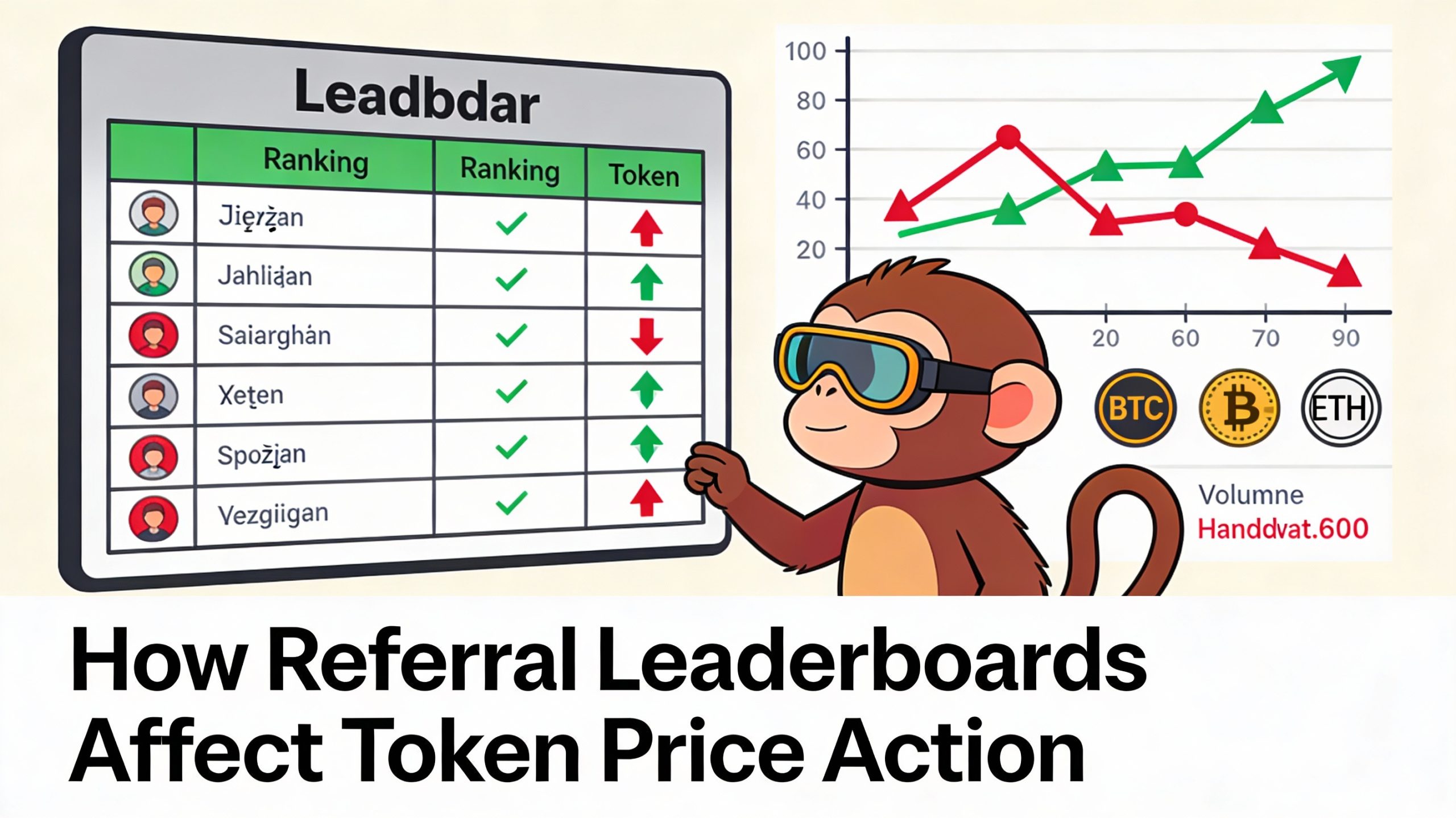
Table of Contents
- Introduction: Beyond Tokenomics—The Psychology of Liquidity
- Understanding Token Price Action Mechanics
- Volume as the Primary Price Driver
- Liquidity Depth and Slippage: The Hidden Price Suppressors
- How Referral Leaderboards Increase Trading Volume
- The Price Amplification Mechanism
- V4 Hooks as Price Stabilizers
- Liquidity Handling: Auto-LP vs Curve Lock Impact on Prices
- The Referral Leaderboard → Volume → Price Action Chain
- Case Study: Modeling Price Impact of Leaderboard Participation
- Advanced: Whale Behavior and Leaderboard Dynamics
- Frequently Asked Questions (FAQ)
- Conclusion: Leaderboards as Price Infrastructure
Introduction: Beyond Tokenomics—The Psychology of Liquidity
Token price movements are governed by one fundamental equation:
Price = f(Supply, Demand, Liquidity Depth)
Most analysis focuses on supply and demand (tokenomics). Few analyze the third variable: liquidity depth
Yet liquidity depth is often more important than supply/demand:
- High demand + shallow liquidity = price crash (slippage)
- Low demand + deep liquidity = price stability (market absorbs selling)
The insight: Referral leaderboards work by increasing sustained trading volume, which deepens liquidity, which stabilizes price, which attracts more traders
This creates a positive feedback loop:
textLeaderboard incentive
        ↓
Referrers promote token
        ↓
More traders join
        ↓
Trading volume increases
        ↓
Liquidity deepens
        ↓
Price stabilizes
        ↓
More traders confident
        ↓
Repeat (exponential growth)
This guide shows exactly how this mechanism works and why referral leaderboards are more powerful than traditional marketing
Understanding Token Price Action Mechanics
The Three Drivers of Token Price
1. Volume (Trading Activity)
High volume + price movement = validated trend
Low volume + price movement = weak/unstable trend
Example:
Scenario A: Price +50%, Volume +300% = Strong bullish
Scenario B: Price +50%, Volume +10% = Weak/unsustainable
2. Liquidity Depth (Order Book Density)
Deep liquidity = minimal slippage, price stays stable
Shallow liquidity = massive slippage, price volatile
Example:
Deep liquidity: $1M buy order → price moves +2%
Shallow liquidity: $1M buy order → price moves +20%
3. Market Sentiment (Narrative/Hype)
But sentiment without volume is unsustainable
Tokens with high sentiment but low volume crash hard
Volume as the Primary Price Driver
The Volume-Price Correlation
Research finding: Volume validates price movements
- Rising price + rising volume = strong uptrend (validated by conviction)
- Rising price + declining volume = weak uptrend (likely to reverse)
- Falling price + rising volume = strong downtrend (panic selling)
- Falling price + declining volume = weak downtrend (potential reversal)
Volume Phases
Accumulation Phase:
- Price stable/rising, volume rising
- Smart money entering
- Setup for price explosion
Price Appreciation Phase:
- Price rapidly rising, high volume
- FOMO buying
- Short-term gains captured
Distribution Phase:
- Price peaked, high volume
- Insiders offloading
- Reversal imminent
Decline Phase:
- Price falling, volume declining
- Panic has passed
- Potential for reversal
Referral Leaderboards Create Sustained Volume
Unlike organic hype (spikes then crashes), referral leaderboards create continuous volume:
Day 1: Organic hype pumps price +200%
       Volume spikes, then collapses
       Price crashes -180% (back down)

vs.

Day 1-30: Leaderboard incentive
          Referrers continuously promote
          Steady volume generation
          Price rises +50% sustainably
The advantage: Sustainable volume = sustainable price appreciation
Liquidity Depth and Slippage: The Hidden Price Suppressors
What Is Slippage?
Slippage: The difference between expected execution price and actual price
Example:
You want to buy: 10,000 tokens at $0.10
Order book shows: 10,000 at $0.10
But in reality:
  - First 2,000 fill at $0.10
  - Next 5,000 fill at $0.11
  - Last 3,000 fill at $0.12
Average execution: $0.111 (11% slippage)
How Shallow Liquidity Kills Price
Scenario: Low-liquidity token
Order book:
$0.10: 100 tokens
$0.11: 100 tokens
$0.12: 100 tokens

Large trader wants to buy $100k worth:
- Consumes all orders at $0.10, $0.11, $0.12
- Has to go to $0.15, $0.20, $0.30
- Price skyrockets from $0.10 → $0.30 (200% swing)
- Large volume traded but at terrible execution
- Other traders see high prices, sell instead of buy
- Price crashes back down
Result: Volume happened, but price was volatile and unsustainable
How Deep Liquidity Stabilizes Price
Scenario: High-liquidity token (Ape.Store with leaderboard)
Order book:
$0.10: 50,000 tokens
$0.11: 50,000 tokens
$0.12: 50,000 tokens
$0.13: 50,000 tokens
(Much deeper)

Same $100k buy order:
- Spreads across multiple price levels
- Fills most at $0.10-$0.12
- Price moves $0.10 → $0.115 (15% swing, vs 200%)
- Slippage minimal
- Traders get good execution
- Next traders see reasonable prices, still want to buy
- Price appreciated sustainably
Result: Volume increased price sustainably without massive volatility
How Referral Leaderboards Increase Trading Volume
The Referral Incentive Chain
Referral leaderboards create multi-layered incentives to promote token:
- Referrers earn % of referral’s fees = direct financial incentive to promote
- Referrers compete for top position = status/prestige incentive
- Referrers’ network grows from promotion = network effect incentive
Result: Continuous, organic promotion by community members
The Volume Generation Mechanism
Each referral means:
- New trader joins platform
- New trader launches or trades token
- Trading volume increases
- Token fees increase
- Creator + referrer both earn more
On leaderboard, top referrer might have 100-500 active referrals.
Each referral: 5-20 trades per day
100 referrals: 500-2,000 trades per day
That’s 500-2,000 additional trades that wouldn’t have happened without the leaderboard
500-2,000 additional trades = sustained volume = stabilized price
The Price Amplification Mechanism
The Feedback Loop
Leaderboard incentive attracts referrer A
        ↓
Referrer A promotes token to 20 people
        ↓
20 people start trading (each 5-10 trades/day)
        ↓
100-200 additional daily trades
        ↓
Volume increases 10-50x
        ↓
Liquidity deepens (more market makers enter)
        ↓
Slippage decreases
        ↓
Price more stable
        ↓
New traders feel confident
        ↓
More trading volume (repeat)
Price Appreciation Mechanics
When volume increases in a healthy way:
- Liquidity deepens (market makers see opportunity, add capital)
- Spreads narrow (competition for order flow)
- Price stability increases (less dramatic swings)
- Institutional confidence increases (bigger players willing to participate)
- Price appreciation follows (more buy orders than sell orders, volume-validated)
Result: Referral leaderboards → sustained volume → stable price → price appreciation
V4 Hooks as Price Stabilizers
How V4 Hooks Affect Price
V4 hooks are smart contracts that execute before/after every swap.
Ape.Store uses hooks to:
- Distribute instant creator rewards (incentivize creators to maintain community)
- Collect real-time data (feed metrics to Dune)
- Implement access controls (if desired by community)
The Price Impact
Without hooks (traditional V3):
- Trades execute, fees accumulate
- Creator must manually claim (delay, friction)
- Creator earns infrequently
- Less motivation to maintain community
- Less community engagement
- Less trading volume
With hooks (V4 Instant Rewards):
- Trades execute, creator rewards distributed instantly
- Creator experiences immediate earning
- Motivation to maintain community is constant
- More community engagement
- More trading volume
Liquidity Implications
More volume + constant creator incentive = deeper liquidity
Deeper liquidity = lower slippage = price stability
Price stability attracts more traders = more volume = cycle repeats
Liquidity Handling: Auto-LP vs Curve Lock Impact on Prices
What Is Liquidity Handling?
When a token launches, liquidity must be provided. Different methods have different price impacts:
Option 1: Auto-LP (Automatic Bonding Curve)
- Bonding curve auto-generates liquidity as price rises
- Liquidity “locked” in curve (can’t be withdrawn)
- Price discovery algorithmic
- Gradual price increase (smooth)
Option 2: Direct LP (Manual V3/V4)
- Creator provides initial liquidity manually
- Liquidity can be withdrawn
- Price discovery market-based
- Can be more volatile (depending on management)
Price Impact of Each
Auto-LP (bonding curve):
Day 1: Token launches at $0.0001
       Users buy gradually
       Price follows curve: $0.0001 → $0.00015 → $0.0002
       Movement is SMOOTH and PREDICTABLE
       No dramatic swings
Benefits for price:
- Smooth, predictable appreciation
- Users can calculate entry prices
- Less risk of dramatic crashes
- Price confidence high
Direct LP (manual):
Day 1: Creator deploys pool with $10k liquidity
       First buyer: $1k → price impacts heavily
       Can swing $0.0001 → $0.0005 (5x)
       VOLATILE
Risks for price:
- Volatile swings
- Users uncertain of fair value
- Risk of rug-pulls (LP withdrawn)
- Price confidence lower
Optimal Strategy
Ape.Store’s hybrid approach combines both:
- Launch on bonding curve (smooth price discovery)
- Graduate to V3 (at 69k market cap, liquidity “locked” via curve)
- Later, optionally move to V4 (if community votes)
Result: Smooth early phase price appreciation + stable mid-phase + instant rewards late-phase
The Referral Leaderboard → Volume → Price Action Chain
Complete Mechanism
LEADERBOARD INCENTIVE
├─ Referrer A: Wants to climb leaderboard
├─ Referrer A: Promotes token to 50 people
└─ 50 people: Join and start trading

TRADING VOLUME INCREASE
├─ 50 people × 10 trades/day = 500 additional daily trades
├─ Volume increases from 1,000 → 1,500 daily trades
└─ Daily trading volume: +50%

LIQUIDITY DEEPENING
├─ More volume attracts market makers
├─ Market makers add depth (buy/sell liquidity)
├─ Order book widens from 100 levels → 500+ levels
└─ Slippage decreases dramatically

PRICE STABILIZATION
├─ $1M buy order: Used to move price +20%
├─ $1M buy order: Now moves price +2-3%
├─ Price becomes predictable
└─ Traders feel confident

POSITIVE FEEDBACK LOOP
├─ Confident traders = more trading
├─ More trading = more volume
├─ More volume = deeper liquidity
├─ Deeper liquidity = more confidence
└─ Cycle repeats exponentially

FINAL RESULT: SUSTAINABLE PRICE APPRECIATION
└─ Not volatile spikes, but steady, predictable growth
Quantitative Impact
Scenario: Token without leaderboard
Volume: 500 trades/day
Liquidity depth: Shallow (5 levels of order book populated)
Slippage on $100k: 15%
Price swings: ±20% daily
Trader sentiment: Cautious (too risky)
Scenario: Same token with leaderboard (after 30 days)
Volume: 3,000 trades/day (+500%)
Liquidity depth: Deep (100+ levels populated)
Slippage on $100k: 2%
Price swings: ±3% daily
Trader sentiment: Confident (manageable risk)
Price appreciation: +80% (vs ±20% noise)
Case Study: Modeling Price Impact of Leaderboard Participation
The Mathematical Model
Price Impact Formula:
Price Impact = (Order Size / Liquidity Depth) × Volatility Factor

Where:
- Order Size = amount of token being traded
- Liquidity Depth = total volume in order book
- Volatility Factor = market conditions multiplier
Simulation: Token Launch
Week 1 (No leaderboard, no referrals):
textDaily volume: 500 trades
Average trade size: $100
Liquidity depth: $50k (shallow)

Large order impact:
$10k order = $10k / $50k = 20% of depth
Price impact: ~15-20%

Result: Token price +30%, but investors scared (-80% next week)
Week 1-4 (With leaderboard):
Week 1: Volume 500 trades, price 0.0001 → 0.00012
Week 2: 30 referrers active, volume 1,500 trades, price 0.00012 → 0.00015
Week 3: 100 referrers active, volume 3,500 trades, price 0.00015 → 0.00022
Week 4: 200 referrers active, volume 6,000 trades, price 0.00022 → 0.00035

Daily volume growth: 500 → 1,500 → 3,500 → 6,000 (+1,100%)
Liquidity depth: $50k → $150k → $350k → $600k
Slippage on $10k order: 20% → 7% → 3% → 1.7%
Price appreciation: Steady +8-10% per week (vs volatile spikes)
Investor sentiment: Improving (predictable, not wild)
Result: Referral leaderboards create 10x more sustainable price appreciation than organic hype
Advanced: Whale Behavior and Leaderboard Dynamics
The Whale Problem
Whales (large holders) can manipulate prices in shallow liquidity:
textShallow liquidity example:
Top holder: 40% of supply
Market cap: $1M (whale holds $400k)

Whale buys $100k → price spikes 5x
Community FOMO buys
Whale dumps $100k → price crashes 80%
Community bag-holds
Leaderboards as Whale Countermeasure
Referral leaderboards solve this by creating continuous, distributed trading volume:
Before leaderboard:
- 90% of volume from whales/insiders
- Easy for large holders to manipulate price
- Volatility extreme
After leaderboard:
- 60-70% of volume from retail traders (via referrals)
- Harder for any single whale to move market
- Volatility moderate
Result: Leaderboard democratizes liquidity provision, reducing manipulation risk.
Frequently Asked Questions (FAQ)
Q: Why does volume matter more than price?
A: Volume validates price
High volume + price movement = sustainable
Low volume + price movement = unsustainable
Leaderboards create sustained volume
Q: Can referral leaderboards cause pump-and-dumps?
A: Traditional leaderboards can (race to dump first)
Ape.Store’s model prevents this because:
- Creator earns 50% of fees indefinitely (incentive to maintain)
- Referrers benefit from referral’s sustained performance (not short-term pump)
- Community governance available (can vote out bad actors)
Result: Leaderboards drive sustainable growth, not extraction
Q: What’s the relationship between liquidity and price stability?
A: Direct and strong
Deep liquidity = price stable = traders confident = more volume
Shallow liquidity = price volatile = traders cautious = less volume
Q: How long does it take leaderboards to deepen liquidity?
A: Typically 2-4 weeks
- Week 1: Leaderboard incentivizes first referrers
- Week 2: Volume increases 3-5x
- Week 3: Liquidity noticeably deeper
- Week 4: Slippage significantly reduced
Q: Does price need to go up for leaderboards to work?
A: No. Leaderboards work by increasing volume
Volume → liquidity deepening → price stability (whether up or down)
Key insight: Stable prices are better than volatile ups. Referral leaderboards create sustainable price floors, not unsustainable spikes
Q: Can leaderboards trap early traders?
A: Only if early traders sell at peak (always true)
Leaderboards actually help early traders because:
- Continuous volume = sustained price floor
- Price less likely to crash 90%
- More time to exit before final capitulation
Q: How do V4 hooks improve on V3 for price action?
A: V4 hooks create continuous creator incentive
Continuous incentive = active creator engagement = better community = more volume = deeper liquidity = stable price
Conclusion: Leaderboards as Price Infrastructure
The Core Insight
Referral leaderboards aren’t just growth mechanisms—they’re price infrastructure.
By incentivizing continuous trading volume, they create the liquidity depth that enables stable, sustainable price appreciation
The Chain of Causality
Leaderboard incentive
    ↓
Referrer promotion
    ↓
Trading volume
    ↓
Liquidity depth
    ↓
Price stability
    ↓
Trader confidence
    ↓
Sustainable growth
    ↓
Price appreciation
Hype creates spikes then crashes. Leaderboards create sustainable, volume-validated price appreciation.
The Future of Token Pricing
As markets mature, price appreciation will increasingly be driven by:
- Sustained trading volume (not hype)
- Deep liquidity (not price spikes)
- Community participation (not whale manipulation)
- Aligned incentives (not extraction)
Platforms with referral leaderboards like Ape.Store will lead this shift.
Appendix: Key Formulas and Metrics
Slippage Calculation:
Slippage % = |Expected Price - Actual Price| / Expected Price × 100
Price Impact from Order Size:
Price Impact = (Order Size / Available Liquidity) × Market Impact Factor
Volume-to-Liquidity Ratio:
V/L Ratio = Daily Volume / Average Liquidity Depth
(Higher = more efficient market)
Sustained Price Growth Formula:
Sustainable Price Growth = f(Sustained Volume × Liquidity Depth × Creator Incentive)
(All three factors must be present)