
Table of Contents
- Introduction: The Democratization of Token Creation
- The Pre-Pump.fun Landscape: Barriers and Gatekeeping
- How Pump.fun Disrupted the Entire Industry
- The Explosive Growth: Numbers That Changed Everything
- Understanding Pump.fun’s Model: Bonding Curves and Fair Launch
- Social Integration: Viral Mechanics That Drove Adoption
- The Downside: Scams, FUD, and Market Saturation
- Ape.Store’s Counter-Strategy: Quality Over Volume
- Launch Speed Comparison: Pump.fun vs Ape.Store
- Risk Management and Sustainable Community Building
- Frequently Asked Questions (FAQ)
- Conclusion: The Future of Meme Coin Platforms
Introduction: The Democratization of Token Creation
In January 2024, Pump.fun launched and fundamentally transformed the cryptocurrency landscape. What had previously required technical expertise, venture capital backing, or complex smart contract knowledge suddenly became accessible to anyone with a smartphone and five minutes of free time. Within months, over 6 million tokens had launched on the platform, generating more than $700 million in revenue. The meme coin market exploded from a niche speculation vehicle into a global phenomenon, attracting retail traders, content creators, celebrities, and institutional observers alike.
Pump.fun made memes mainstream by removing every barrier to token creation and placing speculation directly into the hands of the masses. The platform’s impact extends far beyond Solana—it fundamentally reshaped how the crypto industry thinks about token launches, community building, and the relationship between viral culture and financial markets.
But with mainstream adoption came unexpected consequences: 98.6% of launched tokens became scams or pump-and-dump schemes, the ecosystem became saturated with bot-generated tokens, and community quality deteriorated as volume exploded. This is where Ape.Store’s emergence becomes significant, offering a deliberate alternative philosophy: prioritizing sustainable community building over explosive volume.
The Pre-Pump.fun Landscape: Barriers and Gatekeeping
Understanding Traditional Token Launches
Before Pump.fun, launching a token required navigating multiple layers of complexity:
Technical Requirements
- Smart contract coding knowledge (Solidity or equivalent)
- Understanding of token standards (ERC-20, SPL, etc.)
- Deployment infrastructure (RPC nodes, testnet verification)
- Security auditing (or at least manual verification)
Financial Barriers
- Gas fees for contract deployment (often $200-$5,000+)
- Liquidity provision (significant capital locked in pairs)
- Venture capital backing (for any credibility)
- Team formation (perceived legitimacy)
Community Barriers
- Professional marketing budgets
- Influencer relationships and paid promotions
- Established social media following
- Institutional partnerships
Result: Token launches were gated behind expertise, capital, and networks. The average person couldn’t create a token even if they wanted to.
Who Benefited from Gatekeeping?
Established Projects
- Already-funded ventures with teams and resources
- Venture-backed startups with strategic connections
- Experienced founders with past successes
Institutional Players
- VCs and angel investors controlling early allocations
- Trading firms with information advantages
- Exchanges gatekeeping access to liquidity
Gatekeepers
- Protocol developers (controlled deployment)
- Exchanges (controlled trading access)
- Influencers (controlled narrative)
Who Was Excluded?
- Artists and content creators (no technical skills)
- Retail traders (no capital)
- International communities (geographic barriers)
- Experimental projects (high risk, low perceived value)
How Pump.fun Disrupted the Entire Industry
The Revolutionary Three Innovations
Innovation 1: Bonding Curve Automation
Pump.fun replaced traditional liquidity provisioning with bonding curves—mathematical formulas that automatically set prices based on token supply. This eliminated the need for users to manually provide liquidity.
How it works:
- Token launches with 800M supply (of 1B total)
- Bonding curve determines initial price (typically very low)
- Early buyers get massive price discounts
- Price increases mathematically as supply decreases
- At $69,000 market cap, token graduates to Raydium DEX (external liquidity)
Impact: No capital required upfront. Token can launch with zero liquidity because the algorithm handles pricing.
Innovation 2: Permissionless Token Creation
Pump.fun removed gatekeeping entirely:
- No KYC or identity verification
- No team vetting or background checks
- No code review or security audits
- No minimum funding requirements
- Creation in under 60 seconds
Impact: Anyone, anywhere, could create a token instantly. Barriers dropped from months to minutes.
Innovation 3: Immediate Tradability
Tokens became tradable instantly upon creation:
- No launch ceremonies or tiered release schedules
- No presale phases or vesting periods
- Trading begins immediately
- Market price discovered in real-time
- Community forms organically around trading activity
Impact: Network effects accelerate. Early participants can sell, lock profits, or add liquidity instantly.
Why This Was Revolutionary
For Creators: “I have an idea for a meme. I can launch a token in 5 minutes and see if it gains traction.”
For Communities: “We can rally around a token immediately without waiting for venture rounds or founder gatekeeping.”
For Speculators: “Early tokens offer life-changing returns if they go viral.”
For Culture: “Memes transition from entertainment into financial assets instantly.”
The Explosive Growth: Numbers That Changed Everything
The Scale of Adoption
By mid-2025, the numbers became staggering:
| Metric | Value | Timeline |
|---|---|---|
| Total tokens launched | 12+ million | January 2024 – July 2025 |
| Daily token launches | 65,000+ | Average (peak periods) |
| Platform revenue | $700M+ | January 2024 – July 2025 |
| Monthly revenue peak | $100M+ | Peak periods in 2025 |
| Monthly users | 13 million | As of Q2 2025 |
| Mobile app daily users | 200,000+ | After mobile launch (February 2025) |
Context: Over 6 million tokens launching in a single year represents an entirely new category of asset creation.
Market Penetration
Solana Economy Exposure:
- Over 60% of Solana’s economy exposed to meme coin activity
- Telegram bots generating 26% of app revenue (primarily trading meme coins)
- Launchpads representing 23% of Solana ecosystem revenue
Blockchain Market Share:
- Solana, Base, and BNB Chain: 95% of new meme token launches
- Ethereum (traditionally dominant): Fell below 5% for meme coins
- Reason: Low transaction fees ($0.001-$0.01 vs Ethereum’s $2-$50)
Competitor Emergence:
- LetsBonk challenged Pump.fun with reinvestment mechanisms
- HeavenDEX captured 15% market share within weeks of launch
- Vector.fun (acquired by Coinbase) integrated social trading features
- Multiple platforms now replicate Pump.fun’s model
Understanding Pump.fun’s Model: Bonding Curves and Fair Launch
How the Bonding Curve Works
Initial State:
- Token supply: 1 billion total (800M tradeable, 200M in curve)
- Curve price: Extremely low (often fractions of a cent)
- Market cap: $0 (no real valuation)
Early Buying Phase:
- First buyers purchase at lowest prices
- Their buys increase supply (more tokens released)
- Price increases mathematically per bonding curve formula
- 2nd buyer pays slightly more than 1st buyer
- 100th buyer pays significantly more
Price Discovery:
textPrice = (supply_remaining / virtual_reserve) ^ constant
Higher supply → Higher price
Lower reserve → Higher price
Market Cap Calculation:
textMarket Cap = Current Price × Total Supply
Example: $0.01 price × 1B tokens = $10M market cap
Graduation to DEX:
- Token reaches $69,000 market cap trigger
- Automatic migration to Raydium (external DEX)
- Liquidity provision moves off-platform
- Organic price discovery continues
Impact on Distribution:
- Early buyers get 1000x exposure
- Middle buyers get 10x exposure
- Late buyers get minimal returns or losses
- Risk/reward heavily skewed toward early participation
Why “Fair Launch” Is Misleading
What Pump.fun Claims:
- “Fair launch—no presales or team allocations”
- “Everyone gets equal access to launch”
- “No hidden insider rounds”
Reality:
- Earliest buyers (seconds after launch) get 100-1000x advantage
- Information asymmetry (some learn about launch faster than others)
- Bot infrastructure advantage (bots can execute faster than humans)
- Network effects advantage (connected users get early alerts)
Fair launch specifically means:
- No pre-minted tokens held by founders
- No team vesting schedules
- No preferential pricing
But doesn’t address:
- Speed advantages
- Information advantages
- Capital advantages
- Coordination advantages
Social Integration: Viral Mechanics That Drove Adoption
Twitter Integration: One-Click Viral Loops
Pump.fun’s integration with Twitter created unprecedented viral mechanics:
The Viral Loop:
- Token Creation → Creator launches token instantly
- Pre-formatted Tweet → Pump.fun generates share template with token name, image, trending stats
- One-Click Sharing → Creator posts to Twitter with Pump.fun link
- Follower Exposure → All followers see token launch
- Immediate Trading → Followers click link, buy token directly on Pump.fun
- Price Movement → Early buyers generate FOMO
- Bot Amplification → Twitter bots retweet token announcements, tag influencers
- Influencer Attention → Real influencers notice trending token
- Cascade Effect → Followers of influencers join, create more FOMO
- Peak Virality → Token reaches Twitter trending, tops Pump.fun trending
Timeline: From token creation to trending status: 15-60 minutes
Impact: Token visibility moved from niche crypto forums to mainstream Twitter attention instantly.
The Psychology of FOMO
Pump.fun’s design explicitly triggers fear of missing out:
- Trending notifications alert users to rising tokens
- Price movement displays show past gains (“Already 50x’d!”)
- Community size metrics show holder count increasing
- Leaderboard rankings create competition dynamics
- Bots retweeting create appearance of organic viral interest
Result: Psychological pressure to “buy before it’s too late.”
Cross-Platform Coordination
Successful tokens maintained presence across:
- Twitter (narrative and trending)
- Telegram (community organizing and coordination)
- Discord (engaged core community)
- Pump.fun (trading and price movement)
- X Spaces (AMAs and narrative reinforcement)
This multi-platform presence made tokens feel ubiquitous—if a token was trending on Twitter, had active Telegram, and was on Pump.fun trending tab, the appearance of legitimacy increased dramatically.
The Downside: Scams, FUD, and Market Saturation
The Fraud Problem
Fraud Rates Are Staggering:
- 98.6% of launched tokens are scams or pump-and-dump schemes
- 99.99% of tokens fail to graduate from bonding curve to Raydium
- Only 97,000 out of 7 million+ tokens maintain liquidity above $1,000
Types of Fraud:
Rug Pulls
- Creator launches token
- Accepts SOL deposits in bonding curve
- Removes virtual liquidity from curve
- Token price crashes 99%
- Creator vanishes with collected SOL
Pump and Dumps
- Coordinated group buys token early
- Bot amplification creates appearance of momentum
- Media coverage drives retail FOMO
- Insiders and bots dump holdings
- Price crashes, retail left holding losses
Honeypots
- Token appears normal but cannot be sold
- Smart contract designed so only insiders can exit
- Retail buys and gets trapped
Contract Exploits
- Hidden backdoors in smart contract code
- Allow creator to mint unlimited tokens
- Allow creator to steal liquidity
Information Quality Collapse
With 65,000 tokens launching daily, signal became impossible to distinguish from noise:
- Genuine project updates: <5% of information flow
- Bot spam and hype posts: 40-50% of information flow
- Paid shilling (undisclosed): 10-20% of information flow
- Impersonation accounts: Rising substantially
Result: Traders couldn’t rely on social information anymore. Distinction between real projects and scams became impossible for most users.
Bot Takeover
The Pump.fun ecosystem became bot-dominated:
- Bots launch 30-40% of all tokens
- One wallet created 491 tokens in 24 hours (LetsBonk)
- Bot tokens dominate trending tabs
- Bot activity creates wash trading (fake volume)
- Bot impersonation of influencers creates scams
Result: Ecosystem metrics became unreliable. Trending status no longer indicated genuine adoption.
Market Saturation and Trader Exhaustion
As supply exploded, demand remained finite:
- 65,000 new tokens per day
- But finite number of traders entering market each day
- Competition for attention increased exponentially
- Average token lifetime: 2-4 hours
- Median launch loses money for 99%+ of retail buyers
Result: Most tokens launched directly into failed state. Hype became unsustainable.
Ape.Store’s Counter-Strategy: Quality Over Volume
Philosophical Positioning: Different Problem to Solve
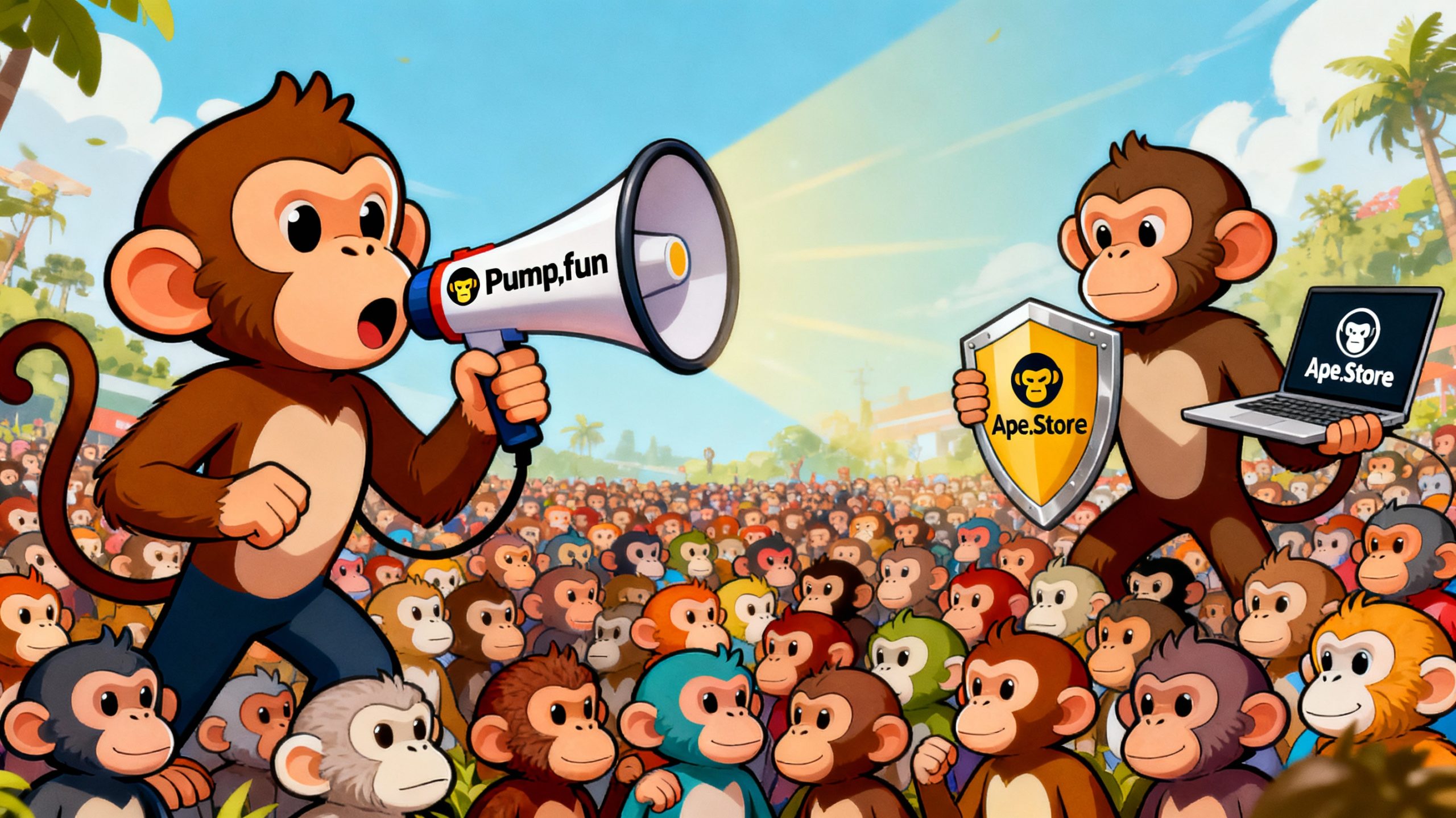
While Pump.fun optimized for speed and volume, Ape.Store recognized an emerging market need: sustainable communities, not just speculative frenzy.
Pump.fun Philosophy:
- “Maximize token creation velocity”
- “Remove all barriers”
- “Let market sort winners from losers”
- “Platform agnostic about outcomes”
Ape.Store Philosophy:
- “Build sustainable communities”
- “Integrate protocol-level verification”
- “Provide educational resources”
- “Align platform incentives with user outcomes”
Key Differentiators
1. Social Integration Strategy: Farcaster Over Twitter
[Ape.Store’s Farcaster integration fundamentally differs from Pump.fun’s Twitter approach.] Rather than using external platform algorithms, Ape.Store built directly into Farcaster protocol:
- Verification: Blockchain-backed creator verification (impossible to impersonate)
- Authenticity: Verified identities prevent fraud
- Discovery: Organic community spreading, not bot amplification
- Sustainability: Gradual community growth sustains longer than viral spikes
2. Launch Philosophy: Quality Curation
Rather than permissionless token creation, Ape.Store emphasizes:
- Creator profile verification
- Community quality assessment
- Project fundamentals review
- Risk management resources
- Educational materials before launch
Result: Fewer tokens launch on Ape.Store, but launched tokens have higher quality communities.
3. Speed Without Recklessness
While Pump.fun emphasizes “launch in 60 seconds,” Ape.Store offers comparable speed while maintaining quality gates. [Projects can launch tokens on Ape.Store in 5 minutes]—fast enough for legitimate projects, but slower than Pump.fun’s friction-free approach.
This slight friction creates meaningful filtering.
Risk Management: From Platform Responsibility to User Education
[Ape.Store provides extensive risk management resources to help traders distinguish real from artificial momentum.]
Key Risk Management Principles:
- Verify contract addresses against official sources
- Analyze liquidity ratios to understand price stability
- Evaluate team transparency through project communications
- Assess community authenticity (real discussion vs. bot spam)
- Understand tokenomics (vesting schedules, allocations, burn mechanics)
Learn the essentials of risk management for meme coin traders.
Platform Design for Safety:
- Dashboard analytics that highlight suspicious trading patterns
- Warnings when contract behavior appears malicious
- Educational content explaining fraud mechanisms
- Community reporting mechanisms for suspicious activity
Launch Speed Comparison: Pump.fun vs Ape.Store
The Timeline Breakdown
| Stage | Pump.fun | Ape.Store | Difference |
|---|---|---|---|
| Token creation | 60 seconds | 90 seconds | +30 sec (creator verification) |
| Initial trading | Immediate | 30 seconds | +30 sec (safety checks) |
| Social integration | 5 minutes | 15 minutes | +10 min (Farcaster slower) |
| Community formation | 15-60 minutes | 2-24 hours | +1-23 hours (organic vs viral) |
| Peak price movement | 30-120 minutes | 6-48 hours | +5-47 hours (gradual vs spike) |
| Community sustainability | 4-72 hours | 7+ days | +3-7 days (if viable) |
What the Timeline Reveals
Speed Advantage: Pump.fun (2-3x faster to peak)
- Explosion of initial excitement
- Faster price discovery
- Earlier exit opportunities for insiders
Sustainability Advantage: Ape.Store
- Gradual community formation
- Genuine participant commitment
- Project viability more apparent
Different Objectives:
- Pump.fun optimizes for trader speed (perfect if you’re insider)
- Ape.Store optimizes for community longevity (better if building project)
For detailed breakdown of launch speeds across platforms, see Ape.Store’s speed comparison data.
Risk Management and Sustainable Community Building
Why Community Sustainability Matters
Short-term perspective: Token launches fast, traders make money quickly, move to next opportunity.
Long-term perspective: Projects that build real communities create lasting value through:
- Repeated trading: Holders continue participating over weeks/months
- Network effects: Community becomes more valuable as it grows
- Utility creation: Projects develop actual functionality over time
- Revenue generation: Communities can fund ongoing development
Successful projects (BONK, WIF, etc.) demonstrate that sustainable communities generate more total value than viral spikes.
Elements of Sustainable Community Building
Transparent Communication
- Founder presence in community
- Regular project updates
- Honest addressing of challenges
- No overpromising or hidden roadmaps
Educational Content
- Explaining project mechanics
- Teaching community risk management
- Comparing to competitor projects
- Honest assessment of tokenomics
Community Recognition
- Profiles and achievement systems
- Recognition for early supporters
- Governance participation opportunities
- Reputation-building mechanisms
Fair Incentive Alignment
- Team allocations transparent and vested
- Creator revenue tied to long-term success
- Community benefits from platform growth
- No artificial scarcity or artificial hype
Ape.Store’s Approach to Sustainability
Profile and Trophy Systems:
[Ape.Store gamifies community participation through profiles and achievement systems.] Rather than pure speculation, community members accumulate status through:
- Early participation (first-mover badges)
- Consistent engagement (community contributor badges)
- Governance participation (voting badges)
- Content creation (influencer badges)
Result: Members feel ownership beyond pure price speculation.
Risk Management Integration:
[Risk management education is integrated into the launch process.] New participants learn:
- How to verify contracts before buying
- How to recognize pump-and-dump patterns
- How to evaluate project fundamentals
- How to manage position sizing and stop-losses
Result: More informed participants make better decisions, creating healthier communities.
Frequently Asked Questions (FAQ)
What made Pump.fun so successful so quickly?
Pump.fun removed every barrier to token creation (technical, financial, regulatory) and made speculation instantly accessible. The combination of bonding curves (eliminating liquidity requirements), one-click Twitter sharing (creating viral loops), and mobile-first design (enabling 24/7 participation) created a perfect storm of adoption. Within 6 months, the platform had processed more tokens than traditional finance processes in decades.
Why are 98% of tokens on Pump.fun scams or failures?
The platform’s permissionless design enables anyone to launch tokens, including scammers. With 65,000 tokens launching daily, most represent either pure speculation (destined to fail) or intentional fraud. The low barrier to entry means no quality filtering, no due diligence, and no accountability. Only tokens with genuine community interest survive; the rest crash to zero within hours or days.
How does Ape.Store differ from Pump.fun in practical terms?
Ape.Store emphasizes verification, education, and sustainable community building over maximum speed. Creators provide profiles, projects include risk management resources, and social integration focuses on Farcaster (protocol-level verification) rather than Twitter (bot-prone). Result: Fewer tokens launch, but communities form more organically and sustain longer.
Can I make money on Pump.fun despite high failure rates?
Yes, but it requires extreme skill or luck. Early entries into successful tokens can generate 100-1000x returns. However, identifying winners before viral moment requires:
- Deep understanding of tokenomics
- Network connections to community insiders
- Fast execution and exit strategies
- Willingness to accept losses on failed attempts
Most retail traders lose money; most profits concentrate among insiders with information advantages.
What is a bonding curve and why does it matter?
A bonding curve is a mathematical formula that automatically sets token prices based on supply. Instead of needing humans to provide liquidity, the algorithm handles pricing automatically. This eliminates capital barriers to launching tokens (you don’t need to lock liquidity) but concentrates risk toward early buyers (prices increase as you buy more). Bonding curves enabled Pump.fun’s explosive growth but also make tokens easier to manipulate.
Why is Farcaster integration different from Twitter integration?
Twitter is an external platform with algorithmic control, bot vulnerabilities, and impersonation risks. Farcaster is a decentralized protocol where Ape.Store can integrate directly. Farcaster identities are blockchain-verified (impossible to impersonate), spam is economically prevented (requires staked capital), and discovery happens through community participation rather than algorithms. Result: Higher signal-to-noise ratio and more authentic community formation.
How does risk management help in meme coin trading?
Risk management teaches traders to:
- Verify contract addresses before buying
- Analyze liquidity and price stability
- Evaluate team transparency
- Recognize fraud patterns
- Size positions appropriately
Many losses occur from impersonation scams, honeypots, or rug pulls—all preventable through basic verification. Ape.Store integrates these lessons directly into the platform.
What makes a meme coin community sustainable vs. temporary?
Temporary communities are built on FOMO and hype (peak and crash). Sustainable communities have:
- Transparent project communication
- Educational content beyond price discussion
- Fair incentive alignment (team success tied to holder success)
- Community recognition systems (reducing pure speculation mindset)
- Ongoing development and roadmap delivery
Ape.Store’s design prioritizes these elements; Pump.fun’s design optimizes for speed (which doesn’t align with sustainability).
Could Pump.fun add quality filtering and still maintain dominance?
Possibly, but it would reduce volume and revenue. Pump.fun’s profitability depends on transaction fees—more tokens = more fees. Adding quality gates would reduce token launches, reducing revenue. The platform’s incentives are aligned with volume, not quality. Ape.Store’s deliberate choice of quality over volume represents a fundamentally different business philosophy.
What happens to failed tokens after launch?
Most failed tokens become “zombie tokens”—no trading activity, no holder engagement, no developer activity. They remain on blockchain permanently but have zero liquidity. Holders cannot exit; tokens become worthless. Blockchain explorers show millions of zombie tokens from past launch booms. They’re digital graveyards of speculative frenzies.
Is meme coin speculation sustainable long-term?
Probably not at current volumes. Current meme coin market capitalizes on retail FOMO and information asymmetry. As markets mature:
- Information quality improves (harder to hide scams)
- Retail sophistication increases (less vulnerable to hype)
- Regulatory pressure increases (less permissiveness)
- Alternative investments compete (other assets improve returns)
Meme coins will likely persist but as smaller percentage of total crypto activity. Communities that build beyond speculation (actual projects with utility) will sustain; pure speculation plays will decline.
What’s the most common mistake meme coin traders make?
Entering late in hype cycle, when price has already moved 100x. Retail traders see trending tokens and assume they’re early, but by the time information reaches mainstream, insiders have already exited. Buying at peak ensures losses. The most successful traders buy before any hype (information asymmetry advantage) or avoid entering entirely (risk management).
How does Ape.Store make money if it prioritizes quality over volume?
Ape.Store likely uses:
- Lower transaction fees per token (less volume, acceptable lower rate)
- Creator revenue sharing programs (aligning incentives)
- Subscription or premium features for advanced analytics
- Partnerships and ecosystem integrations
Revenue comes from longevity and user lifetime value rather than transaction velocity. Smaller but more stable revenue model than Pump.fun’s volume-dependent model.
Will Pump.fun maintain dominance or will competitors overtake it?
Pump.fun has first-mover advantage, brand recognition, and largest user base—significant moats. However:
- Regulatory pressure could change model
- Competition from Vector.fun (Coinbase-backed), LetsBonk, and others continues
- Market saturation reduces trading volume
- Bot takeover reduces authenticity
Pump.fun will likely maintain significant market share but probably won’t dominate indefinitely as competitors differentiate strategically (like Ape.Store does through community focus).
What’s the future of meme coin platforms?
Near-term: More differentiation by strategy (speed vs. quality, volume vs. sustainability, Solana vs. multi-chain)
Medium-term: Regulatory clarity reducing permissionless approaches, quality curation becoming competitive advantage
Long-term: Consolidation around platforms that build sustainable communities with actual utility beyond speculation
Platforms that optimize purely for speculation face long-term decline; platforms that enable community building will likely survive maturation cycle.
Conclusion: The Future of Meme Coin Platforms
What Pump.fun Actually Accomplished
Pump.fun democratized token creation by removing barriers so completely that memes could instantly become financial assets. This fundamentally changed how people think about community, culture, and speculation. The platform’s impact on Solana’s adoption, retail crypto participation, and memetic culture generally cannot be overstated.
But with that democratization came unforeseen consequences: fraud at unprecedented scale, information collapse, bot takeover, and community exhaustion. The platform achieved its goal of removing barriers but didn’t solve for outcomes.
Ape.Store’s Counter-Revolution
Ape.Store emerged not to compete on speed or volume, but to ask: “What if we removed barriers while maintaining quality?” The result is a platform philosophy that prioritizes:
- Verification over speed
- Sustainability over virality
- Community over speculation
- Education over hype
- Authenticity over automation
This represents not a technological innovation but a philosophical repositioning: serving communities rather than maximizing platform revenue.
The Divergence of Platforms
The meme coin industry is splitting into distinct market segments:
Pump.fun’s Future: Dominates the speculative, high-velocity segment. Success measured in transaction volume and fee generation. Community quality remains secondary.
Ape.Store’s Future: Dominates the community-building, sustainable segment. Success measured in user retention and project viability. Quality filtering becomes competitive advantage.
Both Can Coexist: Different traders have different needs. Speed-focused traders use Pump.fun; community-building teams use Ape.Store. Market is large enough for multiple winners.
Lessons for Crypto Markets
Pump.fun’s success demonstrates that barriers exist for reasons (preventing fraud, maintaining information quality). Removing barriers entirely solved speed problems but created fraud problems. The optimal design probably lies between extremes:
- Speed sufficient for legitimate projects (not gated behind venture rounds)
- Quality filtering sufficient to prevent obvious fraud (not gatekeeping innovation)
- Transparency sufficient for educated decision-making (not assuming traders are idiots)
- Community tools sufficient for sustainable growth (not just hype cycles)
Ape.Store’s approach suggests the future of successful platforms involves thoughtful design that balances accessibility with responsibility—not removing all friction, but channeling friction toward safety and sustainability.
The Mainstream Question
As memes became mainstream through Pump.fun, legitimacy questions emerged: Are meme coins “real investments” or “pure gambling?” Is speculation “financial inclusion” or “wealth extraction?”
The answer depends on design. Platforms optimized purely for hype extraction (Pump.fun’s current model) enable wealth extraction. Platforms designed around community building and education (Ape.Store’s approach) enable speculative participation with reduced information asymmetry.
The future of meme coins likely depends on which philosophy wins: Does the industry consolidate around pure speculation (current Pump.fun trajectory) or around community-driven projects (Ape.Store’s vision)?
Markets ultimately determine the answer. Successful projects will likely combine elements of both—the speed and accessibility of Pump.fun with the community focus and verification of Ape.Store.