
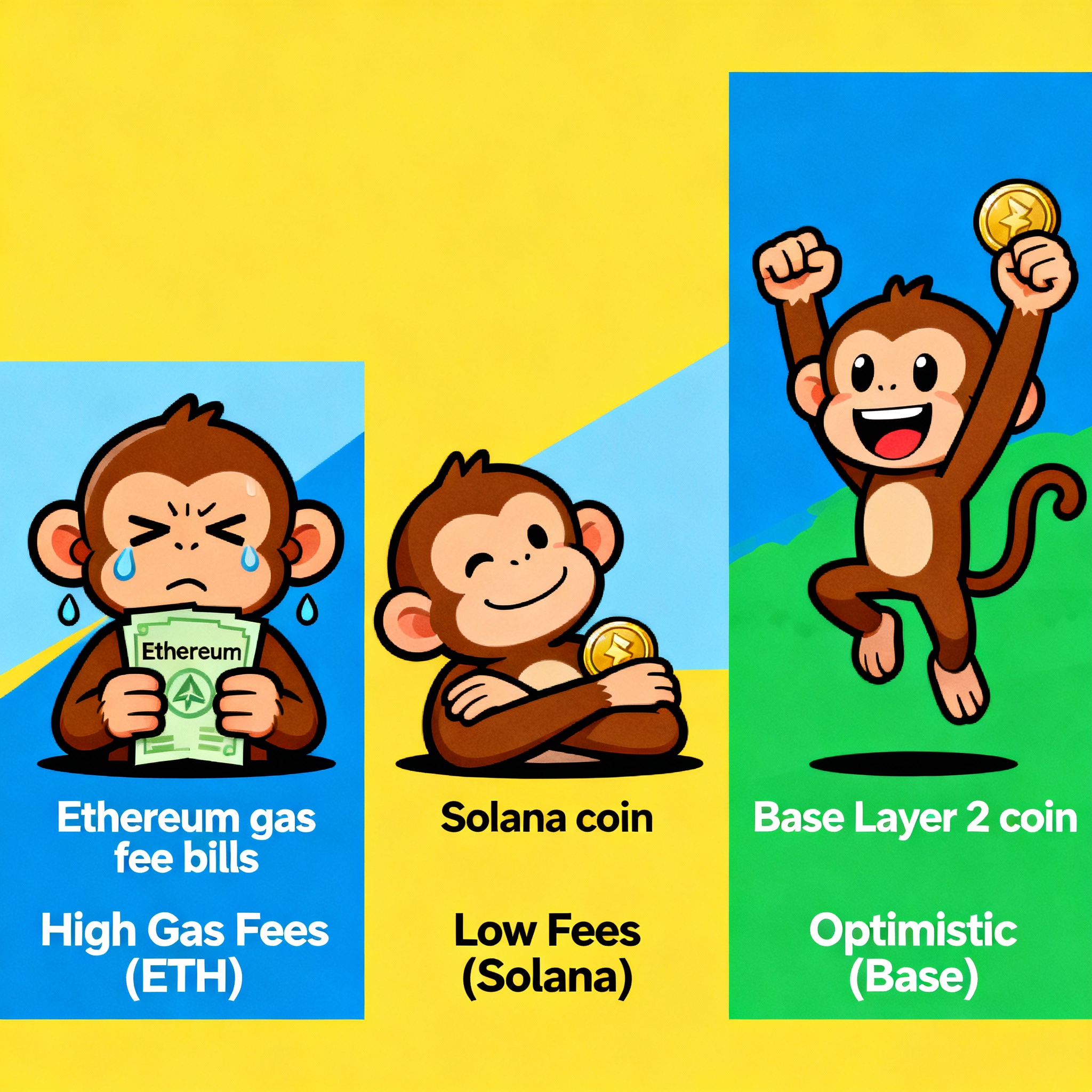
Gas fees are the invisible tax on every cryptocurrency transaction. For memecoin traders executing hundreds of trades monthly, gas fees transform from minor inconvenience to major cost factor—sometimes determining profitability. This analysis examines how gas economics actually impact traders across Ethereum mainnet, Solana, and Base, revealing surprising truths about what “cheap gas” actually means for different trader archetypes.
Understanding Gas Fees: The Mechanics
What Are Gas Fees?
Gas fees compensate network validators for processing and securing transactions. They vary by:
- Network congestion (how many transactions pending)
- Transaction complexity (simple transfer vs. complex smart contract interaction)
- Network design (Layer 1 vs. Layer 2 architecture)
- Demand cycles (peak times cost more than off-peak)
Why They Matter For Meme Traders
Every meme trade requires multiple transactions:
- Approval transaction – Authorize token spending (required once per token)
- Swap transaction – Execute the actual trade
- Management transactions – Claim rewards, rebalance, exit positions
Total transactions per active trader: 50-200+ monthly (serious traders: 500+)
When gas fees total thousands monthly, they directly impact net profitability.
Ethereum Mainnet: The Expensive Reality
Current State: September-October 2025
- Avg gas price: 25-50 gwei during normal hours
- Peak gas price: 100-200+ gwei during network congestion
- Typical simple swap cost: $15-50 per transaction
- Typical complex swap cost: $50-150 per transaction
The Math: What Ethereum Costs Actually Look Like
Scenario: Active meme trader executing 100 trades monthly
| Cost Component | Per Trade | Monthly Total |
|---|---|---|
| Approval transactions (15 new tokens) | $30 average | $450 |
| Swap transactions (100 total) | $30 average | $3,000 |
| Token management/exits | $20 average | $200 |
| Total monthly gas cost | ~$30 avg | ~$3,650 |
Why Traders Still Use Ethereum Mainnet
Despite high fees, serious traders use Ethereum because:
- Liquidity depth – Uniswap v2/v3 have billion-dollar liquidity pools
- Professional infrastructure – Financial tools assume Ethereum
- Institutional integration – Serious money lives on Ethereum
- Safety – Most secure, battle-tested infrastructure
Economics of using Ethereum: Only viable for traders deploying $100k+ positions where 3.6% gas cost is acceptable trade-off for access to deep liquidity and professional infrastructure.
Solana: The Gas Fee Seduction
Current State: September-October 2025
- Avg gas price: $0.00025 per transaction
- Peak gas price: $0.001 per transaction (during extreme congestion)
- Typical simple swap cost: $0.001 per transaction
- Typical complex swap cost: $0.002 per transaction
The Math: What Solana Costs Actually Look Like
Scenario: Same active meme trader executing 100 trades monthly
| Cost Component | Per Trade | Monthly Total |
|---|---|---|
| Approval transactions (15 new tokens) | $0.0005 average | $0.0075 |
| Swap transactions (100 total) | $0.0005 average | $0.05 |
| Token management/exits | $0.0005 average | $0.0075 |
| Total monthly gas cost | ~$0.0005 avg | ~$0.06 |
The Gas Fee Advantage: Quantified
Ethereum monthly gas: ~$3,650
Solana monthly gas: ~$0.06
Difference: Ethereum costs 60,833x more than Solana.
The Psychological Impact
This massive difference creates false perception: “Solana is cheap, Ethereum is expensive.”
But here’s the reality check:
- Trader deploying $10,000: Ethereum cost is $365/month (3.65%), Solana cost is negligible (0.0006%)
- Trader deploying $100,000: Ethereum cost is $3,650/month (3.65%), Solana cost is negligible
- Trader deploying $1,000: Ethereum cost is $36.50/month (3.65%), Solana cost is negligible
The insight: Gas fees matter most to mid-size traders ($10k-100k). For very large positions ($1M+), gas is rounding error. For very small positions ($100-1k), gas consumes huge percentage of capital.
Why Gas Savings Don’t Translate to Profits
Even though Solana gas is negligible, Pump.fun traders often underperform:
- Higher slippage – Less liquidity in individual pools
- Pump and dump dynamics – Most projects are designed to fail
- 98.6% failure rate – Capital destruction overwhelms gas savings
- Bot competition – Sophisticated bots extract value from retail traders
The paradox: Solana’s cheap gas enables high-frequency trading, but high-frequency trading extracts value from retail traders through faster execution and better information.
Result: A trader might save $3,650/month in gas but lose $50,000 in slippage and poor entry/exit timing.
Base: The Middle Ground
Current State: September-October 2025
- Avg gas price: $0.02-0.05 per transaction (varies with Ethereum L1 load)
- Peak gas price: $0.10-0.20 per transaction (during Ethereum congestion)
- Typical simple swap cost: $0.03-0.08 per transaction
- Typical complex swap cost: $0.08-0.20 per transaction
The Math: What Base Costs Actually Look Like
Scenario: Same active meme trader executing 100 trades monthly
| Cost Component | Per Trade | Monthly Total |
|---|---|---|
| Approval transactions (15 new tokens) | $0.08 average | $1.20 |
| Swap transactions (100 total) | $0.08 average | $8.00 |
| Token management/exits | $0.08 average | $0.64 |
| Total monthly gas cost | ~$0.08 avg | ~$9.84 |
Base vs. Ethereum vs. Solana: Complete Comparison
| Metric | Ethereum | Solana | Base |
|---|---|---|---|
| Cost per transaction | $15-50 | $0.0005 | $0.05-0.10 |
| Monthly 100 trades | $3,650 | $0.06 | $9.84 |
| Annual for active trader | $43,800 | $0.72 | $118 |
| Relative cost | Baseline | 1:60,833 | 1:370 |
Why Base Is The Goldilocks Zone
Base offers:
- Negligible gas costs (vs Ethereum’s prohibitive costs)
- Better liquidity than pure Solana alternatives (Uniswap v2 vs Raydium)
- Professional infrastructure (Ethereum DeFi integration)
- Lower slippage (deeper liquidity pools than isolated Solana memes)
The trader’s perspective: Gas costs are irrelevant on Base, but everything else (liquidity, infrastructure, discovery) is better than Solana.
The Hidden Cost: Slippage and Execution Quality
Why Gas Fees Are Only Part of the Story
Most traders focus on gas fees while ignoring bigger costs:
Slippage (difference between expected and actual price) often exceeds gas fees:
Example: Buying 1 million SHIB
| Network | Gas Fee | Slippage | Total Cost |
|---|---|---|---|
| Ethereum | $30 | $50-150 (deep liquidity) | $80-180 |
| Solana | $0.001 | $100-500 (thin liquidity) | $100-500 |
| Base | $0.08 | $20-80 (moderate liquidity) | $20-80 |
The pattern: Ethereum’s high gas fees are offset by deep liquidity. Solana’s low gas fees are overwhelmed by slippage costs from thin liquidity.
The Real Cost Hierarchy For Meme Traders
From most to least expensive:
- Market impact/slippage (often $100-1,000+ per trade)
- Token risk/loss from scams (project fails = 100% loss)
- Timing costs (entering late, exiting early = massive losses)
- Gas fees (usually $0.01-50 per trade)
- DEX fees (0.01-1% per trade = $0.10-100)
The insight: Traders obsessing over gas fees often ignore $10,000 costs in slippage and timing.
Trader Archetypes: How Gas Economics Affect Different Strategies
Archetype 1: High-Frequency Scalper (100+ trades daily)
Profile: Using bots to find small inefficiencies
Capital deployed: $50k-$500k
Monthly trades: 500-2,000
Monthly volume: $1M-$10M
Gas economics:
| Network | Monthly Gas | % of Profits | Viability |
|---|---|---|---|
| Ethereum | $18,250 | 30-50% of profits | Marginal (need scale) |
| Solana | $0.30 | Negligible | Viable |
| Base | $50 | Negligible | Viable |
Best choice: Solana (pure cost optimization)
Reality check: Bots optimize for Solana’s low gas but extract value from retail traders through MEV (maximum extractable value). Solana’s cheap gas enables predatory bot behavior.
Archetype 2: Active Day Trader (20-50 trades daily)
Profile: Manual trading, multiple token exploration
Capital deployed: $10k-$50k
Monthly trades: 100-200
Monthly volume: $100k-$500k
Gas economics:
| Network | Monthly Gas | % of Position | Viability |
|---|---|---|---|
| Ethereum | $3,650 | 7-37% of position | Poor (too expensive) |
| Solana | $0.06 | Negligible | Excellent |
| Base | $9.84 | Negligible | Excellent |
Best choice: Solana or Base (gas irrelevant, other factors matter)
Reality check: For this trader, gas is genuinely negligible. Liquidity, slippage, and discovery become primary concerns.
Archetype 3: Serious Institutional Trader (50 trades daily, large positions)
Profile: Deploying meaningful capital with risk management
Capital deployed: $500k-$10M
Monthly trades: 100-200 (fewer, larger)
Monthly volume: $5M-$50M
Gas economics:
| Network | Monthly Gas | % of Position | Value | Viability |
|–|–|–|–|
| Ethereum | $3,650 | 0.04-0.73% | Deep liquidity justifies cost | Excellent |
| Solana | $0.06 | Negligible | But thin liquidity problematic | Poor |
| Base | $9.84 | Negligible | Better liquidity than Solana | Excellent |
Best choice: Ethereum or Base (depends on position size and liquidity needs)
Reality check: At institutional scale, gas becomes rounding error. Liquidity depth, price stability, and regulatory clarity become primary concerns.
Archetype 4: Retail Hobbyist (5-10 trades weekly)
Profile: Entertainment and small speculation
Capital deployed: $100-$5k
Monthly trades: 20-40
Monthly volume: $5k-$50k
Gas economics:
| Network | Monthly Gas | % of Position | Viability |
|---|---|---|---|
| Ethereum | $730-1,460 | 15-290% of position | Impossible (loses money on fees) |
| Solana | $0.012 | Negligible | Viable |
| Base | $1.97 | Negligible | Viable |
Best choice: Solana or Base (Ethereum destroys small accounts)
Reality check: For retail with small positions, gas fees on Ethereum literally make profitability impossible. A $1,000 position with $300+ monthly gas costs before even considering slippage.
The Unintuitive Truth: Cheap Gas Enables Bad Behavior
Solana’s Gas Seduction Problem
Solana’s extraordinarily cheap gas creates perverse incentives:
- Low barrier to launching scams – Cost to deploy rug pull: $1
- High-frequency bot extraction – Bots can profitably scalp retail
- 98.6% project failure rate – Most tokens die regardless of trader activity
- MEV concentration – Validators/bots capture most profits
The psychological trap: Traders think “cheap gas = profitable opportunity” when actually “cheap gas = environment designed to extract retail capital.”
Base’s Moderate Gas Price: Natural Filtering
Base’s moderate gas costs create opposite incentives:
- Higher barrier to launching – Cost to deploy: $50+ (filters serious projects)
- Less bot-friendly extraction – Gas costs reduce profitability of predatory trading
- Better project sustainability – Only serious projects launch (still fails, but less often)
- More stable liquidity – Professional traders dominate, not bots
The unintuitive insight: Slightly higher gas creates better market conditions for retail traders.
Real-World Scenarios: How Gas Economics Play Out
Scenario 1: Trading a New Solana Memecoin (Pump.fun)
Setup:
- Initial buy: $1,000
- 10 follow-up trades: $500 each
- Exit: $1,000
Costs:
- Gas fees: $0.05
- Slippage on entry: $50 (5%)
- Slippage on exits: $100 (variable)
- Platform fees: $5
- Total costs: $155 (15.5% of position)
- Result: Need 15.5% gains just to break even; 98.6% of projects go to zero
Scenario 2: Trading a New Base Memecoin (Ape.Store/Uniswap v2)
Setup:
- Initial buy: $1,000
- 10 follow-up trades: $500 each
- Exit: $1,000
Costs:
- Gas fees: $10
- Slippage on entry: $20 (2%)
- Slippage on exits: $40 (variable)
- DEX fees: $10
- Total costs: $80 (8% of position)
- Result: Need only 8% gains to break even; better project quality reduces 98.6% failure rate to maybe 95%
Scenario 3: Trading on Ethereum with $10k Position
Setup:
- Initial buy: $10,000
- 10 follow-up trades: $2,500 each
- Exit: $10,000
Costs:
- Gas fees (estimated): $365/month
- Slippage on entry: $50 (0.5%, deep liquidity)
- Slippage on exits: $100 (variable)
- DEX fees: $50
- Total costs: $565 (5.65% for month)
- For 6-month trade: ~$3,395 in gas alone
- Result: Only viable for projects with potential 50%+ gains
FAQ: The Gas Fee Questions Traders Actually Ask
Q: Should I only trade on Solana because gas is cheapest?
A: No. Cheap gas is seductive but misleading. Gas cost is 1% of total trading cost for meme traders. Slippage, project risk, and execution quality matter 10x more than gas.
Q: Is Base cheaper to trade memes than Ethereum?
A: Yes, dramatically. For active traders, Base is $10/month vs Ethereum’s $3,650/month. But Ethereum’s deep liquidity sometimes justifies the cost for large positions.
Q: Do gas fees matter if I’m holding long-term?
A: Minimally. If you buy once and hold 6 months, gas is $30-50 (irrelevant). Gas matters for active traders, not hodlers.
Q: Should I abandon Solana because gas is a “trap”?
A: Not entirely. Cheap gas has real advantages for high-frequency strategies. Just recognize that cheap gas also attracts scams and predatory bots—you’re trading cost efficiency for market quality.
Q: What about gas optimization tools?
A: Various tools optimize gas spending (batch transactions, off-peak timing). Savings are marginal ($10-50/month typically) compared to slippage costs ($100-1,000+/month).
Q: If I’m trading $50k positions, does gas matter?
A: Not significantly. $3,650/month in Ethereum gas is 3.65% of position—meaningful but not decisive. Liquidity access becomes more important than gas at this scale.
Q: Can I arbitrage between chains to profit on gas differences?
A: Theoretically yes, but: (1) Bridge fees often exceed savings, (2) timing risks from bridge delays, (3) sophisticated traders already exploit this, (4) net profit after slippage usually negative.
Q: Why do so many traders still focus on gas fees?
A: Because they’re visible and easy to calculate, while slippage is hard to quantify. Traders optimize what they can measure, ignoring larger unmeasured costs.
Conclusion: Gas Fees Are Just One Variable In Complex Equation
The Hierarchy of Cost Factors For Meme Traders
From most to least impactful:
- Project risk (98%+ failure rate)
- Timing (entry/exit price decisions)
- Slippage (execution quality)
- Position size (risk management)
- Gas fees (transaction costs)
- DEX fees (trading costs)
The Gas Economics Truth
- Ethereum: Expensive for small/medium traders, justified only for large positions with deep liquidity needs
- Solana: Cheap but attracts scams and predatory bots; cheap gas enables bad market conditions
- Base: Sweet spot—cheap enough to be irrelevant but expensive enough to filter low-quality projects
The Strategic Insight
Rather than “choose cheapest gas,” choose based on:
- Position size – Large positions: Ethereum (for liquidity). Medium: Base (best tradeoff). Small: Solana or Base
- Trading frequency – High frequency: Solana (if accepting bot extraction). Low frequency: Any (gas irrelevant)
- Risk tolerance – Low risk: Base (better projects). High risk/entertainment: Solana
- Time horizon – Short-term: Solana. Medium-term: Base. Long-term: Ethereum
The Unintuitive Final Truth
Focusing on gas fees often leads to worse overall outcomes.
A trader might save $3,650/month by trading on Solana instead of Ethereum, but lose $50,000 in slippage and project risk—for a net loss of $46,350.
Alternatively, paying $10/month in gas on Base while trading higher-quality projects might deliver 5% better returns, offsetting $120 annual gas by $50,000+ in better execution and project selection.
The lesson: Optimize for what matters (project quality, liquidity, slippage), not for what’s easiest to measure (gas fees).
Gas fees matter. But they’re never the deciding factor for successful meme trading.