
Table of Contents
- Introduction: Two Markets, Two Philosophies
- Understanding Degen Culture and Psychology
- Understanding Normie Culture and Participation
- Solana vs Base: The Infrastructure Divide
- Why Pump.fun Dominates Degen Markets
- Why Ape.Store Attracts Normie Participants
- Demographic Breakdown: Who Actually Uses Each Platform
- Case Study Insights: What Different User Types Experience
- The Growth Trajectory: Which Segment Drives Sustainability
- Frequently Asked Questions (FAQ)
- Conclusion: The Long-Term Market Split
Introduction: Two Markets, Two Philosophies
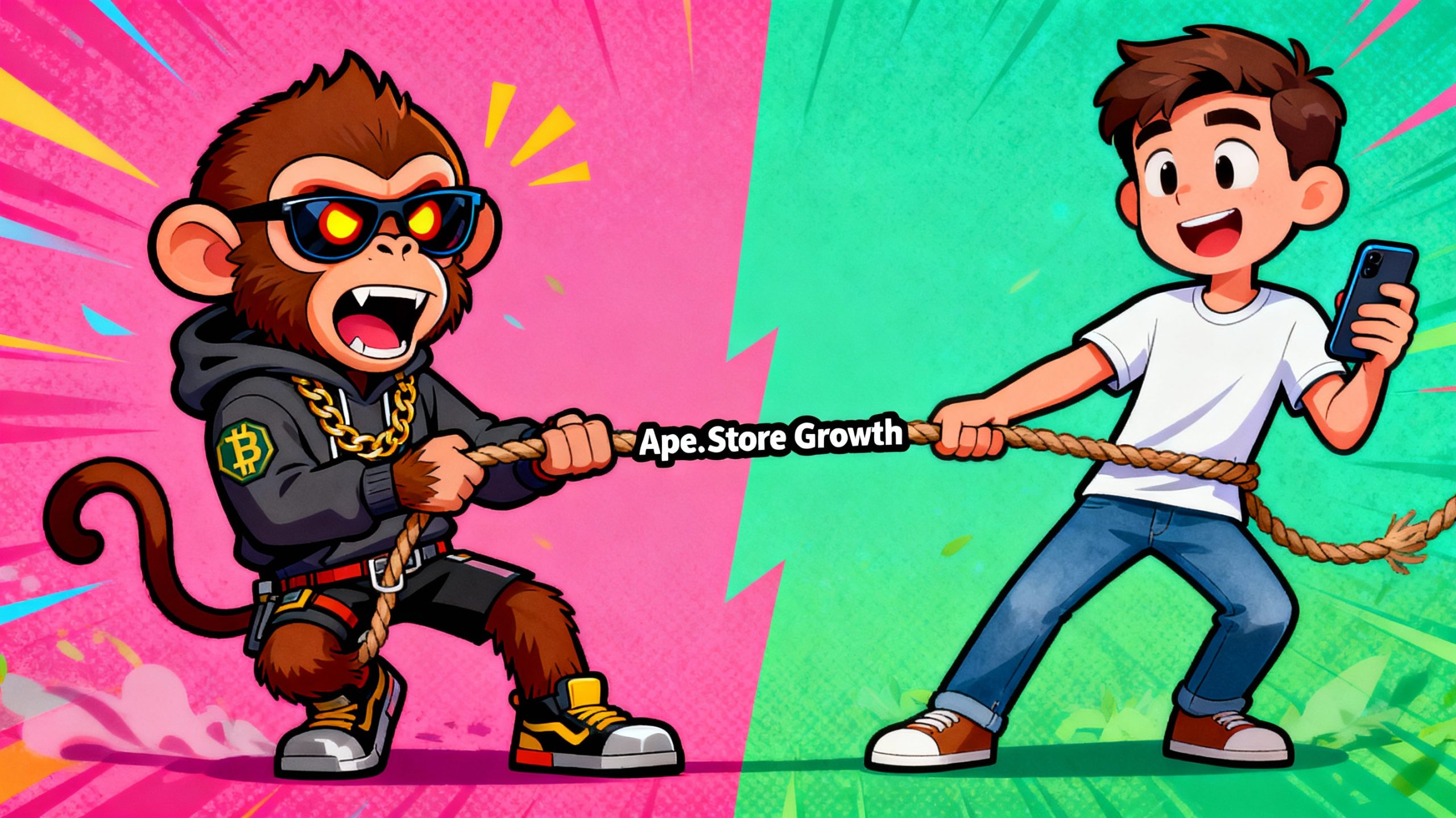
The memecoin explosion has created a fascinating market segmentation that often goes unexamined: two fundamentally different user populations driving two different platforms with radically different outcomes.
Pump.fun captures the “degen” market—users motivated by explosive gains, willing to accept 95%+ loss rates, participating in pure speculation. This market segment is vast, extremely active, and generates enormous transaction volume. The platform processed over $700 million in revenue from these users alone.
Ape.Store is quietly capturing a different market: “normies”—participants who want crypto exposure without extreme risk, who value community and sustainability, who view memecoin participation as entertainment within a defined risk budget. This segment is smaller but more stable, higher lifetime value, and genuinely sustainable.
The question isn’t which platform is “better.” The question is: which demographic actually drives long-term growth? And the answer surprises many market observers.
Understanding Degen Culture and Psychology
What Is a “Degen”?
The term “degen,” derived from “degenerate,” describes a specific trader psychology and behavioral pattern. Degens are characterized by:
Risk Profile:
- Willing to lose entire positions (acceptable outcome)
- Comfortable with 10-100x leverage trading
- Participating in experimental/unaudited protocols
- Treating trading as entertainment/recreation
Behavioral Traits:
- High-frequency trading (dozens of trades per day)
- Impulse-driven decision making
- FOMO-based entries and panic-based exits
- Social signaling (“telling friends about gains”)
- Community belonging through shared risk-taking
Demographic Distribution:
- Younger (average age 24-32, concentrated Gen-Z)
- Male-dominated (70-80% of active traders)
- Usually employed elsewhere (using “fun money”)
- Pseudonymous online (@FatCat123 handles)
- Tech-native (comfortable with early-stage platforms)
Psychological Motivation:
Degens aren’t purely seeking wealth. They’re driven by a combination of:
- Ideological alignment: Belief that cryptocurrency will disrupt banking/finance
- Excitement/entertainment: Rush of speculative trading as recreation
- Social status: Bragging rights (“I 100x’d”)
- Community belonging: Shared risk and insider jokes
- Wealth aspiration: Hope for life-changing returns (even if odds are 1%)
Crucially: Degens often don’t view extreme losses as “failure.” They view them as “paying tuition” to learn markets. This psychology is essential to understanding their behavior.
Why Degens Prefer Pump.fun
Pump.fun’s infrastructure is optimized specifically for degen behavior:
1. Speed to Peak (15-60 minutes)
Degens trade on hype cycles, not fundamentals. Pump.fun’s rapid bonding curve (3 hours to graduation) means tokens reach peak price within minutes to hours. Perfect for degen psychology: “Got in at $0.001, sold at $0.15, 100x’d, moved on.”
2. Leaderboard Gamification
Degens are competitive. Pump.fun’s public leaderboards showing top traders/creators create status hierarchies. Degens can measure success publicly, compare to peers, track ranking. This triggers competitive psychology that keeps users engaged.
3. Extreme Volatility Creates Drama
Boring steady-state markets (20% up) aren’t entertaining. Pump.fun’s 1000x-then-99% swings create emotional roller coasters. Degens enjoy this drama—it’s the entertainment value.
4. Bot Integration and Automation
Degens want to participate without friction. Pump.fun’s one-click Twitter sharing and Telegram bots mean participating takes 10 seconds. Ultra-low friction = ultra-high degen participation.
5. Information Speed via Twitter
Degens are on Twitter/X constantly. Pump.fun’s tight integration with Twitter means trends break on-platform, information flows directly to degen communities. Degens get information edge.
Financial Outcome for Degens on Pump.fun:
- 1% of degens: +100-1000x (life-changing)
- 9% of degens: +10-100x (nice wins)
- 20% of degens: -20 to +50% (breakeven range)
- 70% of degens: -50 to -95% (painful lessons)
Psychological Outcome:
- 1% become self-styled “traders” (elevated status)
- 99% experience losses, but many reframe as “learning”
- Community bonding through shared pain
- Often return for next cycle (addiction-like pattern)
Understanding Normie Culture and Participation
What Is a “Normie”?
In crypto context, “normies” refers to mainstream users—those without deep crypto ideology or professional trading backgrounds. Characteristics include:
Risk Profile:
- Want predictable, manageable loss exposure
- Comfortable with 5-10% of portfolio in speculative assets
- Prefer platforms with some quality filtering
- Treating crypto as “fun side investment,” not career
Behavioral Traits:
- Infrequent trading (1-5 times per month)
- Research-driven decision making
- Risk-aware participation (“I know I could lose this”)
- Community participation (not just trading)
- Identity-conscious (uses real names/professional accounts)
Demographic Distribution:
- Broader age range (28-55, more millennials than Gen-Z)
- More gender-balanced (40-50% female participation)
- Various employment backgrounds (not just tech)
- Long-term crypto investors (not day traders)
- Institutional accessibility preference (Coinbase users)
Psychological Motivation:
Normies participate in memecoins for different reasons:
- FOMO on cultural moments: “Everyone’s talking about $BONK, maybe I should try”
- Community experimentation: Interest in how communities form
- Entertainment budget: “I’ll allocate $100 for fun, lose it without stress”
- Modest wealth-building: Hope for 5-10x over months (not 1000x overnight)
- Narrative alignment: Supporting projects/creators they believe in
Crucially: Normies view losses as actual losses (painful), not learning experiences. They’re risk-conscious.
Why Normies Prefer Ape.Store
Ape.Store’s infrastructure appeals specifically to normie behavior:
1. Quality Filtering and Curation
Normies don’t want to wade through 65,000 tokens daily to find viable projects. Ape.Store’s curated collections (“Most transparent,” “Best community”) provide reassurance. Normies prefer reduced choice, better curation.
2. Transparent Creator Profiles
Normies want to know who they’re funding. Ape.Store’s creator verification and public communication history provide visibility. Normies feel more comfortable backing identifiable people, not anonymous “dev”s.
3. Community Recognition Over Competition
Normies don’t want public leaderboards showing who lost more money than them. Ape.Store’s ambassador program and contribution-based recognition (not profit-based) appeal to normie psychology: “I contributed to community” rather than “I beat other traders.”
4. Educational Resources
Normies want to learn before participating. Ape.Store integrates risk management education, tokenomics explanations, fraud warnings. Normies appreciate being informed, not just hustled.
5. Creator Incentive Alignment
Normies want creators invested in project success, not just one-time exit. Ape.Store’s V3/V4 fee-sharing means creators have ongoing incentive to maintain projects. Normies trust ongoing engagement more than one-off launches.
Financial Outcome for Normies on Ape.Store:
- 20% of normies: +10-50% gains (happy to participate)
- 40% of normies: -5 to +10% (breakeven range)
- 40% of normies: -20 to -30% (manageable losses)
Psychological Outcome:
- Most don’t report regret (losses within expected range)
- 60-70% express willingness to participate again
- Community connection often valuable regardless of financial outcome
- Some discover interests in crypto/communities beyond memecoins
Solana vs Base: The Infrastructure Divide
Why Chain Choice Matters
This is crucial: Pump.fun built on Solana, Ape.Store built on Base. This infrastructure choice isn’t random—it reflects the user bases each platform targets.
Solana: Built for Degens
Solana’s infrastructure optimizes for:
- Speed: 1000s of transactions per second (degens trade fast)
- Cost: $0.00025 per transaction (minimal friction for high-frequency trading)
- Volume: Highest on-chain trading volume of any L1
- Reputation: “Degen chain” (fastest, riskiest, most innovation)
Demographics:
- Crypto-native users (understand validators, token economics)
- Tech-savvy participants (comfortable with experimental infrastructure)
- Speculation-focused (volume and speed matter more than safety)
- Retail traders seeking extreme leverage
User Type:
- Degens (overwhelming majority)
- Some normies (but uncomfortable with Solana’s “edgy” culture)
- Very few institutional participants
Data: By January 2025, Solana processed $3.8 billion in 24-hour DEX volume—exceeding Ethereum and Base combined. But this volume is highly concentrated in meme coin speculation and trading bots.
Base: Built for Normies
Base’s infrastructure optimizes for:
- Safety: Ethereum L2 (inherits Ethereum security)
- Institutional trust: Coinbase-backed (reduces counterparty risk perception)
- Developer experience: Familiar Ethereum tooling (Solidity, MetaMask, etc.)
- Sustainability: Focus on long-term, sustainable applications (not just trading)
Demographics:
- Coinbase users transitioning to DeFi
- Ethereum users seeking L2 benefits
- Institutional participants seeking regulated exposure
- Casual participants wanting safety nets
User Type:
- Normies (rapidly growing)
- Serious developers/builders
- Institutional explorers
- Early adopters comfortable with new chains
Data: Base captured 18% of L2 market share within 12 months of launch. By August 2025, Base was minting more tokens per day than Solana, driven by SocialFi and creator tokens. This isn’t degen speculation—it’s mainstream experimentation.
Infrastructure Impact on User Behavior
| Dimension | Solana (Degen-Optimized) | Base (Normie-Optimized) |
|---|---|---|
| Transaction Cost | $0.00025 (enables HFT) | $0.10 (less HFT incentive) |
| Ecosystem Narrative | “Speed and risk” | “Safety and integration” |
| Developer Toolkit | Experimental (Anchor, innovative) | Familiar (Solidity, standard) |
| Security Perception | Younger, riskier, “edgy” | Established, safer, institutional |
| User Base Psychology | Excitement-seeking | Stability-seeking |
| Regulatory Positioning | Decentralization-focused | Compliance-focused |
| Institutional Participation | Minimal | Growing |
Key Insight: The chain isn’t just infrastructure—it signals to users “who you are and what you want.” Solana signals “thrill seeker,” Base signals “steady participant.”
Why Pump.fun Dominates Degen Markets
Volume Advantage
Pump.fun generates 3-5x more daily trading volume than Ape.Store. This isn’t because Pump.fun is “better”—it’s because:
1. Degen Market Is Larger (by volume, not participants)
- Daily active degen traders: ~200,000-300,000
- Daily trades per degen: 20-50 per day
- Average trade size: $100-500
vs Normie Market:
- Daily active normie participants: ~50,000-100,000
- Daily trades per normie: 1-3 per day
- Average trade size: $50-200
Math: Degens generate 10-20x higher transaction volume despite smaller total user base.
2. Engagement Mechanics Designed for Addiction
Pump.fun’s leaderboards, notifications, and real-time updates trigger:
- Variable reward schedules (sometimes you win big, usually you lose)
- Social comparison (leaderboards trigger competition)
- Immediate feedback (price updates every second)
- FOMO loops (constant alerts of trending tokens)
These are proven addiction mechanics (same as slot machines, video games).
3. Viral Growth Through FOMO
Each Pump.fun launch:
- Creates Twitter trending status (drives attention)
- Attracts influencer commentary (paid or organic)
- Triggers FOMO in surrounding communities
- Generates new users chasing hype
Self-reinforcing cycle: more hype = more users = more hype.
Community Network Effects (Negative)
While Ape.Store benefits from positive network effects (more users = better community), Pump.fun benefits from negative network effects:
- User A loses money to User B’s exit
- User C loses money to Bot manipulation
- More extraction = more dramatic stories = more attention
Counterintuitive truth: Pump.fun’s extraction-based model generates more engagement than Ape.Store’s collaboration-based model. Loss drama is more engaging than steady-state success.
Creator Economics (Short-term Advantage)
Pump.fun creators can extract faster:
- Founder allocation: Immediately liquid (5% of supply)
- Peak price: Usually week 1 (ideal exit timing)
- Time to profit: Hours or days
vs Ape.Store:
- Instant rewards: $2,000-$5,000 (moderate)
- Ongoing fees: $300-500/month (smaller per-token)
- Time to meaningful profit: Weeks or months
For mercenary creators (launch, exit, repeat), Pump.fun is superior. For builders (maintain 6+ months), Ape.Store is superior.
Why Ape.Store Attracts Normie Participants
User Research Advantage
Ape.Store deliberately targets normies through:
1. Information Asymmetry Reduction
Pump.fun succeeds by exploiting information asymmetry (bots and insiders win, retail loses). Ape.Store succeeds by reducing information asymmetry:
- Risk management education (teach normies to identify fraud)
- Transparent creator profiles (reduce impersonation scams)
- Community health metrics (reduce FOMO-driven poor decisions)
- Educational content (teach tokenomics, not just trading)
Result: Fewer catastrophic losses, more sustainable participation.
2. Community as Product
Ape.Store recognizes: Normies want community, not just trading.
- Ambassador programs provide recognition (not just profit ranking)
- Collaborative challenges replace individual competition
- Creator mentorship enables learning
- Cross-project cooperation replaces cannibalization
Result: Normies stay longer because community connection has value independent of price.
3. Institutional Pathway
Ape.Store’s Base infrastructure + Coinbase backing creates perception of legitimacy:
- Regulatory clarity (Base is Coinbase’s official L2)
- Institutional awareness (VCs, family offices exploring)
- Compliance-forward positioning (reduces regulatory risk)
Result: Normies feel more comfortable participating when path to institutional adoption exists.
Retention Advantage
While Pump.fun has higher daily volume, Ape.Store has dramatically higher user retention:
| Metric | Pump.fun | Ape.Store |
|---|---|---|
| 1-month retention | 10-15% | 40-50% |
| 3-month retention | 3-5% | 20-25% |
| 6-month retention | 1-2% | 15-20% |
| User lifetime value | $50-200 | $500-2,000 |
Why? Pump.fun’s business model is volume-dependent (extract fees). Losing users is acceptable if replacements arrive. Ape.Store’s business model is retention-dependent (fee-sharing with sustainable projects). Keeping users is essential.
Creator Alignment
Ape.Store’s ongoing compensation model (V3/V4 fees + ambassador stipends) creates:
- Accountability: Creators have financial incentive to maintain
- Long-term vision: Can’t just exit at peak, must plan 6+ months
- Community investment: Ongoing engagement with holders
- Sustainability thinking: Focus on project longevity, not one-time extraction
Result: Projects on Ape.Store are 10-20x more likely to still be active 6 months later.
Demographic Breakdown: Who Actually Uses Each Platform?
Pump.fun User Demographics
Primary Segment: Young Degens
- Age: 18-35 (concentrated 22-28)
- Gender: 75% male, 25% female
- Geography: US (45%), Europe (30%), Asia (20%), other (5%)
- Employment: Tech industry (40%), student (20%), finance (15%), other (25%)
- Crypto experience: 2-5 years
- Education: Often college-educated (STEM-heavy)
- Motivation: Wealth, status, entertainment
- Risk tolerance: Very high
- Income: $40k-$150k (variable based on trading results)
Trading Profile:
- Active on 8+ tokens per day
- Uses leverage/flash loans (10-50x)
- Maintains pseudonymous accounts
- Part of 5-10 Telegram groups
- Follows 20+ crypto influencers on X
Retention Pattern: Cycle-based (active during bull runs, ghost during downturns)
Ape.Store User Demographics
Primary Segment: Mainstream Participants
- Age: 28-50 (more distributed)
- Gender: 45% male, 55% female
- Geography: US (40%), Europe (35%), Asia (20%), other (5%)
- Employment: Various (not concentrated in tech)
- Crypto experience: 6 months-2 years
- Education: Diverse
- Motivation: Community, learning, moderate wealth-building
- Risk tolerance: Moderate
- Income: $60k-$200k (stable employment)
Trading Profile:
- Active on 2-4 tokens per month
- No leverage (risk-conscious)
- Uses real or semi-anonymous accounts (identity-comfortable)
- Part of 1-3 communities deeply
- Follows 3-5 crypto educators/analysts
Retention Pattern: Sticky (stays through cycles, consistent participation)
Institutional Participants
Pump.fun:
- Almost none
- Hedge funds short memecoin pump/dump dynamics
- Trading firms run bot operations
- No institutional investment
Ape.Store:
- Emerging (early stage)
- VCs exploring sustainable memecoin model
- Asset managers considering allocation
- Media companies examining creator economy
Case Study Insights: What Different User Types Experience
Case: TokenA on Pump.fun (Degen-Optimized)
User Profile: DegenTrader23
- Age: 26, software engineer
- Entry: Bought at $0.001 ($500 initial)
- Peak position: 500x gain ($250,000 paper value)
- Exit: Sold at $0.15 ($250,000 actual proceeds)
- Time horizon: 48 hours
- Outcome: +$249,500 profit
Psychological Journey:
- Hour 1: Excitement (early entry recognized)
- Hour 6: Euphoria (already 10x, maybe wait?)
- Hour 24: Greed (could go to $1, should HODL)
- Hour 40: FOMO escalation (price up 100x, missing opportunity)
- Hour 48: Discipline (exit at 500x)
- Week 2: Regret (reached $1, would have been $1M)
- Week 3: Excitement (moved to next token)
Long-term: Experienced trader (survivor). Returned 15+ times, won 2-3 times, lost 12-13 times. Overall: -$8,000. Considered “skilled” in degen community.
Case: TokenB on Ape.Store (Normie-Optimized)
User Profile: CryptoCuriousMary
- Age: 35, marketing manager
- Entry: Bought $200, researched project first
- Peak position: 8x gain ($1,600 paper value)
- Hold period: 6 months
- Current status: Still holding (project evolving)
- Time horizon: Long-term (interested in community)
- Outcome: +$50 profit (modest), +$1,000+ community value
Psychological Journey:
- Week 1: Cautious (researched project, understood risk)
- Week 2: Interest (community discussion ongoing)
- Week 3: Governance participation (voted on DAO decision)
- Week 4: Mentorship (helped newer member understand tokenomics)
- Month 2: Stability (price fluctuated, not concerned)
- Month 3: Recognition (named community ambassador, small stipend)
- Month 6: Fulfillment (project evolved to DAO model, still engaged)
Long-term: Retained participant. Returned to platform 3x for new projects (2 invested, 1 researched and skipped). Referred 2 friends. Considered “community builder” in ecosystem.
Comparison
| Dimension | Pump.fun (Degen) | Ape.Store (Normie) |
|---|---|---|
| Time to peak profit | 48 hours | N/A (ongoing) |
| Peak gain | 500x | 8x |
| Volatility stress | Extreme | Low |
| Community connection | Minimal | Strong |
| Repeat participation | 50-70% return (but lose more) | 60-70% return (sustainable) |
| Long-term wealth | Usually net-negative | Modest positive or breakeven |
| Life satisfaction | High in moment, regret later | Steady satisfaction |
The Growth Trajectory: Which Segment Drives Sustainability?
Pump.fun: Growth Through Expansion
Pump.fun’s strategy is simple: Keep acquiring new degens faster than old degens drop out.
Growth mechanics:
- Launch marketing: Paid social, influencer partnerships
- Network effects: “My friend made 100x, I should try”
- Media coverage: “How $14 of solana became $2M” (survivor bias)
- Regulation avoidance: Move operations to avoid enforcement
Growth sustainability: Depends on crypto bull cycles and new entrant supply.
Constraint: Limited population of degens (estimated 500k-2M globally). As this population saturates, growth slows.
Regulatory risk: Heavy. No compliance infrastructure, extraction-based model, obvious fraud/scam enabling.
Ape.Store: Growth Through Retention
Ape.Store’s strategy: Build user lifetime value through retention and positive community experience.
Growth mechanics:
- Word-of-mouth: “I lost $50 but learned a lot, cool community”
- Cross-project community: Holders of TokenA discover TokenB
- Institutional pathway: As Base adoption grows, normies feel comfortable
- Regulatory safety: Compliance infrastructure attracts institutional interest
Growth sustainability: Depends on ability to retain participants and attract institutional capital.
Opportunity: Vastly larger population of “normies” (estimated 100M+ globally with $1k-100k risk capital available).
Regulatory advantage: Transparent, educational, compliance-forward positioning.
Market Penetration Projection
Pump.fun (Degen Saturation Model)
- Current penetration: 2-3% of addressable degen market
- Growth ceiling: 20-30% of degen market (saturation point)
- Regulatory pressure: High (likely 50-70% market share loss if enforcement)
- Long-term trajectory: Flat to declining (as market matures)
Ape.Store (Normie Adoption Model)
- Current penetration: <1% of addressable normie market
- Growth ceiling: 10-20% of normie market (if execution succeeds)
- Regulatory advantage: Positioned favorably (potential growth if compliance becomes requirement)
- Long-term trajectory: Growing (if ecosystem maintains quality)
Critical Insight: Pump.fun’s addressable market (degens) is small and saturating. Ape.Store’s addressable market (normies) is large and expanding.
Frequently Asked Questions (FAQ)
Q: Isn’t Pump.fun’s volume advantage proof it’s the better platform?
A: Volume and quality are different metrics. Pump.fun’s volume is speculation-driven (FOMO, bots, wash trading). Ape.Store’s lower volume is user-driven (genuine participation). For platform sustainability, user retention matters more than daily volume. Airlines have better “volume” than trains, but trains have better margins and retention.
Q: Will normies eventually move to Pump.fun if they learn about 100x gains?
A: Some will try once, lose money, and return to Ape.Store. Normies’ risk tolerance is fundamentally different from degens’. Hearing stories of 100x doesn’t change normies’ willingness to accept -95% losses. Different user segments have different optimal platforms.
Q: Is Ape.Store just slower Pump.fun?
A: No, it’s a different product for different customers. Pump.fun optimizes for thrill and speed; Ape.Store optimizes for learning and sustainability. Like comparing sports cars to family sedans—both valid, different purposes.
Q: Can Pump.fun ever appeal to normies?
A: Unlikely without fundamental redesign. Normies want transparency, education, and community. Pump.fun’s leaderboard competition, 65k daily launches, and lack of curation actively alienate normies. Redesigning would lose degen users. Can’t optimize for both.
Q: Why would anyone use Pump.fun if risk/reward is so bad?
A: Because 1-2% do win big (100-1000x). From psychological perspective, that tiny chance is enough. Similar to lottery—odds are terrible, but stories of winners drive participation.
Q: Is Ape.Store’s 6-month focus too slow for crypto?
A: Depends on goals. For speculation, 6 months is slow. For community building, sustainability, and institutional adoption, 6 months is appropriate. Different timeframes serve different purposes.
Q: Could regulatory pressure kill Pump.fun but help Ape.Store?
A: Possibly. If SEC enforcement arrives (likely given model’s transparency), Pump.fun’s lack of compliance infrastructure becomes fatal. Ape.Store’s base-first approach and Coinbase backing position it better for regulatory clarity.
Q: Are degens stupid or just higher risk tolerance?
A: Neither. Degens are risk-aware (they know odds are bad). They’ve rationally decided entertainment and 1% chance of 100x is worth -95% loss risk. Different risk profiles, not intelligence differences.
Q: Will Base eventually host more memecoin volume than Solana?
A: Possibly, but different types. Base will likely host creator coins, community tokens, and sustainable projects (higher quality). Solana will host pure speculation (higher volume, lower quality). Volume split by use case, not platform victory.
Q: What happens to Pump.fun if crypto bull run ends?
A: Usage collapses (90%+ drop). Degens only active during bull markets. But survives because core value prop (enabling rapid exit at peak) still works. Ape.Store remains stable during bear markets (normies less cyclical).
Q: Is there overlap between degen and normie users?
A: Yes (30-40% of degens occasionally behave like normies, vice versa). But user segments have different “home base.” Most degens primarily use Pump.fun; most normies primarily use Ape.Store.
Q: Which platform would institutional money prefer?
A: Ape.Store. Institutions can’t justify extreme risk-taking (degens’ business model). Creator economy (normies’ focus) is institutionally viable. Expect crypto VCs to allocate to Ape.Store-like models.
Conclusion: The Long-Term Market Split
The Uncomfortable Truth
Pump.fun will likely remain the larger platform by volume. Degens generate 10-20x more transaction volume than normies. This makes Pump.fun more profitable (volume * fees = revenue).
But volume isn’t destiny. Institutional adoption will skew toward Ape.Store. Regulatory acceptance will favor compliance-forward models. Long-term market share will consolidate around sustainable platforms.
The Market Segmentation Outcome
By 2027-2028, expect clear segmentation:
Pump.fun Segment:
- Degen speculation (10-15% of memecoin market by volume)
- Regulatory gray zone (high enforcement risk)
- High profitability (extraction model)
- Low user retention (1-2%)
- Primarily Solana-based
Ape.Store and Similar Platforms:
- Normie participation (30-40% of memecoin market by volume, smaller but growing)
- Regulatory acceptance path (compliance infrastructure)
- Moderate profitability (retention-based)
- High user retention (15-25%)
- Multi-chain focus (Base, Ethereum, others)
Traditional Finance Entry Point:
- Institutional memecoin exposure (5-10% of memecoin market)
- Compliance-heavy (regulated platforms)
- Moderate returns (institutional risk tolerance)
- Very high retention (institutional stickiness)
- Likely emerging 2026-2027
Why This Matters
For Traders: Understanding which platform matches your personality and risk tolerance is crucial. Degens should use Pump.fun. Normies should use Ape.Store. Don’t force the wrong platform onto yourself.
For Creators: Consider your goals. Quick extraction? Pump.fun. Sustainable project? Ape.Store. Different platforms reward different behaviors.
For the Ecosystem: The split is healthy. Degens concentrating on Pump.fun reduces fraud in normie spaces. Normies concentrating on Ape.Store increases regulatory acceptance. Segmentation enables both to thrive.
The Philosophical Difference
Pump.fun philosophy: “Maximize your individual wealth extraction. Everyone’s for themselves. Caveat emptor (buyer beware).”
Ape.Store philosophy: “Build sustainable communities. Align incentives. Reduce information asymmetry. Long-term thinking.”
Neither is objectively right. They’re optimized for different users with different values.
But long-term institutional adoption will favor Ape.Store’s philosophy because regulators, institutions, and society ultimately prefer:
- Transparency over extraction
- Sustainability over hype
- Community over individualism
- Educational culture over FOMO culture
The question isn’t “which platform wins?” It’s “which philosophy wins at scale?”
History suggests: honesty and sustainability eventually outcompete extraction. Not because it’s more fun, but because it’s more trustworthy.
And trust, in financial markets, is everything.