
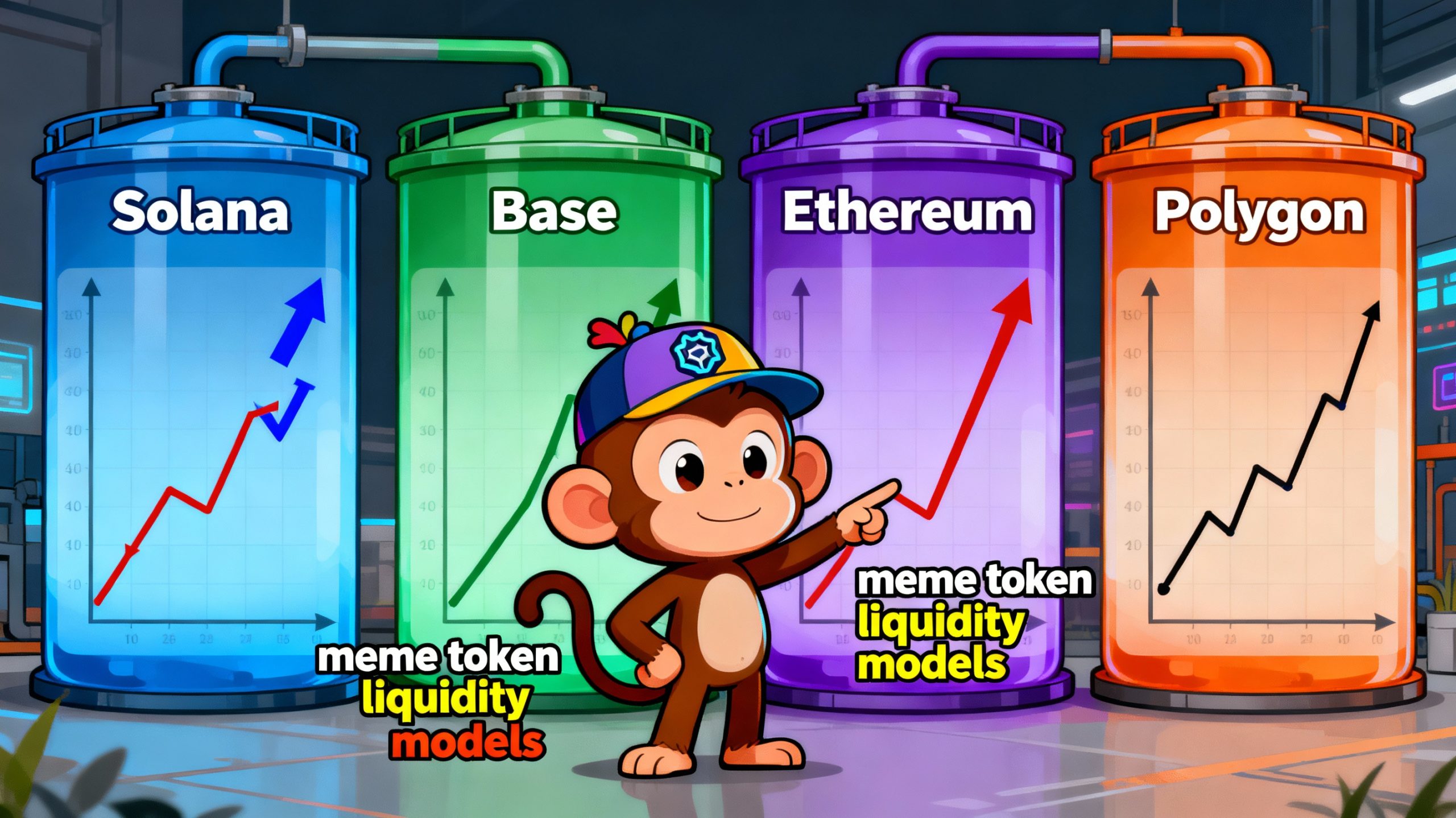
Liquidity is the invisible infrastructure beneath every memecoin trade. Without sufficient liquidity, tokens become untradeable—prices spike on small buys, crash on small sells, and communities evaporate as traders realize they can’t exit. Yet liquidity models vary dramatically across blockchains, each with distinct trade-offs that shape the memecoin experience. Solana’s SPL tokens paired with Raydium create ultra-fast, ultra-cheap liquidity but sacrifice depth. Base’s ERC-20 tokens integrated with Uniswap v4 provide professional infrastructure but at higher cost. Ethereum mainnet offers maximum liquidity depth but prohibitive fees for small traders. Understanding how liquidity works across chains—how it’s created, maintained, and sometimes weaponized—reveals why certain platforms dominate specific memecoin segments and why the choice between ERC-20 and SPL token standards fundamentally shapes trader experience. This guide examines liquidity mechanics, compares models across major chains, analyzes how launchpads like Ape.Store and Pump.fun design liquidity differently, and shows traders how to evaluate liquidity safety before committing capital.
What Is Liquidity and Why Does It Matter for Memecoins?
Liquidity Defined
Liquidity is the ease with which a token can be bought or sold without significantly moving its price.
High liquidity characteristics:
- Large buy orders don’t spike price dramatically
- Large sell orders don’t crash price dramatically
- Tight spread between buy and sell price
- Fast execution (orders fill immediately)
- Multiple market makers competing for trades
Low liquidity characteristics:
- Small buy orders spike price 10-50%+
- Small sell orders crash price 10-50%+
- Wide spread between buy and sell price
- Slow execution (orders partially fill or fail)
- Single liquidity source (monopoly pricing)
Why Liquidity Is Critical for Memecoins
For traders:
- Entry: Can you buy at expected price?
- Exit: Can you sell without crashing price?
- Slippage: How much price movement occurs during trade?
- Timing: Can you execute instantly when opportunity appears?
For creators:
- Launch success: Sufficient liquidity enables price discovery
- Community confidence: Deep liquidity signals legitimacy
- Sustainability: Liquidity depth determines project lifespan
For the ecosystem:
- Market efficiency: Liquidity enables fair price discovery
- Capital flow: Liquidity attracts more traders, creating flywheel
- Platform reputation: Liquidity quality determines user trust
The Liquidity Problem in Memecoins
Traditional assets (stocks, major cryptocurrencies) have deep liquidity from:
- Institutional market makers
- Years of accumulated trading
- Regulatory frameworks ensuring liquidity provision
- Multiple exchanges competing for volume
Memecoins have:
- No institutional market makers (too risky, too volatile)
- Hours to days of trading history (insufficient accumulation)
- No regulatory framework (wild west)
- Single DEX liquidity pool (monopoly)
Result: Memecoins face structural liquidity challenges that traditional assets don’t. Liquidity model design becomes critical differentiator.
Liquidity Models: How Different Chains Handle It
Model 1: Automated Market Makers (AMMs)
How AMMs work:
Traditional exchanges use order books (buyers and sellers post prices, exchange matches orders). AMMs use liquidity pools (token pairs deposited into smart contract, mathematical formula determines price).
AMM formula (simplified):
x × y = k
Where x = quantity of Token A, y = quantity of Token B, k = constant
When you buy Token A, you add Token B to the pool. Pool rebalances according to formula. Price changes based on new ratio.
Advantages:
- Always liquid (no order book required)
- Permissionless (anyone can provide liquidity)
- Simple (no market maker coordination needed)
- Automatic (price adjusts mathematically)
Disadvantages:
- Impermanent loss (liquidity providers lose value vs holding)
- Slippage (large trades move price significantly)
- MEV vulnerability (front-running, sandwich attacks)
- Capital inefficiency (liquidity spread across price range)
Model 2: Bonding Curves (Launchpad-Specific)
How bonding curves work:
Token launches with no initial liquidity. Price determined by mathematical formula tied to supply. Each purchase mints new tokens at progressively higher price. Each sale burns tokens at progressively lower price.
Bonding curve formula (simplified):
Price = f(supply)
As supply increases (more buyers), price increases. As supply decreases (more sellers), price decreases.
Advantages:
- Instant liquidity (no bootstrap required)
- Fair launch (everyone buys at current price)
- Price discovery (organic market forms)
- No impermanent loss (different mechanism)
Disadvantages:
- Early buyer advantage (first buyers get lowest price)
- Graduation risk (what happens after bonding curve ends?)
- Manipulation potential (whales can pump/dump on curve)
- Limited depth (bonding curves handle small volumes better than large)
Model 3: Concentrated Liquidity (Uniswap v3/v4)
How concentrated liquidity works:
Traditional AMMs spread liquidity across entire price range (0 to infinity). Concentrated liquidity lets providers specify price range for their capital. Capital more efficient within chosen range, but zero liquidity outside range.
Advantages:
- Capital efficiency (same depth with less capital)
- Customization (providers choose risk/reward)
- Lower slippage (more liquidity at current price)
- Better for stable pairs (predictable price ranges)
Disadvantages:
- Complexity (providers must actively manage positions)
- Out-of-range risk (liquidity disappears if price moves)
- Higher skill requirement (not beginner-friendly)
- Gas costs for rebalancing (Ethereum-based)
Chain-by-Chain Liquidity Comparison
Solana (SPL Tokens + Raydium)
Liquidity characteristics:
Speed: Ultra-fast (400ms block time)
Cost: Ultra-low ($0.00025 per transaction)
Depth: Variable (depends on pool size)
Infrastructure: Raydium, Orca, Jupiter aggregation
How Pump.fun liquidity works:
- Token launches on bonding curve (instant liquidity)
- At $69k market cap, liquidity migrates to Raydium
- LP tokens either locked or accessible (depends on creator choice)
- Post-graduation liquidity depends on community trading
Strengths:
- Speed enables high-frequency trading
- Low cost enables small trades (no gas barrier)
- Jupiter aggregates liquidity across DEXs
- Large memecoin community (network effects)
Weaknesses:
- Shallow depth for most tokens (concentrated in top projects)
- MEV and bot manipulation prevalent
- Liquidity fragmentation across multiple DEXs
- No integration with Ethereum DeFi ecosystem
Best for: High-frequency trading, small position sizes, speed-prioritizing traders
Base (ERC-20 Tokens + Uniswap v4)
Liquidity characteristics:
Speed: Moderate (2-4 second block time)
Cost: Low-moderate ($0.01-0.10 per transaction)
Depth: Growing (Uniswap v4 efficiency)
Infrastructure: Uniswap v4, Aerodrome, BaseSwap
How Ape.Store liquidity works:
- Token launches on bonding curve (instant liquidity)
- At graduation threshold, liquidity migrates to Uniswap v4
- LP tokens automatically burned (permanent liquidity)
- Custom hooks enable advanced fee structures
Strengths:
- Uniswap v4 concentrated liquidity (capital efficient)
- LP burn mechanism (rug pull protection)
- Integration with Ethereum DeFi (composability)
- Professional infrastructure (institutional-ready)
Weaknesses:
- Slower than Solana (not ideal for scalping)
- Higher costs than Solana (barrier for micro-trades)
- Smaller memecoin community (network effects developing)
- Less trading volume (liquidity still accumulating)
Best for: Sustainable projects, larger position sizes, quality-prioritizing traders
Ethereum Mainnet (ERC-20 + Uniswap v2/v3)
Liquidity characteristics:
Speed: Slow (12 second block time)
Cost: High ($5-50+ per transaction)
Depth: Maximum (deepest liquidity pools in crypto)
Infrastructure: Uniswap, Sushiswap, Curve, 1inch aggregation
How mainnet memecoin liquidity works:
- Traditional launch: Creator provides initial liquidity
- DEX listing: Trading begins on Uniswap v2/v3
- LP management: Creator locks or burns LP tokens
- Aggregation: 1inch routes trades across DEXs
Strengths:
- Deepest liquidity in crypto (institutional presence)
- Maximum security (Ethereum’s validator network)
- Full DeFi integration (lending, staking, yield)
- Regulatory clarity (most compliant ecosystem)
Weaknesses:
- Gas costs prohibitive for small traders
- Speed inadequate for memecoin trading style
- Barrier to entry too high for casual participation
- Most memecoin activity migrated to L2s
Best for: Large position sizes ($10k+), institutional traders, blue-chip memecoins only
Arbitrum and Optimism (ERC-20 + Various DEXs)
Liquidity characteristics:
Speed: Moderate (similar to Base)
Cost: Low ($0.01-0.05 per transaction)
Depth: Moderate (less than Base for memecoins)
Infrastructure: Camelot (Arbitrum), Velodrome (Optimism)
How L2 memecoin liquidity works:
- Similar to Base (ERC-20, AMM-based)
- Less memecoin-specific infrastructure than Base
- Fragmented across multiple DEXs
- No dominant launchpad (unlike Base’s Ape.Store)
Strengths:
- Ethereum security with lower costs
- Established DeFi ecosystems
- Growing developer communities
- Alternative to Base/Solana duopoly
Weaknesses:
- No dominant memecoin platform (fragmentation)
- Lower memecoin trading volume
- Less cultural momentum than Solana/Base
- Liquidity spread thin across many DEXs
Best for: Diversification, alternative ecosystem exposure, DeFi-native traders
Liquidity Model Comparison Table
| Feature | Solana/Pump.fun | Base/Ape.Store | Ethereum Mainnet | Arbitrum/Optimism |
|---|---|---|---|---|
| Transaction Speed | 400ms | 2-4 seconds | 12 seconds | 2-4 seconds |
| Transaction Cost | $0.00025 | $0.01-0.10 | $5-50+ | $0.01-0.05 |
| LP Token Security | Variable | Auto-burned | Variable | Variable |
| DEX Infrastructure | Raydium | Uniswap v4 | Uniswap v2/v3 | Camelot/Velodrome |
| DeFi Integration | Limited | Full Ethereum | Maximum | Full Ethereum |
| Memecoin Volume | Highest | Growing | Declining | Low |
| Rug Pull Risk | Higher | Lower | Variable | Variable |
| Best For | Speed traders | Quality projects | Large positions | Diversification |
How Launchpads Design Liquidity Differently
Pump.fun’s Liquidity Approach
Philosophy: Maximize speed and volume, minimize friction
Bonding curve phase:
- Instant liquidity from first buyer
- Price discovery through bonding curve
- No LP tokens required (curve handles liquidity)
- Fast graduation ($69k threshold)
Post-graduation:
- Liquidity migrates to Raydium automatically
- LP tokens created (ownership depends on settings)
- Creator can withdraw or lock LP tokens
- Community continues trading on Raydium
Strengths:
- Fastest possible launch-to-trading
- Zero capital required for creators
- Familiar Raydium interface post-graduation
- Maximum FOMO potential (speed creates urgency)
Weaknesses:
- LP token security varies (rug pull possible if not locked)
- Shallow post-graduation liquidity (depends on volume)
- No integration with broader DeFi
- Liquidity fragmentation across thousands of tokens
Ape.Store’s Liquidity Approach
Philosophy: Balance speed with safety, prioritize sustainability
Bonding curve phase:
- Instant liquidity from first buyer (same as Pump.fun)
- Price discovery through bonding curve (same mechanism)
- Transparent curve parameters (predictable)
- Graduation to Uniswap v4
Post-graduation:
- Liquidity migrates to Uniswap v4 automatically
- LP tokens automatically burned (permanent liquidity)
- No rug pull possible (mathematical certainty)
- Professional DEX infrastructure
Strengths:
- LP burn eliminates rug pull risk (structural safety)
- Uniswap v4 integration (DeFi composability)
- Professional infrastructure attracts serious projects
- Concentrated liquidity enables capital efficiency
Weaknesses:
- Slower than Solana (speed-obsessed traders prefer Pump.fun)
- Higher costs than Solana (micro-trade barrier)
- Smaller community (network effects still building)
- Less “chaos energy” (quality focus vs FOMO focus)
Understanding Liquidity Safety
Red Flags in Liquidity Design
Warning sign 1: Unlocked LP tokens
If creator can withdraw LP tokens at any time, rug pull possible. Check: Are LP tokens locked? For how long? Who controls unlock?
Warning sign 2: Low liquidity-to-market-cap ratio
Formula: Liquidity (USD) ÷ Market Cap (USD)
Healthy: >10% ratio
Adequate: 5-10% ratio
Dangerous: <5% ratio
Low ratio means: Large sells crash price, liquidity trap possible, exit difficult.
Warning sign 3: Single liquidity source
If all liquidity in one pool controlled by one address, manipulation easy. Check: Multiple liquidity sources? Distributed LP ownership?
Warning sign 4: No liquidity lock proof
Creator claims “liquidity locked” but no on-chain evidence. Always verify on block explorer. Never trust claims without proof.
How to Verify Liquidity Safety
Step 1: Find liquidity pool address
On Basescan or Solscan, find token contract. Look for main trading pair (usually Token/ETH or Token/SOL). Get pool address.
Step 2: Check LP token distribution
Who owns LP tokens? If burned address (0x000…dead): Permanent liquidity (safe). If creator wallet: Rug pull risk (verify lock). If lock contract: Check lock duration.
Step 3: Calculate liquidity ratio
Get liquidity value in USD. Get market cap. Divide: Liquidity ÷ Market Cap. If <5%: High slippage risk.
Step 4: Test with small trade
Before large position, execute small test trade. Check actual slippage vs expected. If slippage much higher than expected: Liquidity problem.
The Liquidity Lifecycle in Memecoins
Phase 1: Launch (Hours 0-24)
Liquidity source: Bonding curve (Pump.fun, Ape.Store) or creator-provided (traditional)
Characteristics:
- Liquidity depth: Minimal (just launched)
- Slippage: High (small pool)
- Risk: Maximum (unproven project)
- Opportunity: Maximum (if project succeeds)
What to watch:
- Is bonding curve progressing? (buyers entering)
- Is volume increasing? (organic interest)
- Is community forming? (sustainability signal)
Phase 2: Graduation (Hours 24-72)
Liquidity source: Migration from bonding curve to DEX
Characteristics:
- Liquidity depth: Growing (graduation adds DEX liquidity)
- Slippage: Decreasing (larger pool)
- Risk: High but decreasing (project proven minimally viable)
- Opportunity: Still significant (early stage)
What to watch:
- Did graduation complete successfully?
- Are LP tokens burned or locked?
- Is post-graduation volume sustained?
Phase 3: Establishment (Days 3-30)
Liquidity source: DEX pool + additional LP providers
Characteristics:
- Liquidity depth: Stabilizing (finds equilibrium)
- Slippage: Predictable (enough data)
- Risk: Moderate (project has track record)
- Opportunity: Moderate (less early-stage upside)
What to watch:
- Is liquidity growing or shrinking?
- Are whales accumulating or distributing?
- Is community activity sustained?
Phase 4: Maturity or Decline (Month 1+)
Liquidity source: Established pool + market maker activity (if successful)
Characteristics:
- Liquidity depth: Maximum (for this project) or declining
- Slippage: Optimal or worsening
- Risk: Lower (proven) or higher (declining)
- Opportunity: Limited (mature) or exit (declining)
What to watch:
- Is project still active?
- Is liquidity being withdrawn?
- Is volume declining consistently?
Cross-Chain Liquidity: Bridging and Its Challenges
Why Cross-Chain Liquidity Matters
As meme culture in 2025 fragments across chains, cross-chain liquidity becomes increasingly important:
- Traders want access to best opportunities regardless of chain
- Creators want maximum reach (Solana AND Base audiences)
- Capital efficiency improves with unified liquidity
- Arbitrage opportunities exist between chain versions
Current Cross-Chain Solutions
Bridges (Wormhole, LayerZero, etc.):
How it works: Lock token on Chain A, mint wrapped version on Chain B. Trade wrapped version. Burn to unlock original.
Advantages: Enables cross-chain movement. Disadvantages: Bridge risk (hacks, exploits), wrapped tokens less liquid than native, complexity for users.
Multi-chain launches:
How it works: Launch token natively on multiple chains simultaneously. Separate liquidity pools on each chain.
Advantages: Native tokens on each chain (no wrapping). Disadvantages: Liquidity fragmented, price can diverge, complex management.
Aggregators (Li.Fi, Socket, etc.):
How it works: Find best route across chains and DEXs. Execute complex swaps in single transaction.
Advantages: User experience simplified. Disadvantages: Higher fees, smart contract risk, not always optimal pricing.
Cross-Chain Liquidity Challenges
Challenge 1: Fragmentation
Liquidity split across chains means less depth on each. Token with $1M liquidity on one chain beats token with $250k on four chains for trading experience.
Challenge 2: Arbitrage complexity
Price differences between chains create arbitrage opportunities. But arbitrage requires speed, capital, and technical sophistication. Retail traders often lose to arbitrageurs.
Challenge 3: Bridge risk
Bridges have been hacked for billions. Cross-chain assets carry bridge risk on top of token risk. Additional attack surface.
Challenge 4: User experience
Most traders want simple experience. Cross-chain adds wallet management, bridge understanding, chain switching. Friction reduces adoption.
FAQ: Liquidity Models Across Chains
Q: Which chain has the best liquidity for memecoins?
A: Depends on definition of “best.” Solana has most volume (speed and cost enable high-frequency trading). Base has best infrastructure (Uniswap v4, LP burns). Ethereum has deepest pools (but prohibitive costs). Choose based on your trading style.
Q: Why does Ape.Store burn LP tokens while Pump.fun doesn’t always?
A: Different philosophies. Ape.Store prioritizes safety (LP burn = no rug pull possible). Pump.fun prioritizes flexibility (creator chooses LP handling). Ape.Store trades creator flexibility for user safety.
Q: How do I know if liquidity is sufficient before trading?
A: Calculate liquidity ratio (liquidity ÷ market cap). Above 10% = healthy. 5-10% = adequate. Below 5% = dangerous. Also test with small trade to check actual slippage.
Q: Can liquidity be faked or manipulated?
A: Yes. Wash trading inflates volume. Temporary liquidity can be added then removed. LP token manipulation possible if not burned. Always verify on-chain, not just interface numbers.
Q: Why do some tokens have high volume but low liquidity?
A: Wash trading. Bots trade back and forth to inflate volume metrics. Real liquidity (depth available for your trade) is separate from volume (total trading activity). Check liquidity depth, not just volume.
Q: Is concentrated liquidity (Uniswap v4) better than traditional AMM?
A: For capital efficiency, yes. Same depth with less capital locked. But requires active management and carries out-of-range risk. Better for sophisticated traders and serious projects.
Q: What happens to liquidity when a memecoin dies?
A: LPs withdraw if possible (LP tokens not burned). Liquidity drains. Remaining traders can’t exit. Token becomes untradeable. If LP burned, liquidity remains but becomes worthless (no buyers).
Q: Should I provide liquidity to memecoin pools?
A: High risk. Impermanent loss likely (memecoins volatile). Rug pull risk if LP not burned. Reward: Trading fees. Only provide liquidity if you understand risks and can afford total loss.
Q: How does liquidity affect price discovery?
A: Deep liquidity enables accurate price discovery (large trades don’t move price much). Shallow liquidity enables manipulation (small trades move price significantly). Quality projects need deep liquidity for fair pricing.
Q: Will cross-chain liquidity become standard?
A: Eventually. But current solutions (bridges, aggregators) have friction and risk. Native multi-chain launches fragmenting. Unified liquidity likely 2-3 years away for memecoins.
Conclusion: Liquidity as Competitive Advantage
The Core Insight
Liquidity is the hidden infrastructure that determines memecoin viability.
Deep liquidity enables:
- Fair price discovery
- Reliable exits
- Community confidence
- Sustainable growth
Shallow liquidity creates:
- Price manipulation
- Exit traps
- Community skepticism
- Rapid collapse
Chain Selection Based on Liquidity Needs
Choose Solana (Pump.fun) if:
- You prioritize speed over safety
- You trade small positions frequently
- You accept higher rug pull risk for higher potential returns
- You want maximum memecoin selection
Choose Base (Ape.Store) if:
- You prioritize safety over speed
- You trade larger positions less frequently
- You want structural rug pull protection
- You value DeFi integration and professional infrastructure
Choose Ethereum mainnet if:
- You trade only established memecoins (Doge, Shiba, Pepe)
- You have large positions ($10k+)
- You require maximum security
- Gas costs are acceptable for your trade size
The Future of Memecoin Liquidity
Short-term (2025):
- Solana dominates volume (speed advantage)
- Base grows quality segment (safety advantage)
- Fragmentation continues (multiple chains, multiple DEXs)
Medium-term (2026-2027):
- Cross-chain solutions mature (better bridges, aggregators)
- Concentrated liquidity becomes standard (capital efficiency)
- Institutional liquidity enters (professional market makers)
Long-term (2028+):
- Unified liquidity possible (chain abstraction)
- Professional infrastructure standard (institutional-grade)
- Liquidity depth determines project tier (quality signal)
The Strategic Takeaway
Liquidity model choice reflects platform philosophy:
- Pump.fun: Speed and volume over safety (liquidity flexibility)
- Ape.Store: Safety and sustainability over speed (liquidity burns)
Neither is universally better. Both serve different trader segments.
The sophisticated trader understands liquidity mechanics and chooses platform accordingly. The unsophisticated trader gets trapped in illiquid positions.
Understanding liquidity is understanding survival in memecoin markets.