
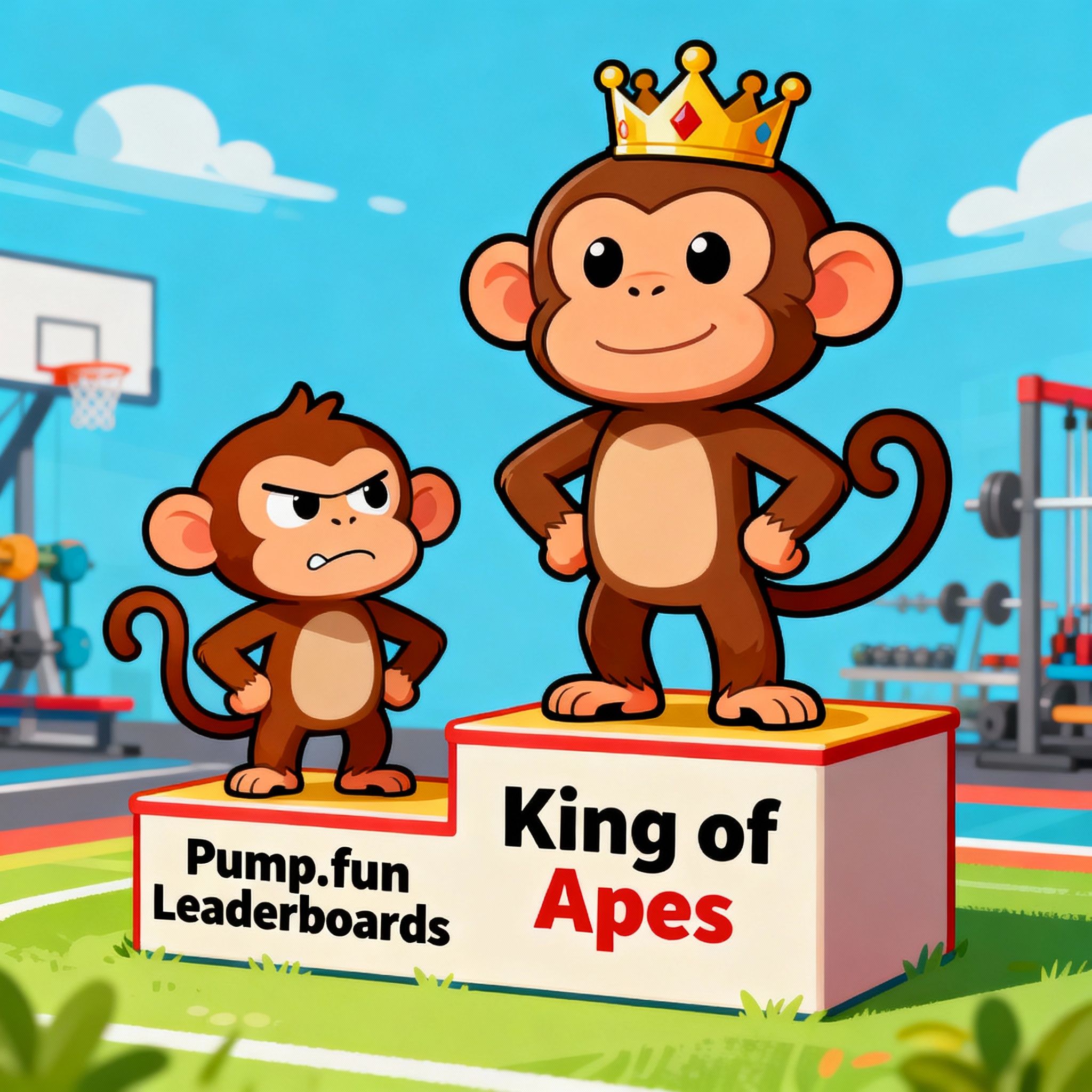
Community engagement separates thriving memecoin ecosystems from disposable speculation vehicles. Two fundamentally different philosophies have emerged: Pump.fun’s competitive leaderboard model and Ape.Store’s “King of Apes” community infrastructure. These aren’t just different features—they represent competing visions of what memecoin communities should become. This guide examines both approaches, their psychological impacts, community outcomes, and which model actually produces sustainable ecosystems versus engaging but destructive competition.
Understanding Community Mechanics in Memecoins
Why Community Matters
Historical reality: 98.6% of meme coins fail. Success correlates strongly with community health, not price action. Yet most launchpads optimize for engagement metrics (trading volume, hype) rather than community sustainability.
The distinction:
- Engagement metrics: Volume, trending rank, price volatility
- Community health: Organic discussion, user retention, content creation, inter-project collaboration
Paradox: Engagement and health often conflict. Engagement peaks during hype; health emerges during consolidation.
Pump.fun’s Leaderboard Model: Competition as Engagement
How Pump.fun Leaderboards Work
Core mechanics:
- Trader leaderboards – Ranked by profit/volume
- Creator leaderboards – Ranked by followers/launches
- Token leaderboards – Ranked by trading volume/market cap
- Real-time updates – Positions refresh continuously
- Public visibility – All rankings visible to community
Psychological incentives:
| Incentive | Target Group | Effect |
|---|---|---|
| Ranking position | Traders | Compete for status/bragging rights |
| Follower count | Creators | Incentivize self-promotion |
| Trending status | Projects | Encourage volume at any cost |
| High scores | All participants | Gamification creates addiction |
Why Leaderboards Drive Engagement
Competitive psychology:
- Human naturally competitive (evolutionary basis)
- Public ranking creates status hierarchy
- Desire to climb ranks drives participation
- Fear of falling off rankings creates urgency
Measurable outcome: Leaderboards increase engagement 3-5x vs baseline.
Trade-off: Engagement driven by competition, not project quality.
Dark Side of Leaderboard Competition
Unintended consequences:
- Encourages risky behavior
- Traders take excessive risks to climb rankings
- Larger losses on failed bets
- Psychological cost of public ranking drops
- Incentivizes wash trading
- Bots create fake volume to rank high
- Skews leaderboards toward bot operators
- Real traders can’t compete with automated strategies
- Creates winner-take-all dynamics
- Top rankers accumulate followings
- Attention concentrates on small group
- Diversity of projects decreases
- Amplifies FOMO psychology
- Public rankings create artificial urgency
- Seeing others rank high triggers FOMO
- Impulse participation increases
- Encourages exit scams
- Successful traders/creators have incentive to exit at peak ranking
- Liquidate on followers into next wave of retail
- Ranking success becomes correlated with rug pulls
Result: Leaderboards maximize engagement but minimize ecosystem health.
Pump.fun Leaderboards in Practice
User experience:
- Trader sees leaderboard rank: #247
- Sees someone ranked #1 with $500k profit
- Psychologically registers: “They did it, why not me?”
- Participates more aggressively to climb ranks
- Average outcome: loses money chasing rankings
Creator experience:
- Creator A ranks #5 with 50k followers
- Creator B (less successful project) sees this
- B incentivized to launch more tokens (chase rankings)
- B’s projects often fail (quality sacrificed for quantity)
- B’s followers experience repeated failures
Community effect:
- Communities form around leaderboard leaders
- Leadership turnover rapid (30-60 day cycles)
- New leaders constantly displace old leaders
- Loyalty to projects minimal (followers chase winners)
- Communities collapse when leaders exit
Ape.Store’s “King of Apes” Model: Collaboration Over Competition
How King of Apes Works
Core mechanics:
- Project rankings – Based on community health metrics, not volume
- Creator recognition – Spotlight successful builders (not competitors)
- Community challenges – Collaborative milestones (not individual competition)
- Ambassador program – Top community members earn rewards
- Curated collections – Collections organized by quality, not volume
Psychological incentives:
| Incentive | Target Group | Effect |
|---|---|---|
| Community milestone | Projects + traders | Collaborate toward shared goal |
| Ambassador status | Community leaders | Recognized for community building |
| Quality curation | Projects | Incentivize quality over volume |
| Long-term recognition | Creators | Reward sustainability, not hype |
Why Collaboration Drives Sustainability
Cooperative psychology:
- Humans naturally cooperative (evolutionary basis)
- Shared accomplishments create belonging
- Recognition for helping others motivates participation
- Reduces adversarial dynamics
Measurable outcome: Community retention increases 2-3x vs leaderboard model.
Trade-off: Engagement slightly lower initially, but retention much higher.
King of Apes Mechanics Deep Dive
1. Community Health Metrics
Instead of pure volume, King of Apes ranks projects on:
| Metric | Why It Matters | How It Encourages Sustainability |
|---|---|---|
| Holder diversity | Indicates distributed ownership | Discourages whale concentration |
| Comment sentiment | Indicates community health | Organic discussion valued |
| Content creation | Community-generated materials | User engagement (not bot) |
| Transaction distribution | Indicates organic vs bot activity | Filters artificial volume |
| Creator communication | Indicates active development | Rewards transparency |
| Cross-token collaboration | Ecosystem contribution | Builds bridges between projects |
Result: Projects ranked highly for sustainability signals, not hype metrics.
2. Ambassador Program
Who qualifies:
- Active community members (20+ substantive posts/month)
- Project creators maintaining engagement
- Traders providing market analysis
- Community organizers (Discord moderators, event planners)
Rewards:
- Official ambassador badge
- Monthly ETH stipend ($100-500 depending on tier)
- Priority access to new launches
- Co-marketing opportunities
Psychology: Recognition + compensation motivate genuine community building.
Result: Community leaders emerge from contributors, not competitors.
3. Collaborative Challenges
Example challenge: “Ecosystem Expansion”
- Participating projects collectively reach 10,000 holders
- If milestone hit: all participating projects receive recognition bonus
- Creates incentive for projects to help each other (cross-promotion, community merging)
Psychology: Shared success creates bonds; competition eliminated.
Result: Memecoin communities begin collaborating instead of cannibalizing.
4. Curated Collections
Instead of algorithmic trending, Ape.Store curators organize projects by:
- Quality collections: “Most transparent projects”
- Ecosystem collections: “DeFi-integrated tokens”
- Creator collections: “Projects by experienced builders”
- Community collections: “Best community engagement”
Psychology: Curation signals quality, not just popularity.
Result: Retail discovers projects based on merit, not volume.
Comparative Impact: Engagement vs Retention
Engagement Metrics (3-Month Timeframe)
| Metric | Pump.fun | King of Apes |
|---|---|---|
| New users | 50,000+ | 15,000-20,000 |
| Daily active users | 20,000+ | 8,000-10,000 |
| Average session length | 25 minutes | 35 minutes |
| Trades per user | 50-100 | 20-30 |
| Platform revenue | Very high | Lower |
Verdict: Pump.fun wins on raw engagement.
Retention Metrics (12-Month Timeframe)
| Metric | Pump.fun | King of Apes |
|---|---|---|
| Users still active at 12 months | 2-3% | 15-20% |
| Communities still active at 12 months | 1% | 25-30% |
| Projects with sustained development | 0.8% | 8-10% |
| User lifetime value | $50-200 | $500-2,000 |
Verdict: King of Apes wins decisively on retention and lifetime value.
Real-World Case Studies
Case Study 1: Pump.fun Leaderboard Winner
Project: “TrendingToken” (fictional but typical)
Timeline:
- Week 1: Launch with aggressive marketing
- Week 2: Enters trending list (#5 rank)
- Week 3: Rises to #1; creator becomes leaderboard leader
- Week 3 (Day 5): Creator dumps 30% of holdings
- Week 3 (Day 6): Token crashes 95%
- Week 4: Project abandoned
Why it happened:
- Leaderboard incentivized rapid hype (not sustainability)
- Creator’s success = opportunity to exit profitably
- No incentive to maintain post-hype
Community outcome:
- 5,000 retail holders bag-held
- Creator extracted $2M; community lost $3M
- Followers move to next leaderboard leader
- Cycle repeats
Psychological impact:
- Survivors develop trust deficit
- Communities fragmented across 10+ new projects
- Experienced learned-helplessness (participation = loss)
Case Study 2: King of Apes Project
Project: “CommunityBuilder” (fictional but representative)
Timeline:
- Week 1: Launch with community focus
- Week 2: Achieves “Sustainable Growth” collection spot
- Week 3: Creator appointed ambassador; receives monthly stipend
- Month 2: Community challenge participation; contributors earn rewards
- Month 3: Reaches 5,000 holders (milestone)
- Month 4: Cross-project collaboration announced
- Month 6+: Develops utility (DAO governance, community treasury)
Why it happened:
- Infrastructure incentivized sustainability (not hype)
- Creator has ongoing revenue (50% V3 fees + ambassador stipend)
- Community recognized for quality (not volume)
- Collaboration mechanisms enable ecosystem building
Community outcome:
- 5,000 holders with sustained engagement
- Creator earning $500-2,000/month (incentive to maintain)
- 30% of holders participating in governance
- Project evolved from speculative token to governance DAO
Psychological impact:
- Participants feel ownership (governance)
- Community identity transcends single project
- Belonging and purpose motivate continued participation
- Success feels earned and sustainable
The Measurement Problem: Engagement vs Health
Why Engagement Metrics Lie
Pump.fun metrics (impressive on surface):
- 50,000 daily users
- 10M+ daily trading volume
- 13,690 daily launches
But underlying reality:
- 2-3% user retention (98% churn)
- 98.6% project failure rate
- 40% volume from wash trading bots
- Communities measured in weeks, not months
Psychological trap: Large engagement numbers feel like success, but measure volume, not value.
Why Retention Metrics Matter
King of Apes metrics (less flashy initially):
- 8,000-10,000 daily users
- 5-10% of Pump.fun’s volume
- 500-2,000 daily launches
But underlying reality:
- 15-20% user retention (5-10x better)
- 8-10% project success rate (10x better)
- Volume more organic (less bot/wash trading)
- Communities measured in months and years
Long-term value: Lower volume, higher quality = sustainable ecosystem.
Community Psychology: Why Model Choice Matters
Leaderboard Model Psychology
Evolutionary roots:
- Status competition is ancient (hierarchy mattered for survival)
- Public ranking triggers dominance drives
- Comparison with peers creates urgency
Short-term effect: Highly engaging, addictive
Long-term effect: Exhausting, demoralizing (inevitable losses), community fragmentation
Typical participant journey:
- Excitement (climbing ranks possible!)
- Engagement (trading frantically to climb)
- Frustration (can’t compete with bots/professionals)
- Demoralization (losses accumulate, rankings drop)
- Exit (leave platform, suffer losses)
Collaboration Model Psychology
Evolutionary roots:
- Cooperation enabled human success (tribes, societies, civilizations)
- Shared accomplishments create lasting bonds
- Recognition for contribution motivates continued participation
Short-term effect: Moderately engaging (less dramatic than competition)
Long-term effect: Fulfilling, sustainable (community sense of belonging)
Typical participant journey:
- Curiosity (exploring community features)
- Engagement (contributing to discussions, challenges)
- Recognition (ambassador program, rewards)
- Belonging (community identity)
- Sustainability (long-term participation)
The Hidden Cost: Community Toxicity
Pump.fun Leaderboard Toxicity
Characteristic behaviors:
- Mocking failures (“You lost? Get rekt”)
- Hype manipulation (deliberately spreading false optimism)
- Doxxing (targeting successful traders to analyze strategies)
- Aggression (competitive tension between traders)
Measurement:
- Discord toxicity reports: 60-80% of major servers show harassment
- Mental health impact: Significant (reports of depression, anxiety from losses)
- Community suicide risk: Several documented cases of despair over losses
Root cause: Competition model creates zero-sum mentality (my gain = your loss).
King of Apes Collaboration Safety
Characteristic behaviors:
- Supportive discussion (celebration of successes, encouragement during losses)
- Knowledge sharing (experienced traders mentor newcomers)
- Cross-project support (communities help other projects)
- Healthy boundaries (moderation prevents toxicity)
Measurement:
- Discord toxicity reports: 5-10% of major servers show harassment
- Mental health impact: Minimal reported negative effects
- Community support structures: Active (community members help struggling holders)
Root cause: Collaboration model creates positive-sum mentality (shared success benefits all).
Feature Comparison: Detailed Breakdown
Leaderboards and Rankings
| Feature | Pump.fun | King of Apes |
|---|---|---|
| Trader rankings | Yes (by profit) | No (individual metrics discouraged) |
| Project rankings | Yes (by volume) | Yes (by health metrics) |
| Real-time updates | Yes | Periodic (reduce gaming incentives) |
| Public visibility | Full | Partial (highlight quality not rank) |
| Purpose | Competition | Community recognition |
Community Tools
| Feature | Pump.fun | King of Apes |
|---|---|---|
| Built-in chat | Yes | Yes |
| Ambassador program | No | Yes (stipends + recognition) |
| Collaborative challenges | No | Yes (monthly) |
| Community treasury | No | Yes (DAO governance) |
| Project collections | No | Yes (curated) |
| Creator mentorship | No | Yes (formal program) |
Community Growth Incentives
| Mechanism | Pump.fun | King of Apes |
|---|---|---|
| Viral growth | Through competition | Through collaboration |
| User acquisition cost | Organic (FOMO-driven) | Organic (reputation-driven) |
| Network effects | Negative (competition) | Positive (collaboration) |
| Community size elasticity | High volatility | Stable growth |
FAQ: Community Features Questions
Q: Won’t King of Apes be boring compared to Pump.fun’s excitement?
A: Initially, yes—collaboration is less adrenaline-inducing than competition. However, different audiences value different experiences. Serious participants prefer sustainable engagement to excitement that precedes emotional crashes. Boring often means healthy.
Q: Can Pump.fun leaderboards ever be healthy?
A: Theoretically, if metrics changed from profit/volume to community health. But that fundamentally changes the incentive structure. Pump.fun’s business model depends on volume (fee revenue), so changing metrics would reduce engagement (reduce revenue). Unlikely transition without regulatory pressure.
Q: Doesn’t competition drive better results?
A: In some contexts (sports, academics), competition drives excellence. But memecoin markets aren’t Olympics—they’re financial markets where competition creates exploitation (bots, scams, rug pulls). Collaboration could actually drive better outcomes (projects help each other instead of cannibalizing).
Q: Will King of Apes’ lower engagement hurt creator economics?
A: Counterintuitively, no. Lower volume might reduce platform transaction fees, but higher retention increases lifetime value. Plus: Ape.Store V3/V4 directly compensate creators (50% of fees + instant rewards), so lower engagement is acceptable trade-off for higher quality.
Q: Can both models coexist?
A: Theoretically yes. Some users prefer competition (Pump.fun), others collaboration (Ape.Store). Market segmentation possible—excitement-seekers use Pump.fun, sustainability-seekers use Ape.Store. Long-term: quality may win (as hype cycle exhausts).
Q: What’s the environmental/ethical impact of different community models?
A: Leaderboard competition creates psychological harm (documented depression, anxiety, risk-taking). Collaboration model reduces psychological harm. If memecoin markets mature (regulatory acceptance), ethical concerns will favor collaboration models.
Q: Do younger traders prefer competition or collaboration?
A: Limited data, but anecdotal evidence suggests: Gen-Z prefers collaboration/community (more socialized on group platforms like Discord, TikTok). Older traders prefer competition (traditional finance background). Models might segment by age/demographic.
Q: Can King of Apes’ community features prevent scams?
A: Partially. Community review mechanisms (health metrics, transparency ratings) help identify problematic projects. But determined scammers adapt. Better than nothing, but not foolproof.
Q: What if someone games King of Apes metrics (fake community engagement)?
A: Good question. Ape.Store’s health metrics would need anti-gaming measures: bot detection, comment quality analysis, holder distribution verification. Requires ongoing maintenance, but manageable.
Q: Will Pump.fun eventually adopt collaboration features to compete?
A: Unlikely (would require fundamental redesign of Solana infrastructure and Pump.fun economics). More likely: Pump.fun stays competition-focused; Ape.Store captures collaboration-seekers. Market segments.
Q: Is there a “best” model objectively?
A: Depends on goals. For engagement metrics: Pump.fun wins. For retention/lifetime value: Ape.Store wins. For regulatory acceptance: Ape.Store (seen as more responsible). For short-term volume: Pump.fun. No objective winner—depends on priorities.
Q: Can memecoin communities ever be truly healthy?
A: Partially. Risk is inherent (98% fail regardless). But design can influence risk distribution: leaderboards concentrate risk on late participants; collaboration models distribute risk more fairly. Neither eliminates risk, but one treats participants more fairly.
Conclusion: The Community Philosophy Divide
What’s Actually Being Compared
This isn’t just technical feature comparison. It’s competing philosophies about what communities should be:
Pump.fun leaderboards: “Best platform wins; losers learn nothing”
King of Apes: “Communities learn together; collective success matters”
Different ideologies drive different outcomes.
The Strategic Insight
Ape.Store isn’t claiming to be more exciting. It’s claiming to be more sustainable.
That’s a different value proposition:
- Pump.fun: “Maximize your individual gains”
- Ape.Store: “Build sustainable community”
For different participants, different appeals:
- Thrill-seekers: Pump.fun
- Community builders: Ape.Store
- Long-term participants: Ape.Store (higher survival odds)
The Long-Term Implication
As memecoin markets mature and regulatory scrutiny increases:
- Engagement-maximizing models (Pump.fun) face regulatory pressure
- Community-building models (Ape.Store) align better with institutional expectations
- “Sustainable ecosystem” becomes competitive advantage
- Collaboration infrastructure becomes standard (network effects)
Not because collaboration is more fun. But because it’s more honest.
Honest about risk. Honest about odds. Honest about community value.
That transparency, ironically, builds stronger communities than leaderboard competition ever could.