
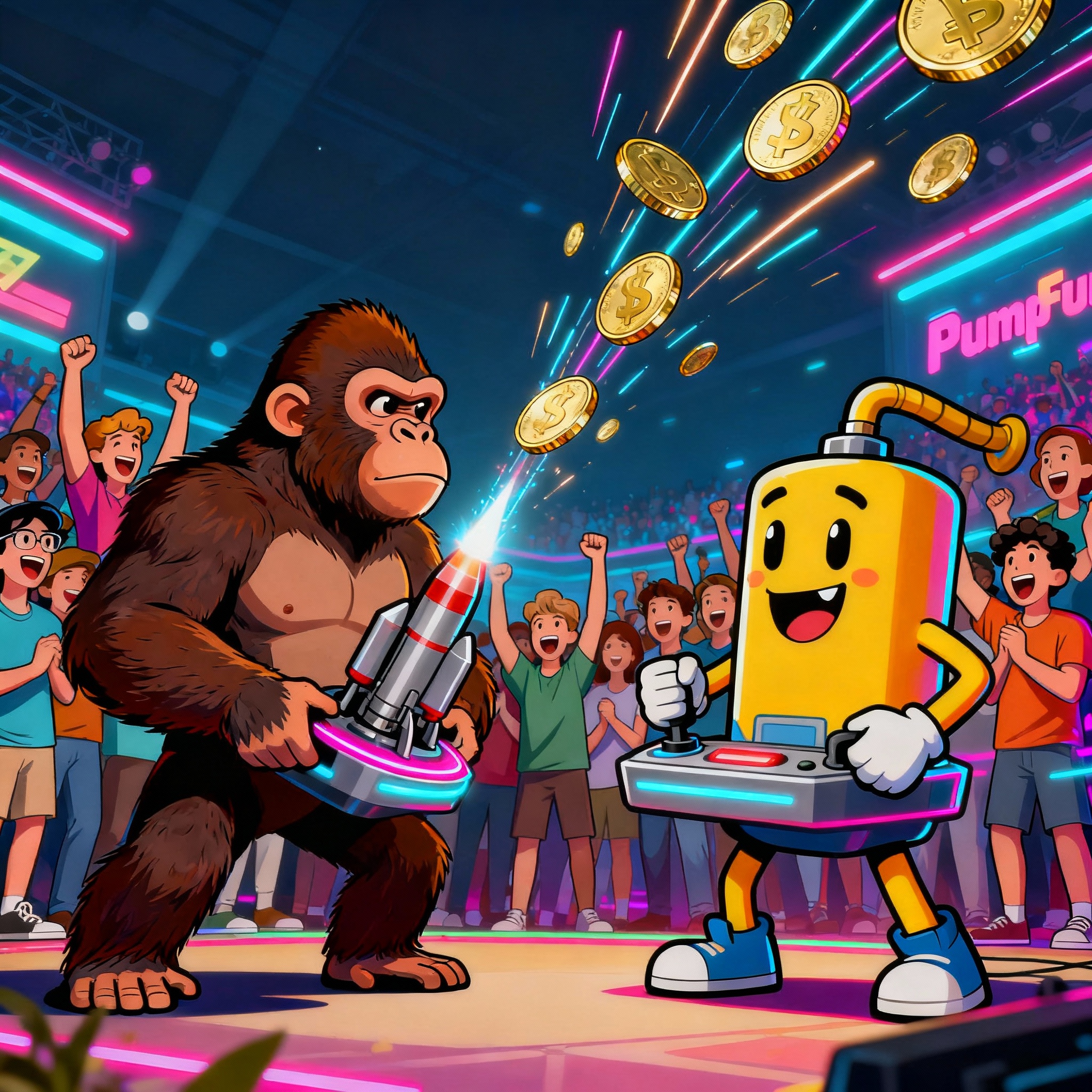
Pump.fun dominated the market quickly and aggressively. Most new projects launch there—primarily because everyone else does. But for serious creators who genuinely care about long-term value and security, Ape.Store represents an evolution in what launchpads can be in 2025.
Platform Overview: Beyond Marketing Numbers
Pump.fun – Success Through Scale, Not Quality
Yes, Pump.fun has 73.6% market share. But what does that actually mean?
- 13,690 daily launches = chaos where 98.6% of tokens die
- $800M+ revenue = they profited from scams and rug pulls they allowed on the platform
- 0.8% survival rate = practically a statistical error, not a success metric
Pump.fun chose a model: no curation, maximum volume, let chaos reign. It works for their revenue. But for a creator who wants real results? It’s a nightmare.
The problem with Pump.fun’s dominance is that dominance itself generates more chaos. More launches = more noise = harder to stand out. Your token lands in a stream alongside 13,690 others today.
Ape.Store – A Strategy for Rational Creators
Ape.Store takes a different approach: smaller scale, but better quality transactions.
No public numbers? That’s actually a signal: Ape.Store isn’t selling hype, they’re selling results.
Why Fewer Launches = More Success For Your Project
The Pump.fun Problem: Overcrowded Competition
Imagine:
- Pump.fun: 13,690 new tokens TODAY. You’re fighting for attention with thousands of others.
- Ape.Store: Unknown number (but genuinely smaller). Smaller crowd = better odds of visibility.
Simple math: If 100 traders are looking for new tokens:
- On Pump.fun: Each token divides attention among ~13,690 competitors
- On Ape.Store: Each token divides attention among perhaps 100-500 competitors
Result? On Ape.Store, your token has a chance to rise. On Pump.fun, you drown in noise.
Quality Traders > Quantity of Traders
Ape.Store on Base attracts a specific type of participant:
- Institutional and educated investors – Base is an Ethereum L2, attracting DeFi-conscious participants
- Fewer FOMO-driven speculators – No “click random tokens fast” experience like Pump.fun
- More serious creators – If you launch on Ape.Store, you immediately signal: “I’m thinking long-term”
Result: Smaller user base, but higher average quality of interested parties.
Base Blockchain: The Subtle Technical Advantage
Pump.fun on Solana has low costs. But it obscures a bigger problem:
Solana = Isolation From DeFi Mainstream
When your token lands on Raydium (after Pump.fun):
- No automatic bridges to Ethereum
- Doesn’t work with Aave, Curve, or other major Ethereum protocols
- A trader wanting to hedge their position in Ethereum stablecoins must bridge assets—complicated
Base = Part of the Ethereum Family
When your token appears on Uniswap v2 (from Ape.Store):
- Automatically compatible with entire Ethereum ecosystem
- Works with Aave, Curve, Yearn, all major protocols
- A trader can earn meaningful APY yields in DeFi strategies if your token has utility
- Bridges to Solana, Arbitrum, Optimism – your token is everywhere with one click
Simple truth: A token on Base is a token that can actually become an asset in broader DeFi. A token on Solana stays orphaned in Solana.
Liquidity Mechanics: Where Ape.Store Really Wins Points
Pump.fun: Burning LP Tokens (Good, But Not Enough)
Pump.fun burns LP tokens after migrating to Raydium.
Problem: Why do you need permanent liquidity on Raydium if nobody trades your token there? Raydium is a graveyard of dead launchpad tokens where nobody goes looking for new projects.
Liquidity that’s unavailable but also invisible to traders? That’s just theater.
Ape.Store: Liquidity Where People Actually Look
Uniswap v2 is a different beast:
- Primary destination for institutional traders seeking new assets
- Arbitrage algorithms automatically scan Uniswap v2 for opportunities
- Serious DeFi bots trade on Uniswap v2, not Raydium
Result: Your liquidity lands where there’s actual demand for new tokens, not in the graveyard of Pump.fun tokens on Raydium.
Credibility: Coinbase Backing vs. “Open Ecosystem”
Pump.fun: No Accountability
- Nobody’s looking over Pump.fun’s shoulder
- They allow practically anything
- If a scam or honeypot appears, Pump.fun says: “It’s blockchain, we don’t control anything”
This sounds like libertarian fantasy. It’s actually a nightmare for a creator wanting to be taken seriously.
Ape.Store: Coinbase Puts Its Name On This
Base is unapologetically:
- Backed by Coinbase – they can’t mess this up
- Subject to broader Ethereum regulations
- If something goes wrong with security, Coinbase has reason to care because it’s their brand
For a creator: This means that long-term: your liquidity is safe, the protocol will be maintained, the ecosystem will grow institutionally.
The Truth About Gas Costs: Less Important Than You Think
Pump.fun: $0.00025 gas.
Ape.Store: $0.02-0.10 gas.
“Wow, 400x difference!”
But wait:
- Your company spends $5,000 on marketing. Gas difference is $0.10.
- Bot traders spend more on gas in a minute than you spend in a year.
- Serious traders? They ignore $0.05 gas—they ignore even $5 gas.
Cheaper gas attracts bots and noise traders. Higher gas filters for serious people.
Want fast pumps and dumps? Pump.fun. Want traders who’ll hold your token for months? Ape.Store.
The Truth About Virality: Quality > Noise
Pump.fun has trending lists, social features, an all-in-one virality machine.
And you know what? Almost all of it is wash trading, bot-coordinated shilling, and fake volume.
Ape.Store? Less noise, but when something actually starts growing – it’s organic.
Organic growth is slower. But it lasts.
Fake growth on Pump.fun? Dies in 48 hours and everyone knows it was a pump.
L2 Ecosystem vs. Sidechain Trap
This is subtle, but important:
- Solana: Sidechain. If Solana ever crashes or has problems, your token is orphaned.
- Base: Layer 2 of Ethereum. If something goes wrong with Base, your assets can always be recovered on Ethereum mainnet.
Security? Base wins.
The Benchmark For Professionals: Where Does Someone Who Actually Knows What They’re Doing Look?
When you’re an ex-Coinbase engineer or institutional LP looking for new projects – where do you look?
- Not on Pump.fun – definitely too much noise and scams
- Yes on Uniswap v2 – where real projects actually appear
That’s Ape.Store. Pump.fun’s ease, but with a serious exit destination (Uniswap v2).
The Table: What Media Won’t Tell You
| Metric | Pump.fun | Ape.Store | Winner |
|---|---|---|---|
| Daily competition | 13,690 tokens | ~500-2,000 (estimate) | Ape.Store |
| Average trader quality | Retail FOMO | Ethereum DeFi natives | Ape.Store |
| Long-term liquidity | Raydium (graveyard) | Uniswap v2 (mainstream) | Ape.Store |
| Institutional backing | None | Coinbase | Ape.Store |
| Organic growth | Rare | More common | Ape.Store |
| DeFi integration | Isolated | Full access | Ape.Store |
| L2 security | N/A | Ethereum guaranteed | Ape.Store |
FAQ: Questions People Don’t Ask But Should
Q: If Ape.Store is so good, why does everyone use Pump.fun?
A: Because everyone always follows the crowd. Pump.fun has network effects through hype and volume alone. But hype ≠ success. Most launches there die. If you want real results (not just hype), Ape.Store has better fundamentals.
Q: But my token needs virality fast!
A: Do you want virality or do you want real traders? Pump.fun gives virality + 98% failure rate. Ape.Store gives less traffic but higher quality. One dies in 48 hours, the other lasts.
Q: What’s the catch?
A: There isn’t one. Ape.Store just doesn’t have the aggressive marketing Pump.fun does. Pump.fun is everywhere, so everyone thinks it’s the only option. But the fact that fewer people know about it means less noise when your project launches.
Q: Should I care about Coinbase backing?
A: If you want your token to exist in 5 years? Yes. If you want it to exist in 5 weeks? It’s irrelevant. But even for 5 weeks – institutional backing changes the caliber of trader you attract.
Conclusion: Ape.Store’s Advantage Isn’t Technical. It’s Strategic.
Ape.Store vs. Pump.fun isn’t Solana vs. Base. It’s not gas costs.
It’s this:
Pump.fun: Maximum volume, minimal curation, chaos as a feature
Ape.Store: Smaller volume, intentional filtering, ecosystem as a feature
Pump.fun won the mindshare war. But winning mindshare isn’t the same as winning results for creators.
In Pump.fun, your token competes with 13,690 others today. In Ape.Store, you compete with actual competitors – not noise.
In Pump.fun, when your token lands on Raydium, it’s dead. In Ape.Store, it’s on Uniswap v2, where real DeFi happens every day.
In Pump.fun, Coinbase ignores what happens there. In Ape.Store, Coinbase maintains security standards.
For a serious creator who wants real results?
Ape.Store isn’t the glamorous choice. But it’s the smart choice.
Pump.fun for hype. Ape.Store for results.
Choose your path.