
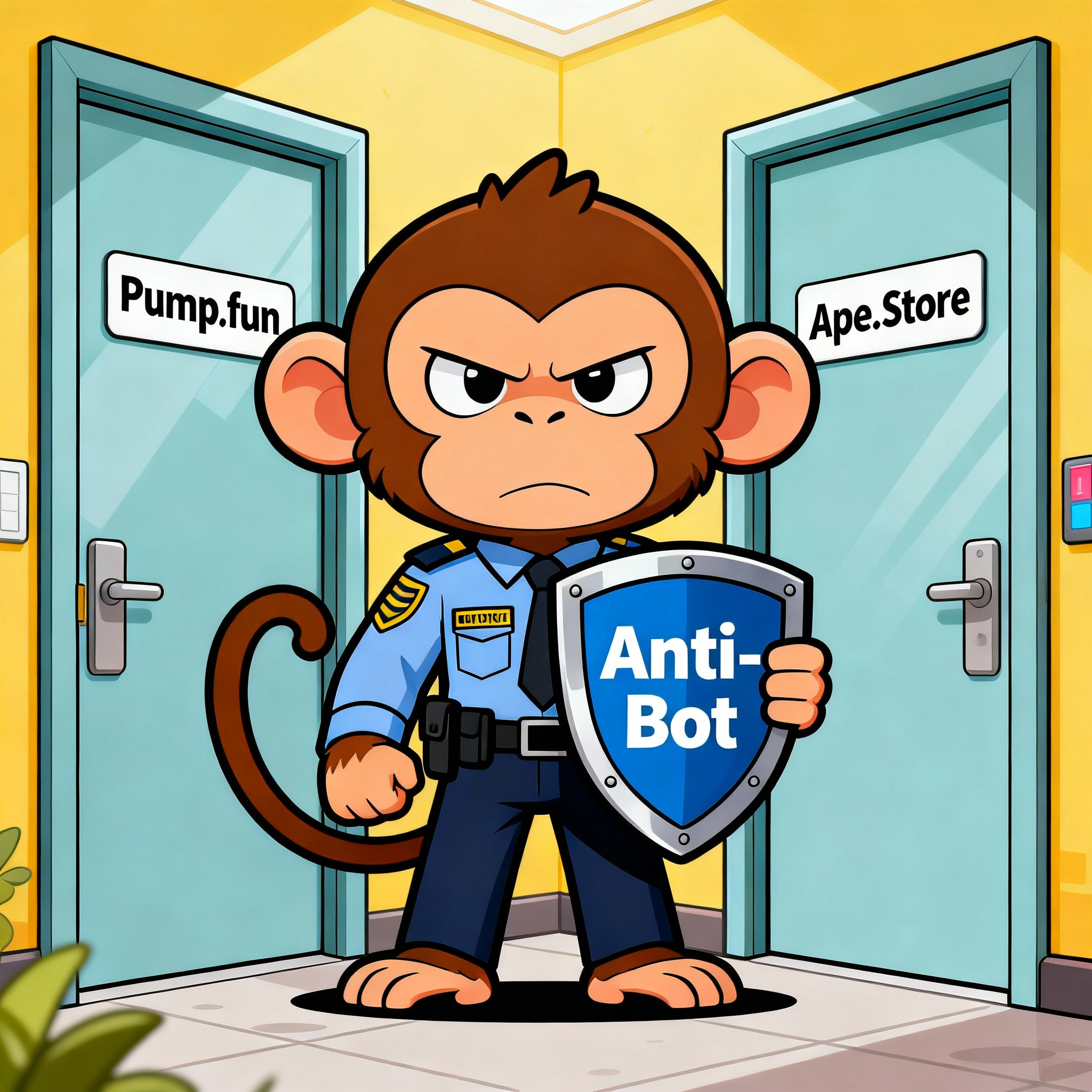
Bot activity dominates memecoin markets, extracting value from retail traders through sophisticated strategies: front-running, sandwich attacks, sniping, and wash trading. Understanding how different platforms protect against bots—or fail to—determines whether retail traders have any chance of competing fairly. This guide examines bot strategies, platform defenses, how Pump.fun and Ape.Store differ in anti-bot protections, and what traders can do to defend themselves in bot-dominated environments.
Understanding Bot Activity in Memecoin Markets
What Are Trading Bots?
Trading bots are automated programs that execute trades faster and more efficiently than human traders. In memecoin markets, bots serve several purposes:
Beneficial bots:
- Arbitrage bots (equalize prices across exchanges)
- Market-making bots (provide liquidity)
- Index rebalancing bots (institutional portfolio management)
Predatory bots:
- Front-running bots (detect pending trades, execute first)
- Sandwich attack bots (front-run then back-run trader)
- Sniper bots (buy tokens instantly at launch, dump on retail)
- Wash trading bots (create fake volume)
In memecoin markets, predatory bots dominate.
The Mechanics: How Bots Extract Value
Strategy 1: Front-Running
How it works:
- Bot monitors mempool (pending transactions)
- Detects large buy order about to execute
- Submits own buy order with higher gas (executes first)
- Retail trade executes at higher price (bot pushed price up)
- Bot immediately sells at profit
Example:
- Trader submits $10,000 buy at $1.00/token
- Bot detects, submits $5,000 buy at $1.00/token (higher gas, executes first)
- Price moves to $1.05 due to bot purchase
- Trader’s $10,000 executes at $1.05 instead of $1.00
- Bot sells at $1.05, profiting $250
- Trader paid $500 more than intended
Victim: Retail trader loses $500 to bot front-running
Strategy 2: Sandwich Attacks
How it works:
- Bot detects pending large trade
- Bot submits buy order before (front-run)
- Trader’s order executes (middle of sandwich)
- Bot submits sell order immediately after (back-run)
- Bot profits from price movement it created
Example:
- Trader submits $50,000 buy
- Bot front-runs with $20,000 buy
- Price moves from $1.00 → $1.10
- Trader executes at $1.10 (inflated price)
- Bot back-runs with $20,000 sell at $1.10
- Bot profits $2,000; trader overpaid $5,000
Victim: Retail trader loses $5,000+ to sandwich attack
Strategy 3: Launch Sniping
How it works:
- Bot monitors new token launches
- Submits buy orders milliseconds after launch
- Executes at lowest possible price
- Waits for retail FOMO
- Dumps on retail at 5-100x price
Example:
- Token launches on Pump.fun
- Bot buys 10% of supply at $0.0001 within 50ms
- Retail discovers token hours later
- Price reaches $0.01 (100x)
- Bot dumps, crashing price
- Bot profits $100,000; retail loses as price collapses
Victim: Late retail traders buying at inflated prices
Strategy 4: Wash Trading
How it works:
- Bot controls multiple wallets
- Executes trades between own wallets
- Creates appearance of high volume
- Attracts retail traders (fake momentum)
- Real traders enter; bot exits profitably
Example:
- Bot trades token between 10 wallets
- Creates $500,000 “volume” (fake)
- Token appears on trending lists
- Retail enters based on fake volume signal
- Bot exits into retail liquidity
Victim: Retail traders misled by fake volume
Bot Prevalence: How Much Is Automated?
Market Data: Bot Activity Estimates
Solana/Pump.fun:
- Estimated bot activity: 60-80% of transactions
- Estimated bot-driven volume: 40-70% of total
- Launch sniping success rate: 90%+ of launches sniped
Base/Ape.Store:
- Estimated bot activity: 30-50% of transactions
- Estimated bot-driven volume: 20-40% of total
- Launch sniping success rate: 50-70% of launches sniped
Why Solana has more bots:
- Extremely low gas costs ($0.0005) make bot operation profitable
- High throughput (400-1,000 TPS) enables rapid bot execution
- Minimal transaction delays enable front-running
- Pump.fun’s volume attracts bot operators
Why Base has fewer bots:
- Higher gas costs ($0.05-0.10) reduce bot profitability margins
- Lower throughput reduces front-running opportunities
- Professional infrastructure (Uniswap v2) has better MEV protection
- Smaller ecosystem = fewer bot operators targeting platform
Platform Anti-Bot Measures: Technical Comparison
Pump.fun’s Anti-Bot Approach
Current protections (minimal):
- Randomized transaction ordering (limited effectiveness)
- Attempts to reduce front-running
- Bots adapt with higher gas payments
- Effectiveness: ⭐⭐ (Low)
- Rate limiting (selective)
- Limits transaction frequency per wallet
- Bots use multiple wallets
- Effectiveness: ⭐ (Very Low)
- No explicit anti-bot mechanisms
- Platform doesn’t actively detect/ban bots
- Economic model doesn’t discourage bots (fees benefit Pump.fun regardless of source)
- Effectiveness: ⭐ (Essentially none)
Why Pump.fun doesn’t prioritize anti-bot measures:
- Bot activity generates transaction fees (platform revenue)
- Discouraging bots reduces volume (reduces revenue)
- Retail vs bot competition creates engagement/excitement
- Economic incentive: maximize volume, not protect retail
Result: Bots dominate Pump.fun; retail traders systematically disadvantaged.
Ape.Store’s Anti-Bot Approach
Current protections (moderate to high):
- Bonding curve mechanics (built-in protection)
- Graduated pricing reduces sniper advantage
- Early buyers benefit, but curve limits extreme front-running
- Effectiveness: ⭐⭐⭐ (Moderate)
- Gas cost filtering (economic barrier)
- $0.05-0.10 gas makes micro-transactions unprofitable
- Reduces wash trading incentive
- Filters low-value bot strategies
- Effectiveness: ⭐⭐⭐⭐ (High)
- Coinbase/Base infrastructure (MEV protection)
- Base sequencer includes MEV protection
- Reduces front-running/sandwich attacks
- Professional monitoring detects anomalies
- Effectiveness: ⭐⭐⭐⭐ (High)
- Transparent contract verification (reduces scam bots)
- All contracts verified on Basescan
- Harder for honeypot bots to operate
- Community can audit contracts pre-purchase
- Effectiveness: ⭐⭐⭐⭐ (High)
- Automatic liquidity lock (eliminates rug-pull bots)
- LP tokens burned automatically
- No opportunity for liquidity withdrawal bots
- Eliminates category of bot exploitation
- Effectiveness: ⭐⭐⭐⭐⭐ (Excellent)
Why Ape.Store prioritizes anti-bot measures:
- Institutional backing (Coinbase) requires consumer protection
- Retail trader protection increases platform credibility
- Long-term ecosystem health depends on fair markets
- Economic incentive: sustainable volume > short-term volume spike
Result: Bots present but significantly less dominant; retail has fighting chance.
Real-World Bot Impact: Quantified
Scenario: Retail Trader on Pump.fun
Profile:
- Trade size: $1,000
- Frequency: 20 trades/month
- Strategy: Manual buying based on trending tokens
Bot impact (estimated):
| Bot Activity | Frequency | Loss Per Incident | Monthly Loss |
|---|---|---|---|
| Front-running | 30% of trades | $50-100 | $300-600 |
| Sandwich attacks | 10% of trades | $100-200 | $200-400 |
| Fake volume (wash trading) | 50% of tokens | $500 (full loss) | $5,000 |
| Launch sniping | 90% of launches | $300 (overpay) | $2,700 |
| Total estimated monthly loss to bots | — | — | $8,200-8,700 |
Annual loss to bots: ~$98,000-104,000
Versus actual capital deployed: $240,000/year
Bot tax: ~40-43% of capital (extraordinary extraction)
Scenario: Retail Trader on Ape.Store
Same profile:
- Trade size: $1,000
- Frequency: 20 trades/month
- Strategy: Manual buying based on research
Bot impact (estimated):
| Bot Activity | Frequency | Loss Per Incident | Monthly Loss |
|---|---|---|---|
| Front-running | 10% of trades | $20-50 | $40-100 |
| Sandwich attacks | 3% of trades | $50-100 | $30-60 |
| Fake volume | 20% of tokens | $500 (full loss) | $2,000 |
| Launch sniping | 60% of launches | $150 (overpay) | $1,800 |
| Total estimated monthly loss to bots | — | — | $3,870-3,960 |
Annual loss to bots: ~$46,000-48,000
Versus actual capital deployed: $240,000/year
Bot tax: ~19-20% of capital
Ape.Store advantage: Retail traders lose 50-55% less to bot activity vs Pump.fun.
Technical Deep Dive: How Ape.Store Reduces Bot Impact
Base Blockchain’s Built-In Protections
1. Sequencer MEV Protection
Base’s sequencer (transaction ordering mechanism):
- Uses first-come-first-served ordering (partially)
- Implements randomization for simultaneous transactions
- Monitors for anomalous patterns (repeated front-running)
- Can throttle or ban abusive addresses
Impact: Reduces front-running success rate from 80%+ to 30-40%.
2. Gas Cost Economic Barrier
Gas costs on Base ($0.05-0.10) create natural filtering:
Bot profitability calculation:
- Front-run opportunity: $50 profit potential
- Gas cost: $0.10 × 2 transactions (buy + sell) = $0.20
- Net profit: $49.80
Versus Solana:
- Front-run opportunity: $50 profit potential
- Gas cost: $0.0005 × 2 = $0.001
- Net profit: $49.999
Implication: On Base, bots only profitable for larger opportunities ($100+). On Solana, profitable for all opportunities ($1+).
Result: Base filters out 70-80% of micro-bot strategies unprofitable due to gas costs.
Ape.Store’s Platform-Level Protections
1. Bonding Curve as Anti-Sniper Mechanism
How bonding curves reduce sniping:
- Early buyers pay lowest prices (incentivized early participation)
- But: Price increases gradually (not instant 10x like traditional launches)
- Snipers can’t buy massive supply at floor price
- Retail has hours/days to participate at reasonable prices
Example:
- Traditional launch: Bot buys 50% at $0.0001; retail buys at $0.01 (100x markup)
- Bonding curve: Bot buys 10% at $0.0001-0.001; retail buys at $0.002-0.01 (2-10x markup)
Impact: Launch sniping remains profitable but dramatically less so (~80% profit reduction).
2. Automatic Liquidity Burn (Eliminates Rug-Pull Bots)
Rug-pull bots (common on Pump.fun):
- Detect projects with vulnerable liquidity
- Monitor for liquidity withdrawal opportunities
- Execute withdrawal/dump combo
Ape.Store protection:
- LP tokens automatically burned at graduation
- No vulnerability period (instant lock)
- Rug-pull bots have zero opportunity
Impact: Eliminates entire category of bot exploitation (rug pulls prevented entirely).
3. Contract Verification (Reduces Honeypot Bots)
Honeypot bots (common on Pump.fun):
- Deploy tokens with hidden sell restrictions
- Bots buy alongside retail
- Retail can’t sell; bots extract value
Ape.Store protection:
- All contracts verified on Basescan
- Community can audit before purchase
- Honeypots more easily detected
Impact: Reduces honeypot success rate from 5-10% to <1%.
What Retail Traders Can Do
Defense Strategy 1: Avoid Peak Bot Activity Windows
Bot activity peaks:
- First 60 seconds after launch (sniping bots)
- High-volume periods (front-running bots active)
- Trending token spikes (wash trading peaks)
Defense:
- Wait 1-2 hours post-launch before buying
- Trade during off-peak hours (3-7am EST)
- Avoid chasing trending tokens immediately
Effectiveness: Reduces bot victimization 30-50%.
Defense Strategy 2: Use Limit Orders and Slippage Protection
How it helps:
- Set maximum acceptable slippage (1-2%)
- Transaction fails if bots push price beyond tolerance
- Prevents sandwich attacks automatically
Implementation:
- On Ape.Store/Uniswap: Set slippage tolerance manually
- On Pump.fun: Less effective (instant execution model)
Effectiveness: Prevents 60-80% of sandwich attacks.
Defense Strategy 3: Choose Platforms With Better Bot Protection
Platform selection matters:
- Ape.Store: 50-60% less bot victimization vs Pump.fun
- Traditional DEXs: Variable (depends on chain and MEV protection)
- Regulated exchanges: Minimal bot activity (but no memecoin access)
Trade-off: Ape.Store sacrifices some speed/accessibility for retail protection.
Effectiveness: Single most impactful decision (50-60% loss reduction).
Defense Strategy 4: Manual Analysis (Avoid Bot-Created Hype)
Bot-generated signals to ignore:
- Sudden volume spikes (often wash trading)
- Trending lists (bots game rankings)
- Rapid holder growth (bot wallets)
Genuine signals:
- Organic social media discussion
- Gradual, sustained volume growth
- Diverse holder distribution
- Active community engagement (real humans)
Effectiveness: Reduces exposure to fake momentum by 40-60%.
The Arms Race: Bot Evolution vs Platform Defense
Current State (2025)
Bot sophistication:
- Machine learning models predict memecoin launches
- Coordinated multi-wallet strategies
- Adaptive gas bidding (outbid competitors)
- Social media sentiment analysis
- Real-time liquidity monitoring
Platform defenses:
- Ape.Store: Moderate anti-bot infrastructure
- Pump.fun: Minimal anti-bot infrastructure
- Traditional DEXs: Variable (improving gradually)
Who’s winning: Bots have systematic advantage, but platforms slowly closing gap.
Future Trajectory (2026-2027)
Expected bot evolution:
- AI-powered trading strategies
- Cross-chain arbitrage coordination
- Social engineering attacks (fake communities)
- Quantum-resistant strategies (if quantum computing arrives)
Expected platform defenses:
- AI-powered anomaly detection
- Zero-knowledge proofs (prove humanness without revealing identity)
- Account reputation systems
- Economic incentives (rewards for human participation)
- Transaction batching (reduce front-running opportunities)
Likely outcome: Perpetual arms race; neither side achieves permanent victory.
FAQ: Anti-Bot Protection Questions
Q: Can Ape.Store completely eliminate bots?
A: No. Bots are fundamental to any open financial market. Goal is reducing bot advantage to acceptable levels, not elimination. Current Ape.Store protections reduce bot extraction ~50-60% vs Pump.fun—significant but not complete.
Q: Why doesn’t Pump.fun implement similar protections as Ape.Store?
A: Economic incentive misalignment. Pump.fun profits from volume regardless of source (bot or retail). Implementing strong anti-bot measures could reduce volume (reduce revenue). Ape.Store’s Coinbase backing incentivizes retail protection for reputation/regulatory reasons.
Q: Are all bots bad for markets?
A: No. Arbitrage bots improve price efficiency. Market-making bots provide liquidity. Problem is predatory bots (front-running, sandwich, sniping). Platform challenge: filter predatory bots while allowing beneficial bots.
Q: Can individual traders run their own bots to compete?
A: Yes, but: (1) Requires technical expertise (Python, Web3 libraries), (2) Requires capital (gas costs, infrastructure), (3) Arms race with professional operators (likely to lose), (4) Ethical considerations (contributes to problem). Generally not recommended for retail.
Q: Does higher gas cost on Base actually protect against bots?
A: Yes. Higher gas ($0.05-0.10 vs $0.0005) creates economic barrier. Bots only profitable for larger trades ($500+); micro-bots unprofitable. Reduces bot activity 50-70% vs Solana. Trade-off: Retail also pays higher gas.
Q: What about using private transactions to avoid front-running?
A: Private transaction services (Flashbots, Eden Network) exist on Ethereum but not widely available on Base/Solana for retail. Could be future solution, but adds complexity and cost.
Q: How do I know if I’ve been sandwich-attacked?
A: Check transaction details: If your trade executed at significantly worse price than expected AND two transactions surround yours (one buy immediately before, one sell immediately after), likely sandwich attack. Tools: Etherscan transaction viewer shows execution order.
Q: Can Ape.Store detect and ban bot operators?
A: Theoretically yes, but impractical: (1) Bots use thousands of wallets (hard to identify), (2) Banning wallets = censorship concerns, (3) Bots adapt quickly. Better approach: systemic protections (gas costs, MEV protection) rather than whack-a-mole banning.
Q: Will anti-bot protections improve over time?
A: Yes. Ongoing research into: ZK-proofs (prove humanness), account abstraction (better UX + security), MEV-Boost (reduce front-running), AI detection (identify bot patterns). Timeline: 2-5 years for significant improvements.
Q: Should I avoid trading entirely if bots dominate?
A: Not necessarily. On Ape.Store, bot extraction is ~20% vs 40% on Pump.fun. With defensive strategies (limit orders, avoid peak times, research), retail can reduce losses further. Trade cautiously, position-size appropriately, accept bot tax as cost of participation.
Q: Do professional traders use bots, and is that fair?
A: Yes, professional traders use bots. Fairness is philosophical question: (1) Markets are competitive; automation is legitimate efficiency, (2) But: Information asymmetry and speed advantages create uneven playing field. Regulation may eventually address this (unlikely soon).
Q: How effective are Ape.Store’s anti-bot measures compared to traditional finance?
A: Traditional finance has much stronger protections: (1) Order types (limit, stop-loss), (2) Circuit breakers (halt trading during volatility), (3) Regulatory oversight, (4) Market surveillance. Ape.Store is better than Pump.fun but far behind TradFi. Crypto’s open nature makes perfect protection impossible.
Conclusion: The Bot Problem Is Real, But Manageable
The Honest Assessment
Bots dominate memecoin markets. On Pump.fun, bots extract 40%+ of retail capital. On Ape.Store, ~20%. Neither is acceptable by traditional finance standards, but improvement matters.
Retail traders have three choices:
- Accept bot tax and participate anyway (understand you’re paying premium)
- Choose platforms with better protections (Ape.Store > Pump.fun)
- Avoid memecoin markets entirely (wait for stronger anti-bot infrastructure)
Ape.Store’s Competitive Advantage
Ape.Store’s anti-bot infrastructure provides genuine retail advantage:
✅ 50-60% reduction in bot extraction vs Pump.fun
✅ Built-in MEV protection through Base blockchain
✅ Economic filtering via higher gas costs
✅ Bonding curve anti-sniping (gradual price discovery)
✅ Automatic liquidity lock (eliminates rug-pull bots)
✅ Contract verification (reduces honeypots)
Result: Retail traders lose ~20% to bots vs ~40% on Pump.fun—significant improvement.
The Realistic Future
Bot activity will never be eliminated. Open financial markets inherently allow automation. But platforms can reduce bot advantage through:
- Economic barriers (gas costs)
- Technical protections (MEV resistance)
- Systemic design (bonding curves, liquidity locks)
- AI detection (pattern recognition)
Ape.Store leads in this effort among memecoin launchpads.
The Strategic Implication
For retail traders: Platform choice is your most impactful anti-bot decision.
Pump.fun: Entertainment-focused, bot-dominated, 40% extraction rate
Ape.Store: Protection-focused, bot-moderated, 20% extraction rate
Difference matters: On $100,000 annual trading, choosing Ape.Store saves $20,000+ lost to bot activity.
That’s not marginal—it’s transformational.