
Table of Contents
- Introduction: How Internet Memes Became Billion-Dollar Phenomena
- The Doge Phenomenon: The Template for All Meme Coins
- Celebrity Endorsements and Market-Moving Moments
- BONK as Community Revival: Solana’s Cultural Comeback
- From Trading to Tipping: Memecoin Integration Into Daily Life
- The King of Apes Era: Platform-Level Community Recognition
- How Pop Culture Moments Drive Adoption vs Sustainability
- Rug Pulls and Scams: The Dark Side of Pop Culture Virality
- The Evolution: From Speculation to Cultural Institution
- Frequently Asked Questions (FAQ)
- Conclusion: The Mainstreaming of Meme Coins
Introduction: How Internet Memes Became Billion-Dollar Phenomena
Somewhere between 2013 and 2025, the cryptocurrency industry fundamentally transformed. Not through technology breakthroughs or financial innovation. But through internet jokes becoming trillion-dollar asset classes.
A Shiba Inu dog meme became a $20 billion cryptocurrency. A cartoon dog hitting things became a $3 billion ecosystem revival. A frog became a political statement and $2 billion valuation. These aren’t market anomalies. They’re evidence of a complete inversion in how value forms in modern economies.
Traditional markets measure value through cash flows, discounted profits, and fundamentals. Memecoin markets measure value through cultural resonance, viral moments, and internet adoption. The second measurement system is winning.
By 2025, memecoin pop culture moments weren’t niche internet events anymore. They were mainstream media coverage. Presidential elections referenced memecoins. Sports leagues accepted them as payment. Billionaires publicly endorsed them. The cultural legitimacy of memecoins had shifted from “joke” to “genuine phenomenon requiring explanation.”
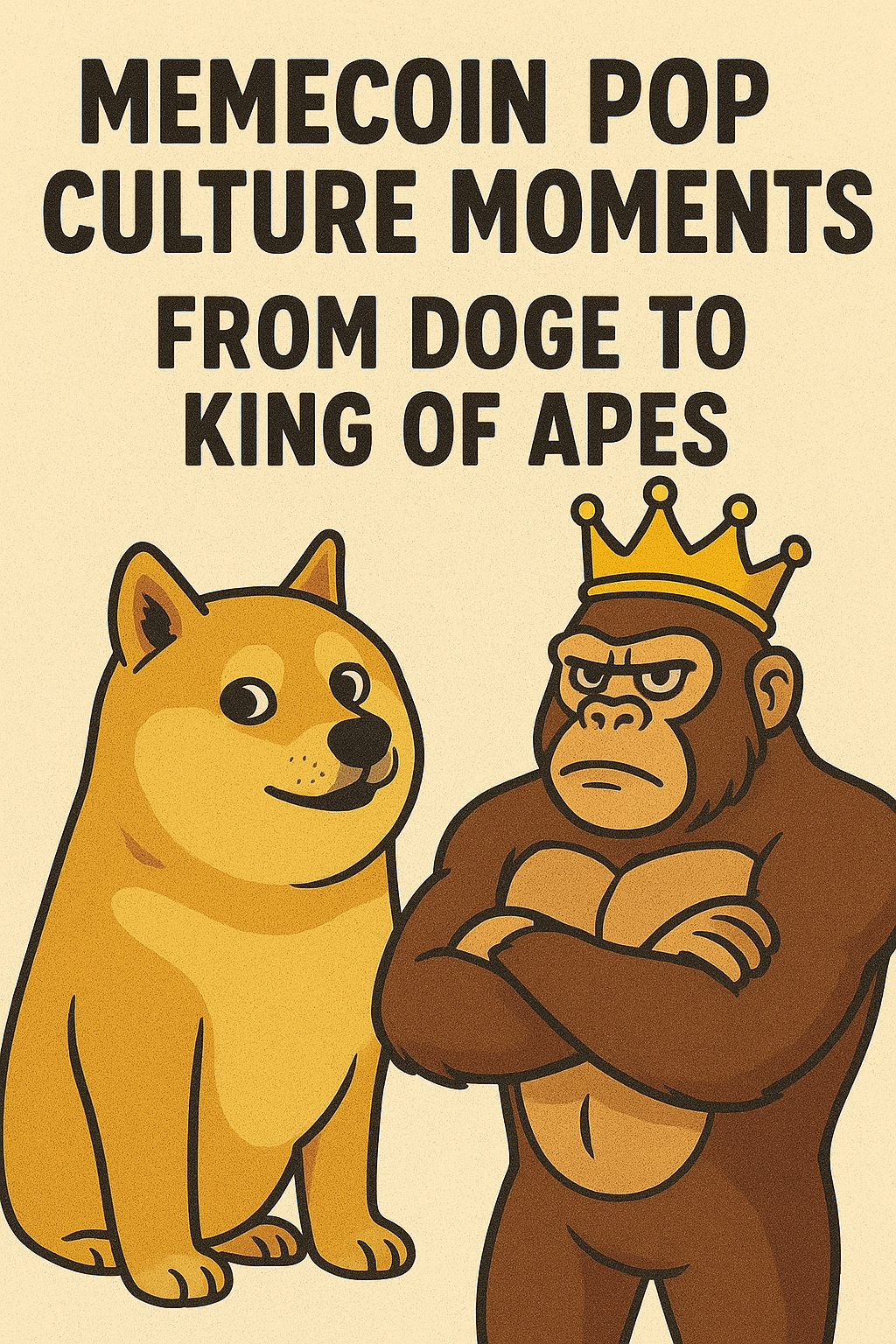
This guide examines the trajectory of memecoin pop culture moments: what creates them, how they drive adoption, why some sustain while others collapse, and what the King of Apes era represents as the evolution from pure speculation to platform-level community infrastructure.
The Doge Phenomenon: The Template for All Meme Coins
The Origin Story (2010-2013)
The Doge meme originated from a 2010 Tumblr post featuring Kabosu, a Shiba Inu dog. The accompanying broken English (“much wow,” “so amaze,” “very concern”) became iconic. By 2013, the Doge meme had achieved ubiquity across internet culture—recognized by virtually anyone online.
In December 2013, developer Jackson Palmer created Dogecoin as a joke. A fork of Litecoin with a dog picture. No serious purpose. Intentionally humorous.
The joke was the point.
The Virality Explosion (2013-2014)
What happened next surprised everyone. Dogecoin didn’t stay a joke. It became the most accessible cryptocurrency for mainstream participants.
Why Dogecoin succeeded where Bitcoin failed (for mainstream adoption):
| Dimension | Bitcoin | Dogecoin |
|---|---|---|
| Mental model | “Digital gold” (abstract) | “Dog money” (relatable) |
| Barrier to understanding | Cryptographic hash functions | “Much wow” (joke) |
| Cultural context | Revolutionary tech | Internet meme |
| Accessibility | $50,000+ per coin (intimidating) | $0.0001 per coin (accessible) |
| Community feeling | Serious investors | Fun community |
By 2014, Dogecoin had achieved mainstream awareness. Reddit communities used it for tipping. Charities accepted it for donations. The NASCAR driver Josh Wise sponsored his race with Doge funding from the community. The cultural penetration was stunning.
The Pop Culture Moment Peak (2021)
Dogecoin remained a sideshow until 2021, when Elon Musk began publicly endorsing it. His tweets moved DOGE prices 50-500% in minutes.
The cultural explosion:
- January 2021: Doge reaches $0.01 (first time above a penny)
- May 2021: Elon Musk appears on SNL, says “I’m actually the Dogefather”
- May 2021: Doge reaches $0.73 (2,400x from 2020 lows)
- November 2024: DOGE surges 200%+ following election news (D.O.G.E department announcement)
The SlumDOGE Millionaire Story:
One user, Glauber Contessoto, invested $250,000 (his life savings plus maxed credit cards) in DOGE at $0.008. By May 2021, his holdings were worth $3 million. He became a YouTube personality (“SlumDOGE Millionaire”). When price crashed from $0.73 to $0.06, he lost everything publicly. Yet he remained convinced and kept holding.
By November 2024, with DOGE surging again, his holdings recovered to $2 million+. His story became emblematic of memecoin psychology: irrational conviction rewarded by market timing.
The Lasting Impact
Dogecoin’s pop culture moment wasn’t a temporary phenomenon. It created permanent cultural artifacts:
- “Much wow” entered mainstream vocabulary
- Doge meme remains ubiquitous (recognizable to Gen-Z and millennials)
- Elon Musk associated with Dogecoin permanently (even became Department of Government Efficiency: “D.O.G.E”)
- Dogecoin became synonym for “memecoin” in mainstream media
Crucial insight: Dogecoin proved that cultural belonging could drive trillion-dollar market valuations. Not technology. Not fundamentals. Just: “I understand this meme, so I’m in.”
Celebrity Endorsements and Market-Moving Moments
The Elon Musk Effect
Research from the International Journal of Current Research and Review found that Elon Musk is the single most impactful individual on memecoin pricing. His tweets have triggered:
- 100% price increases (single tweet)
- 900% price increases (sustained campaign of engagement)
- Market cap changes of billions (within hours)
Examples:
- October 2020: Musk tweets single word “Doge” + rocket emoji = DOGE up 20%
- May 2021: Musk appears on SNL as “Dogefather” = DOGE surges to $0.73
- December 2024: Musk receives D.O.G.E. department appointment = DOGE up 200% in month
Why is Musk’s influence so outsized? Multiple factors:
- Authority signal: Billionaire validating something makes mainstream audience take it seriously
- Sustained engagement: Musk repeatedly returns to Dogecoin (not one-off mention)
- Narrative alignment: His anti-establishment positioning matches memecoin culture
- Reach: His tweets reach millions instantly
Other Celebrity Moments
Beyond Elon, other celebrities triggered pop culture moments:
Snoop Dogg (2021): Changed his Twitter profile picture to Dogecoin + announced rap album incorporating memes. Result: DOGE surge + cultural credibility increase.
Gene Simmons (2021): KISS bassist publicly endorsed DOGE. Result: Cultural legitimacy in older demographic.
Mark Cuban (2014): Dallas Mavericks started accepting Dogecoin for tickets and merchandise. 20,000 transactions in two days. Result: Dogecoin became accepted payment method (utility, not just speculation).
David Portnoy (2021): Barstool Sports founder actively traded memecoins on social media. Result: Sports audience awareness of crypto trading.
The Celebrity Paradox
Celebrity endorsements are double-edged:
Advantage:
- Brings mainstream awareness
- Signals legitimacy to mainstream audiences
- Triggers FOMO waves
Disadvantage:
- Creates price peaks followed by crashes (when celebrity moves on)
- When celebrity endorsement dies down, project momentum dies
- Retail followers often enter at peak, lose money, blame celebrity
Timing risk: Most participants following celebrity endorsements enter after the peak. They experience the crash, not the appreciation.
Research Findings on Celebrity Impact
Academic research confirms:
- 80% of memecoin social media chatter is influencer-driven (not organic community discussion)
- Celebrity endorsements create 3-10 day price surges (highly temporary)
- Without sustained celebrity engagement, memecoin communities struggle
- Tweets from high-profile figures correlate with 100-900% price spikes (wildly volatile)
Implication: Memecoins dependent on celebrity endorsements are inherently unstable. Price driven by celebrity attention, not fundamentals or community. When attention moves (inevitable), price crashes.
BONK as Community Revival: Solana’s Cultural Comeback
The Collapse That Preceded BONK
Before BONK’s emergence, Solana ecosystem suffered existential crisis. The FTX collapse (built on Solana ecosystem) devastated community confidence. The network experienced multiple outages and security issues. Solana went from “$100 billion ecosystem” to “dying chain” in community perception.
The community was demoralized. Developers leaving. Users departing. Culture seemed dead.
BONK’s Launch Strategy (December 2022)
BONK launched with radical distribution strategy:
50% of total supply (50 trillion tokens) airdropped to Solana community:
- NFT holders
- Developers
- Artists
- Active traders
The philosophy: “We’re reviving this community through shared ownership, not insider extraction.”
The Cultural Moment (2023-2025)
BONK’s marketing strategy was pure meme culture:
- Dog bonking other dogs (visual metaphor for “hitting back”)
- Solana had been “hit” repeatedly (FTX, outages) = “bonk” them back
- Humor-driven narrative: “Community rising together”
The result:
BONK grew from $0 to $3 billion+ market cap within 12 months. More importantly, the project became symbol of Solana community resilience.
Cultural penetration:
- Became most-held dog-themed token on Solana
- Integrated into sports partnerships (attracted new audiences)
- Built DAO governance (transitioned from speculation to community structure)
- Added real utility (tipping, staking, dApp integration)
BONK’s Pop Culture Success Formula
1. Perfect Timing:
Launched when community was demoralized. Offered hope narrative at moment of despair.
2. Authentic Community:
Created by Solana community members for Solana community (not external team).
3. Humor as Medicine:
Dog bonking metaphor provided cathartic humor during crisis.
4. Fair Distribution:
Massive airdrop created sense of shared ownership (not insider extraction).
5. Governance Integration:
DAO structure let community participate in decisions (transitioned from speculation to membership).
6. Sustainability Mechanism:
Added utility beyond joke (integration into dApps, tipping, staking).
Why BONK Sustained (vs Temporary Memes)
BONK didn’t fade like most memes because:
Strategic evolution: Added layers (governance, utility, integration) that gave long-term purpose.
Community alignment: Community interests aligned with project success (stakeholders in revival, not just traders).
Narrative sustainability: Story changed from “revive Solana” to “Solana ecosystem governance” (fresh narrative, same community).
Cultural institution: Became symbol of Solana identity (wearing BONK is cultural statement).
From Trading to Tipping: Memecoin Integration Into Daily Life
The Merchant Adoption Moment
Pop culture moments often translate into practical adoption. Dogecoin provides the clearest example:
Mark Cuban’s Dallas Mavericks Partnership (2014):
- Dallas Mavericks announced acceptance of Dogecoin for ticket and merchandise purchases
- Result: 20,000 transactions in two days
- Impact: Dogecoin became accepted payment method (not just speculation vehicle)
This transaction normalized Dogecoin. It was no longer “internet funny money.” It was accepted at NBA games.
Integration Into Community Tipping
Dogecoin enabled low-friction tipping:
- Reddit communities used DOGE for rewarding quality content
- Twitter users tipped each other (before official tipping features)
- Communities formed around Dogecoin tipping culture
Cultural impact: Dogecoin became verb (“tip someone doge” = reward community member).
Utility Expanding Use Cases
BONK accelerated this trend further:
BONK use cases:
- Tipping mechanism (Telegram bots enable instant tipping)
- Staking rewards (earn yield holding BONK)
- Liquidity provisioning (earn trading fees)
- dApp rewards (games, DeFi apps reward BONK participation)
- Community treasury funding (DAO allocates BONK to ecosystem projects)
This expansion transformed BONK from “speculation meme” to “actual utility token.”
The Long-Term Implication
When memecoin pop culture moments translate into actual utility, sustainability increases dramatically:
Speculation-only meme: Price peaks when hype peaks, crashes when hype fades. 98% fail rate.
Utility-integrated meme: Price supported by actual use cases. Can sustain through hype cycles. 20-30% viability rate.
The King of Apes Era: Platform-Level Community Recognition
The Shift in Memecoin Infrastructure
By 2024-2025, the memecoin industry shifted from “maximize volume” to “build sustainable communities.”
This shift is embodied in Ape.Store’s “King of Apes” framework: moving from individual token speculation to ecosystem-level community recognition and governance.
What King of Apes Represents
Traditional approach (Pump.fun Daily Kings):
- Leaderboard competition (who made most profit)
- Individual achievement focus (“I beat others”)
- Temporary recognition (rankings change daily)
- FOMO psychology (need to climb rank)
King of Apes approach:
- Community health recognition (transparency, engagement, sustainability)
- Collective achievement focus (“we built this together”)
- Sustained reputation (history visible, can’t erase)
- Belonging psychology (part of recognized community)
Pop Culture Impact of King of Apes
The shift to King of Apes creates new pop culture moments:
No longer: “My token 100x’d faster than yours” (toxic competition)
Instead: “Our community achieved governance milestone together” (shared pride)
This reframes memecoin pop culture from “wealth transfer” narrative to “community-building” narrative.
Long-Term Cultural Sustainability
King of Apes and similar community-recognition systems create pop culture moments that sustain longer:
- Communities celebrate milestones (sustainable narrative)
- Members feel ownership (long-term commitment)
- Governance participation becomes cultural status (ongoing reason to stay)
- Ambassador recognition creates role models (mentorship, not just trading)
How Pop Culture Moments Drive Adoption vs Sustainability
The Pop Culture Adoption Curve
Pop culture moments follow predictable pattern:
Phase 1 (Awareness): “Did you see that viral thing?” Explosive growth.
Phase 2 (Participation): “I want to participate in this moment.” Peak adoption.
Phase 3 (Saturation): “Everyone’s talking about it now.” Mainstream but predictable.
Phase 4 (Fade): “That was so last month.” Culture moves forward.
Timeline: Weeks to months (occasionally longer for cultural institutions like Dogecoin).
Why Adoption and Sustainability Diverge
Pop culture moments are explosive but temporary. They drive adoption (millions of new users) but rarely drive sustainability (most users leave after moment passes).
Example: Celebrity-driven token launches
- Day 1 (celebrity endorsement): +500% adoption, +1000% price
- Day 7 (celebrity attention fading): +50% adoption, +50% price
- Day 30 (celebrity moved on): -70% adoption, -95% price crash
Result: Project fails despite pop culture moment because no structure exists beyond moment.
The Sustainability Requirement
Pop culture moments enable adoption. Infrastructure enables sustainability.
Required infrastructure to convert adoption to retention:
- Governance participation (members feel ownership)
- Community recognition (members feel valued)
- Utility beyond speculation (members have ongoing reason to participate)
- Creator alignment (project leadership incentivized to maintain, not exit)
- Educational resources (members learn, don’t just speculate)
Without these, even massive pop culture moments fail to create sustainable projects.
Rug Pulls and Scams: The Dark Side of Pop Culture Virality
What Enables Rug Pulls
Pop culture moments create optimal conditions for fraud:
High attention = easy to exploit:
- Viral moment attracts retail traders seeking entry
- Retail traders unfamiliar with crypto (don’t know how to verify contracts)
- Scammers create fake projects mimicking successful tokens
- Retail buys fake contracts thinking they’re buying real token
Example: When BONK went viral, scammers created 50+ fake “BONK clones” on Solana. Retail traders unfamiliar with verified contract addresses bought the wrong tokens and lost money.
The Specific Mechanisms
1. Fake Project Creation:
Scammer launches token with similar name/logo to viral project. Drives social media hype claiming to be “the real BONK” or “BONK 2.0”.
2. Impersonation Accounts:
Scammer creates Twitter account impersonating project founder. Announces partnerships that don’t exist. Directs followers to fake contract.
3. Honeypot Contracts:
Smart contract appears normal but contains hidden backdoor. Investors can buy but cannot sell (all exit attempts fail). Scammer extracts liquidity while retail is trapped.
4. Rug Pulls:
Creator launches token, accepts investment, then withdraws all liquidity from trading pair. Token becomes worthless overnight. Creator vanishes with funds.
The Scope of Fraud
The 2025 data is sobering:
- 98.6% of launched tokens are classified as scams or unsustainable projects
- During viral moments, fraud rate increases (105%+ scam attempts per viral token)
- Average retail loss per scam: $5,000-$50,000
- Cumulative retail losses in 2024 from meme coin fraud: $2.3 billion+
Prevention and Education
Prevention mechanisms:
- Creator verification (blockchain-backed identity proof)
- Contract auditing (automated and manual scanning for backdoors)
- Liquidity locking (prevents instant exit by creator)
- Community governance (token holders can vote to prevent suspicious actions)
- Risk management education (teach retail to verify before buying)
Education mechanisms:
- Tutorials on identifying honeypot contracts
- Guides on verifying official contract addresses
- Warnings about impersonation accounts
- Resources on risk management
The Cultural Moment of Fraud Prevention
Interestingly, fraud prevention is becoming pop culture moment itself:
“Secure, rug-pull-proof projects” are becoming status symbol among serious memecoin communities. Communities take pride in “we haven’t been scammed” as cultural marker.
This represents shift from “maximize gains” culture to “community integrity” culture.
The Evolution: From Speculation to Cultural Institution
The Timeline of Evolution
2013-2014 (Birth): Dogecoin as pure joke. Understood by internet. Unknown to mainstream.
2015-2020 (Dormancy): Dogecoin meme faded. Token remained as niche sideshow. Market cap $50M-$100M.
2021 (Celebrity Peak): Elon Musk endorsement. DOGE reaches $0.73. Becomes mainstream headlines. SNL appearance.
2021-2023 (Post-Hype Crash): Typical memecoin trajectory. DOGE crashes 92%. Communities scatter. Seems dead.
2024-2025 (Cultural Institution): Dogecoin re-enters cultural consciousness. Now tied to government efficiency movement. DOGE surges 200%+ on political news, not just crypto hype.
The shift: From speculative joke to genuine cultural institution (tied to political movements, mainstream narratives, institutional understanding).
BONK’s Acceleration of This Evolution
BONK compressed this evolution into 12-18 months:
- Launched as community morale booster (months 0-2)
- Achieved Solana symbol status (months 2-6)
- Integrated governance (months 6-12)
- Partnered with sports/media (months 12-18)
- Now functioning as actual DAO treasury (ongoing)
BONK demonstrates that pop culture moments + strategic infrastructure = sustainable cultural institution.
What Cultural Institution Status Means
When memecoin achieves cultural institution status:
- Price less volatile (not purely speculatively driven)
- Community more resilient (not just trend-followers)
- Utility genuine (not theoretical)
- Regulatory acceptance increases (institutions see legitimacy)
- Long-term survival likely (cultural artifact, not just hype)
Frequently Asked Questions (FAQ)
Q: Are memecoin pop culture moments just hype with no real value?
A: Hype and real value are different. Pop culture moments are hype-driven (temporary). But they seed adoptions that can become real value if supported by infrastructure. Dogecoin = pop culture moment + 12-year cultural staying power = arguably real value now.
Q: Why do celebrities have so much power over memecoin prices?
A: Because mainstream audiences use celebrity endorsement as legitimacy proxy. If Elon thinks DOGE is real, then DOGE must be real (reasoning goes). Celebrity attention is shortcut to mainstream awareness. Prices respond to attention, not fundamentals.
Q: Is the King of Apes era better than the Pump.fun leaderboard era?
A: Different philosophies. Pump.fun = maximize engagement volume. King of Apes = maximize community retention. For short-term profit, Pump.fun wins. For long-term sustainability, King of Apes wins. Different markets, different preferences.
Q: Can memecoin pop culture moments be manufactured or do they have to be organic?
A: Mostly organic. Manufactured pop culture moments fail (feels forced). Authentic moments succeed (feels real). The best pop culture moments emerge from authentic community passion + cultural timing. You can’t engineer timing.
Q: Why do rug pulls happen during pop culture peaks?
A: Because peaks create optimal scam conditions: massive attention, new retail entrants, emotional decision-making, verification shortcuts. Scammers exploit peak moments to maximize victim count before disappearing.
Q: How long do memecoin pop culture moments typically sustain?
A: Celebrity-driven moments: 3-30 days. Community-driven moments: 3-6 months. Cultural institution moments: years or decades (if infrastructure supports). BONK = community-driven becoming cultural institution. Dogecoin = celebrity-driven becoming cultural institution (unusual).
Q: Will memecoin pop culture moments continue as market matures?
A: Yes, but character will change. Early moments were pure speculation. Future moments will be hybrid (speculative + utility + cultural). Less extreme volatility, more sustained engagement.
Q: What’s the relationship between pop culture moments and regulatory acceptance?
A: Pop culture legitimacy enables regulatory acceptance. When government assigns D.O.G.E. department name (Dogecoin reference), it signals cultural mainstreaming. As acceptance grows, regulatory clarity improves. Positive feedback loop.
Q: Can small communities create pop culture moments or only massive projects?
A: Can be either. BONK was small project that became massive (community-driven scaling). Some moments require celebrity backing or existing scale. Others emerge organically from passionate communities. Timing and authenticity matter more than scale.
Q: How do communities prevent exploitative scammers during pop culture peaks?
A: Education (teach members to verify contracts), verification systems (creator identity confirmation), community moderation (aggressive spam prevention), and governance (token holders can vote to flag suspicious activity). No perfect prevention, but multiple layers reduce vulnerability.
Q: Are memecoin pop culture moments evidence of crypto maturation or remaining immaturity?
A: Both simultaneously. Immature: That jokes drive billions in value. Mature: That community-driven projects without central leadership create real utility and governance. The evolution toward King of Apes (infrastructure + community) represents maturation. The continued focus on speculation represents immaturity. The field contains both dynamics.
Conclusion: The Mainstreaming of Meme Coins
From Internet Joke to Market Force
In 12 years, memecoin pop culture moments went from niche internet culture to mainstream market force.
Dogecoin: Started as joke nobody took seriously. Ended as $20 billion+ asset referenced in government policy.
BONK: Started as community morale booster during crisis. Ended as $3 billion+ ecosystem with governance infrastructure.
This trajectory wasn’t accident. It reflects how value forms in modern society: through cultural adoption, not through technology or fundamentals.
The Three Eras of Memecoin Pop Culture
Era 1 (2013-2020): Meme Culture Meets Speculation
Dogecoin proved jokes could have financial value. But sustainability remained questionable. Most projects failed within months.
Era 2 (2021-2023): Celebrity-Driven Hype Cycles
Elon Musk showed celebrity endorsements moved markets. Pop culture moments became predictable (celebrity tweets = price spikes). But remained temporary. Crashes inevitable when celebrity attention faded.
Era 3 (2024-2025): Community-Driven Infrastructure Era
King of Apes represents shift from “maximize speculation” to “build sustainable communities.” Pop culture moments now seed adoptions that infrastructure can sustain.
The King of Apes Represents
The transition to King of Apes philosophy represents evolution toward maturity:
Not: “How fast can we pump the price?”
Instead: “How sustainably can we build community?”
This isn’t moral superiority. It’s market recognition that temporary hype is inefficient compared to durable community.
What Remains Constant
Across all eras, one truth persists: cultural belonging drives adoption more powerfully than technology ever could.
Bitcoin solved technological problems. Dogecoin solved psychological ones.
Which drove more adoption?
Dogecoin, by multiple orders of magnitude.
This suggests the future of crypto adoption isn’t more sophisticated technology. It’s more resonant culture.
Pop culture moments—from Doge to BONK to King of Apes—are proof that culture drives value in modern markets.
Understanding this reshapes how we think about adoption, investment, and the future of cryptocurrency integration into mainstream life.