
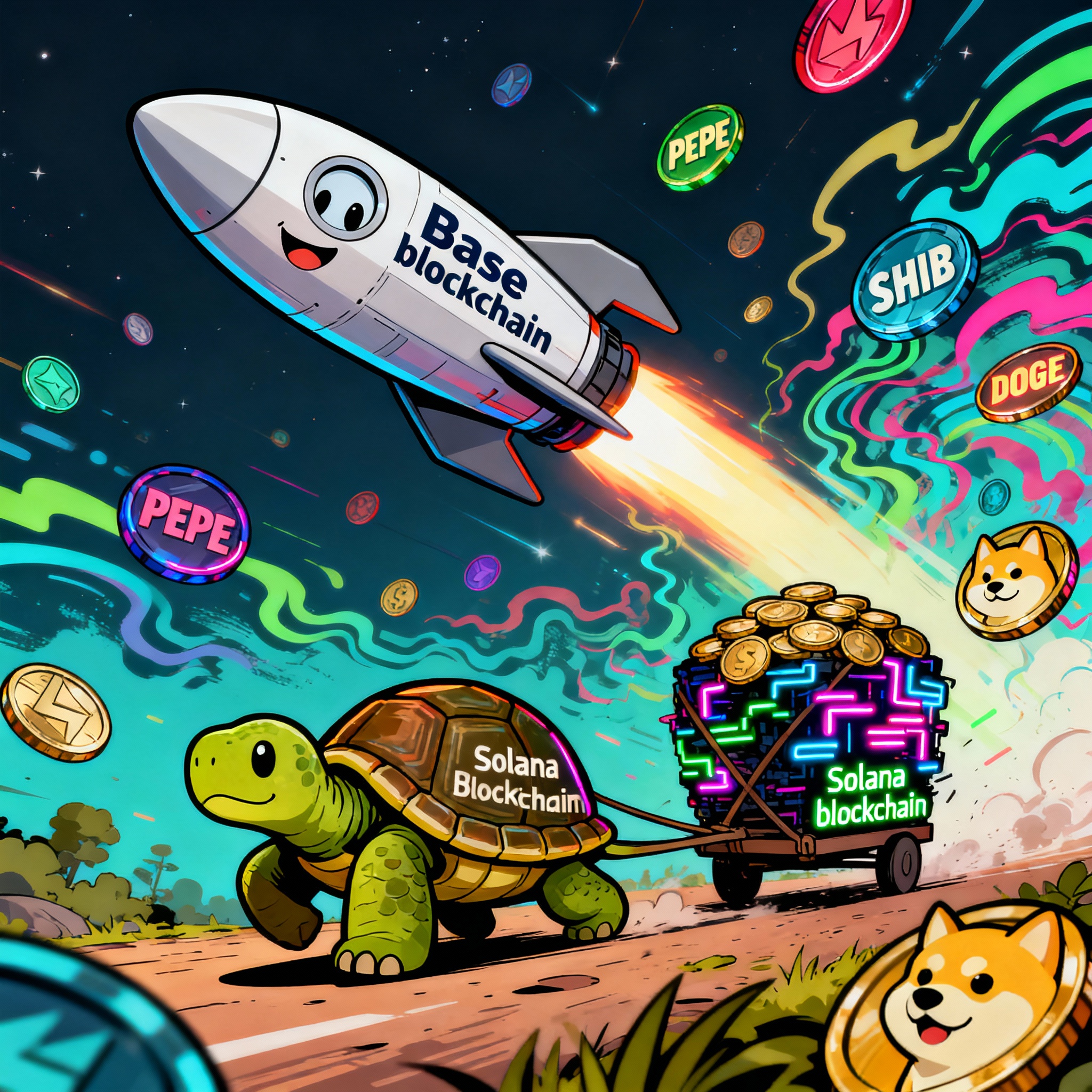
Selecting the right blockchain is a critical decision for memecoin traders and creators. Base and Solana represent distinct architectural approaches, each with genuine trade-offs relevant to memecoin ecosystems. Understanding these differences helps inform platform selection aligned with specific priorities.
Core Blockchain Architectures
Solana: Layer 1 with High Transaction Throughput
Solana is designed as a high-speed Layer 1 blockchain combining Proof of History with Proof of Stake. It achieves:
- Transaction throughput: Typically 400-1,000 TPS under normal conditions; theoretical peak of 65,000 TPS in optimal scenarios
- Transaction fees: Approximately $0.00025 per transaction under light network load; fees rise to $0.05-$0.10+ during periods of heavy congestion
- Network maturity: Established ecosystem with proven DEXs (Raydium, Jupiter), NFT platforms, and developer tooling
- Known limitations: Occasional network outages, validator concentration risks, and historical instability during high-demand periods
Solana’s architecture prioritizes raw transaction speed and cost, making it attractive for high-frequency trading and rapid token launches.
Base: Ethereum Layer 2 Rollup via Optimism
Base is an Ethereum Layer 2 scaling solution built on Optimism’s OP Stack. It operates as:
- Transaction throughput: Approximately 4,000+ TPS at capacity, typically 1,000-2,000 TPS in practice
- Transaction fees: $0.02-$0.10 per transaction depending on Ethereum mainnet congestion (L1 settlement costs)
- Security model: Inherits Ethereum mainnet security through rollup verification and settlement
- Ecosystem compatibility: Native support for ERC-20 tokens, MetaMask, and Ethereum DeFi infrastructure
- Backing: Supported by Coinbase infrastructure and institutional adoption pathways
Base prioritizes security, Ethereum compatibility, and institutional credibility over raw transaction speed.
Blockchain Characteristics Relevant to Memecoin Trading
Transaction Speed and Cost Trade-Off
| Metric | Solana | Base |
|---|---|---|
| Normal TPS | 400-1,000 | 1,000-2,000 |
| Peak TPS | ~2,400 (rare) | ~4,000 |
| Base Fees | $0.00025 (light load) | $0.02-$0.05 (normal) |
| Congestion Fees | $0.05-$0.10+ | $0.05-$0.10 (L1 dependent) |
During high memecoin launch periods, both chains experience fee spikes. Solana’s lower baseline costs become relevant mainly during off-peak trading.
Security and Reliability
Solana’s approach: Fast consensus through Proof of History with occasional network stalls requiring validator restarts. This design prioritizes speed but introduces stability trade-offs. Network outages in 2022-2024 impacted trading continuity.
Base’s approach: Inherits Ethereum’s security model via rollup verification settled on Layer 1. This design trades speed for proven security, though Layer 2 systems introduce unique risks (sequencer failures, bridge exploits) not present in native Layer 1s.
Neither approach is objectively “more secure”—they reflect different risk-return profiles.
Ecosystem Integration and Developer Experience
Solana: Mature memecoin ecosystem with 13,690+ daily launches (August 2025), proven tooling (Phantom wallet, Anchor framework), and Rust-based development. Network effects create self-reinforcing adoption, evidenced by Pump.fun’s market dominance.
Base: Growing adoption with universal Ethereum compatibility (MetaMask, hardware wallets, DeFi bridges). Solidity developers can port code directly. Institutional backing via Coinbase supports mainstream adoption potential, though daily memecoin launch volume remains undisclosed and likely smaller than Solana.
Why Platform Choice Matters for Memecoin Traders
Network Effects and Liquidity
Solana processes 73.6% of memecoin launchpad volume (August 2025), meaning:
- Higher probability of finding trading counterparties
- Larger ecosystem of liquidity aggregators and DEXs
- Established influencer/community infrastructure for token promotion
Base’s smaller ecosystem may reduce discoverability for early-stage tokens, though it offers cleaner on-ramp to Ethereum DeFi and institutional platforms.
Cost Considerations for Traders
- Small frequent trades: Solana’s lower fees ($0.00025) provide 100-200x savings per transaction
- Large single trades: Both chains similar during congestion; fee differences become negligible
- MEV and slippage: Solana’s higher TPS may reduce sandwich attack risks vs Base’s lower transaction density
Risk Profile Trade-Offs
Solana: High speed enables rapid profit-taking but also rapid losses; network instability can trap traders during critical moments
Base: Slower confirmation times but more predictable, with institutional-grade infrastructure reducing outage risk
FAQ
Which blockchain is objectively more secure?
Neither is objectively “more secure”—they optimize for different properties. Base inherits Ethereum’s proven consensus but introduces Layer 2 risks. Solana achieves speed with inherent stability trade-offs. Choose based on your risk tolerance.
Can Base tokens work with my Ethereum wallets?
Yes, Base tokens follow the ERC-20 standard and work with MetaMask, Coinbase Wallet, and most exchanges supporting Ethereum.
Why does Solana dominate memecoin launches?
Network effects, lower fees, faster transactions, and established infrastructure (Phantom, Raydium) create a virtuous cycle. Pump.fun’s market dominance ($800M+ revenue, 13,690 daily launches) reflects accumulated ecosystem advantages rather than technical superiority alone.
Should I choose Base or Solana for memecoin trading?
Solana offers better conditions for high-volume, speed-focused trading; Base offers institutional credibility and Ethereum integration. The “better” choice depends on your trading style, risk tolerance, and portfolio integration needs.
Conclusion
Base and Solana represent fundamentally different blockchain design philosophies, each with legitimate advantages for memecoin ecosystems.
Solana excels at:
- Raw transaction speed and cost-efficiency
- Established memecoin culture and infrastructure
- High-frequency trading dynamics
Base excels at:
- Ethereum ecosystem integration and institutional credibility
- Security inheritance from Layer 1 consensus
- Long-term sustainability through institutional on-ramps
The choice between them depends on your priorities: choose Solana for maximum speed, cost, and integration with the established memecoin ecosystem; choose Base for security, Ethereum compatibility, and institutional credibility.
Neither platform is objectively “superior in 2025″—Solana’s market dominance (73.6% memecoin launchpad share) reflects network effects and established infrastructure, not technical excellence alone. Base represents a compelling alternative for traders prioritizing different risk-return profiles.
This revised version provides balanced, technically accurate analysis acknowledging both platforms’ genuine strengths and legitimate trade-offs.